|
Saint Vartan
Armenian Cathedral
2nd Avenue @ E. 34th Street
by
Celeste Fay
[[email protected]] |
An Armenian Cathedral in New York
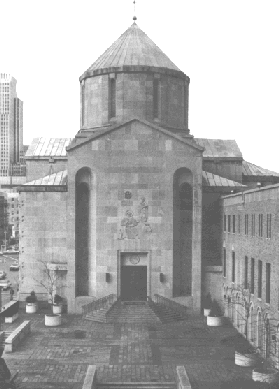
St. Vartan Cathedral is the first cathedral of the Armenian
Apostolic Church to be constructed in North America. It is located in New York City on
the corner of Second Avenue and Thirty-forth street. It was built to resemble The Cathedral of Holy
Etchmiadzin [or here for image], the world's first cruciform church, built in the fourth century and still
standing in Armenia.
St. Vartan's was consecrated on April 28, 1968 by His Holiness Vasken I, Supreme
Patriarch and Catholicos of all Americans.
The Architecture
EXTERIOR
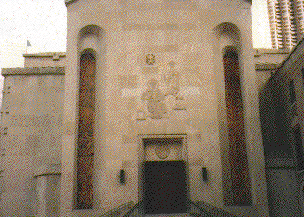
| The cathedral has an L-shaped composition framing an entrance court of
114 feet long by 72 feet wide. It is elevated five feet above street level. It is sheathed
in limestone with one story granite base and exterior staircase.
The main entrance
faces a spacious plaza.
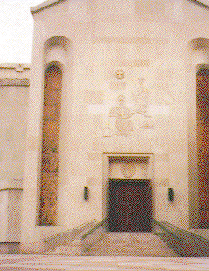 The Design above the door
to main entrance depicts images of Saint Vartan, the Brave. It is patterned after similar
designs found on the exterior of the ancient Armenian Church on the island of Aghtamar in
Lake Van. The image on the right depicts St. Vartan, receiving the blessing of His
Holiness Catholicos Hovsep. The image on the left depicts his military and peaceful
natures. The helmet at the left foot shows the military nature, and the animal on his
right represents his peaceful nature. The Design above the door
to main entrance depicts images of Saint Vartan, the Brave. It is patterned after similar
designs found on the exterior of the ancient Armenian Church on the island of Aghtamar in
Lake Van. The image on the right depicts St. Vartan, receiving the blessing of His
Holiness Catholicos Hovsep. The image on the left depicts his military and peaceful
natures. The helmet at the left foot shows the military nature, and the animal on his
right represents his peaceful nature.
|
INTERIOR
The interior of St. Vartan Cathedral is a simple, yet traditional, structure.
It has two distinct features that are found in many ancient Armenian Churches -- the
double intersecting arches; and the dome. But many of the other features represent an
effort to recall Armenian tradition.
The Arches span the edifice from end to end creating a centralized space that
eliminates the need for columns that would otherwise obstruct the view of the altar. The
spaciousness and centralized interior is representative to the immediate participation in
the worship.
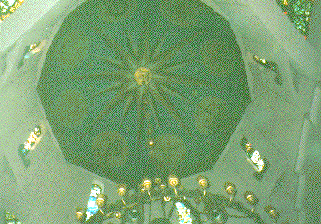 The Dome - The dome in
the center of the cathedral is twenty-seven feet high and forty-five feet in diameter and
is supported by the crowns of the four arches. Directly in the center of the dome is
painted the Armenian letter I which translates "He is" in English. The
circles surrounding the dome depict images of Christ, God, and the Holy Spirit. And the
eight stained glass windows around the dome depict the events in the story of creation. The Dome - The dome in
the center of the cathedral is twenty-seven feet high and forty-five feet in diameter and
is supported by the crowns of the four arches. Directly in the center of the dome is
painted the Armenian letter I which translates "He is" in English. The
circles surrounding the dome depict images of Christ, God, and the Holy Spirit. And the
eight stained glass windows around the dome depict the events in the story of creation.
The Chandeliers: The chandeliers even though, they appear to be modern are
actually reconstructed modes of the seventh century fixtures found in Armenia.
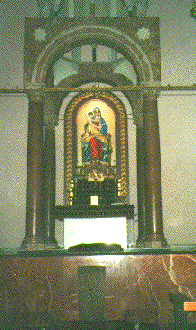 The Altar: The altar
faces East, the traditional position for Christian churches. Crosses are hung without the
body of Christ on them because Armenians like to emphasize the resurrection and glorified
Lord, not suffering and dying. The Altar: The altar
faces East, the traditional position for Christian churches. Crosses are hung without the
body of Christ on them because Armenians like to emphasize the resurrection and glorified
Lord, not suffering and dying.
The Side Altar to the left is dedicated to Saint Gregory the Enlightened and the
altar to the right is dedicated to Saint Neresess Shnorhali. The Divine Liturgy (mass) is
celebrated on the main altar.
Stained Glass Windows- There are six traditional Armenian Church windows that
are high and narrow from the floor to the ceiling crowned with a rounded arch. The windows
represent biblical events and memorial events in the history of the Armenian Church.
Stone Crosses - The stone crosses in this cathedral date back to the fifteenth
century that were discovered in the ruins of a church in Armenia. Sixteen stones represent
the twelve apostles and two evangelists St. Paul and St. Gregory the Illuminator.
The Circle Seal: In Center of the Nave is a marble insert under the dome that is
dedicated to God and the people who enter. The inserts states "Ye are the salt of the
earth, but if the salt hath lost His savor, wherewith shall it be salted." (Matthew
5:13) The two dates on the seal represent the date which Christianity was accepted as the
state religion in Armenia (301) and the year St. Vartan's was consecrated (1968.)
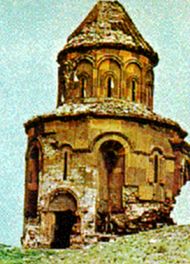
Armenia
|
BASIC FACTS
Armenia is located in the Caucus region lying to the
east of the Anatolia proper. In the eleventh century a "Lesser Armenia"
developed in Cilicia, near the Mediterranan coast.
In the year 301 Christianity was made the state's official religion.
The architecture erected during the height of the Middle Ages in Armenia was influenced
by Byzantine architecture but manifested its own development. The Cathedral of St. Vartan
in New York City is a reconstruction of Churches in Armenia that were built during the
Middle Ages.
|
| ARMENIA LINKS
|
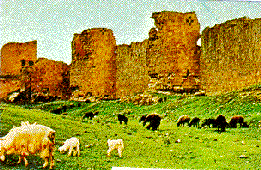
The Walls of Kars
|
|
DETAILS of the Cathedral
St. Vartan Cathedral
630 Second Avenue
New York, NY 10016
(212) 686 0710
Visiting Hours: Weekdays 10-6pm
The Divine Liturgy: Sundays 10:30am
|
| Medieval
New York Page |
This Page is part of the Medieval
New York Web Project, a project of students in the Introduction to Medieval History courses taught by Paul Halsall in the History Department of Fordham University in 1996-1997.
© Copyright to the student creator of each page.
The Internet History Sourcebooks Project is located at the History Department of Fordham University, New York. The Internet
Medieval Sourcebook, and other medieval components of the project, are located at
the Fordham University Center
for Medieval Studies.The IHSP recognizes the contribution of Fordham University, the
Fordham University History Department, and the Fordham Center for Medieval Studies in
providing web space and server support for the project. The IHSP is a project independent of Fordham University. Although the IHSP seeks to follow all applicable copyright law, Fordham University is not
the institutional owner, and is not liable as the result of any legal action.
© Site Concept and Design: Paul Halsall created 26 Jan 1996: latest revision 12 April 2024 [CV]
|

