|
Holy Trinity Church
|
213 West 82nd St.
New York NY 10024
212 787-0634
by
Frederick D. Taylor |
Believe it or not, but some aspects of medieval culture have filtered into
modern society. Although many parts of the medieval age have disappeared and drifted away,
its culture still made some lasting contributions. In fact, medieval methods of
architecture have definitely lingered on as a heavy and dramatic influence upon the modern
era. On any given day you can look around your own town and notice buildings that have
traces of medieval architecture. Medieval-like structures are especially apparent in New
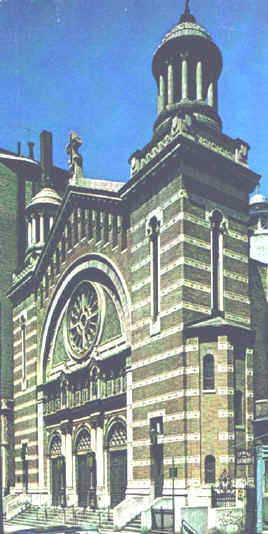
York City. The Holy Trinity Church, located at 213 West 82nd Street, is just
one of many churches which represent medieval architecture.
Background of the Church
It is certainly fitting to acknowledge the beauty of Holy Trinity Church since it is
approaching its centennial birth. On October 23, 1898, Reverend Joseph H. Bigley was
appointed the right to establish a new parish on the West Side between 77th street and 86th from Central Park to the River. As Father Bigley’s diary
reads: "The property selected was the north side of 82nd Street, one
hundred feet west of Amersterdam Avenue… [and was] incorporated under the name of
"The Holy Trinity Roman Catholic Church." Although a parish was established at
the end of 1898, the building, as we know it today, did not begin until 1900, when the
church was under the supervision of Father Michael J. Considine.
The area on the West Side in 1900 was by no means desolate and therefore presented a
problem for Father Considine who wanted to expand the church. Thus, it was not until two
years later when the father managed to purchase the surrounding property and develop the
perimeters of the parish. On Sunday, July 3, 1910, the cornerstone of the church’s
superstructure was finally laid down and the task of completing the parish began.
Father Considine was determined to construct a church whose "beauty would be an
inspiration to man and a tribute to God."(The Holy Trinity Church 7) It is
quite apparent, when viewing the church today, that Father Considine achieved his goal.
One factor, which contributed to this turn of the century church’s beauty, is its
uniqueness. Unlike the other churches of the same era, Father Considine and Joseph H.
McGuire, the church’s chief architect, decided to stray away from the popular and
common use of the classic designs. Both decided not to bind the church’s architecture
extensively to Gothic or Romanesque forms. Instead, Considine and McGuire chose to revert
to the initial form of Christian Architecture – Byzantine. By the time of the
church’s dedication on May 11, 1912, the decision to implement a predominantly
Byzantine form for the church proved to be an excellent and regretless choice. As the
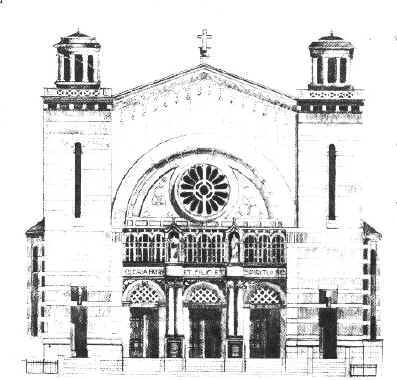
Catholic News stated at the time, "the new Church of the Holy Trinity…is built
of brick and terra cotta and possesses a handsome façade [and] is considered to be one of
the finest examples of Byzantine architecture in this country…"(The Holy
Trinity Church 8)
Sources
Holy Trinity Church, Hackensack, New Jersey, Custombook, Inc., 1973.
Mathews, Thomas F., The Early Churches of Constantinople, University Park,
Pennsylvania State University Press, 1971.
Medieval
NewYork | Holy Trinity Main | Byzantine Architecture |
Exterior | Interior
The Internet History Sourcebooks Project is located at the History Department of Fordham University, New York. The Internet
Medieval Sourcebook, and other medieval components of the project, are located at
the Fordham University Center
for Medieval Studies.The IHSP recognizes the contribution of Fordham University, the
Fordham University History Department, and the Fordham Center for Medieval Studies in
providing web space and server support for the project. The IHSP is a project independent of Fordham University. Although the IHSP seeks to follow all applicable copyright law, Fordham University is not
the institutional owner, and is not liable as the result of any legal action.
© Site Concept and Design: Paul Halsall created 26 Jan 1996: latest revision 12 April 2024 [CV]
|
