Introduction to the Medieval World: Class 7
Class 7: Formation of the Germanic States
Assigned Reading:
I.      Introduction

Church provides continuity in the West with Classical World
but for a long time that was pretty tenuous.

The new factor was the Germanic input.
Modern states often derive names from these tribes
-England, Sweden, France/Frankreich, Germany/Deutschland/
 Allemagne, Denmark
Western Middle Ages are a fusion of Roman and Germanic

II.     Western Europe

A.      Geography and Climate in the Dark Ages
        Rivers - Main means of communications
        Mountains - Provide Natural Borders
        Climate- Probably good btw 400-1200

B.      Ethnography
        -Lots of empty space
        -Original Population - Basques?
        -Celts - all over the West, Often romanized
        -Italic peoples - Italy
        -Greeks in the South
        -In the East - Germans, plus a whole mix of others,
        e.g.. Vlachs, Albanians

C.      Population

        1.      Demography
                -Birthrate
                -Mortality - disease/infanticide/war
                -Nuptiality - importance of Women

        2.      Disease - Plague c. 560-750
                Bacterial and viral infections untreatable
                Medicine in a primitive state

        3.      Population declined in early middle ages

III.    Germans

A.      Source: Tacitus' Germania
        A moral comparison with roman decadence
        Discuss Reading - Tierney

B.      Origins -Around the Baltic See

C.      Society
        -Comitatas/Warband
        -Tribes - really loose confederations
        -Women

D.      Migrations - To the East
        The, under pressure of the Huns, to the West

E.      Contact with Rome
        -The Rhine Frontier
        -Barbarian attitudes to Rome

F.      Goths - Formed around Crimea

IV.     The Germans Move into Roman Empire

A.      Rome's need for soldiers - Feodorati

B.      Adrianople 378/ Sack of Rome 410 - Alaric

C.      Absolute numbers quit small
        [recap why Rome so week in the West - decline of cities,
        withdrawal of governing classes into Villas.

V.      Ostrogoths and Italy

A.      Sources: Lots - Byzantine Authors, Papal Documents.

B.      Odacavar 476

C.      Theodoric 496-526
        -Arianism and Catholicism
        -Dualistic government
        -Preservation of classical civilization
        -Boethius

D.      Justinian's Attacks 533-48
        took advantage of Ostrogothic disunity

E.      The Lombards

F.      Italian Disunity - Lombards, Papacy, Byzantines
        and later the Germans all ruled bits of it.

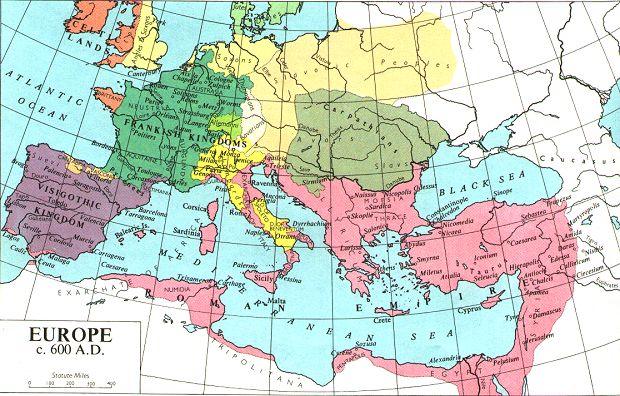
VI.     Visigoths and Spain

A.      Sources: Visigoth Law codes, St. Isidore

B.      Other Tribes in Spain - Suevi

C.      Arianism

D.      Kingdom of Toulouse until 507

E.      Move into Spain beginning 466 - Toledo

F.      Reccared - Conversion to Catholicism 587
        Visigothic dress and customs disappeared

G.      Visigothic Law -  Written in Latin
        Uric's Law Code 476 - shows a process of fusion

H.      Cooperation with Bishops
        Visigoths' status in Spain

I.      711 - Muslim Conquest

J.      The Asturias survive

VII.    Vandals

-Arians
-Sack of Rome 410
-Take Nth Africa in Early 5th Century
-Move to North Africa - persecution of Catholics
-Defeated by Justinian - Disappeared


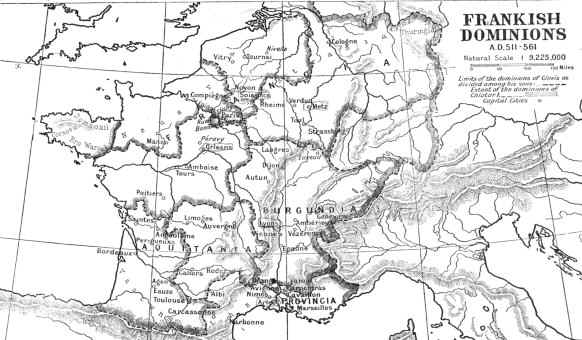
VIII.   Franks and Gaul

A.      Origins of Franks - Unknown
        Invented a descent from the Trojans
        Based in northern Gaul, Belgium, Rhine

B.      Other Tribes in France - Visigoths/Burgundians

C.      Other Tribes in Germany
        Franks controlled what is now Germany and France
        Allemans

D.      Merovingians - the first Race of Kings
        Mythical founder - Merovechus - Long Haired Kings

E.      Clovis 481-
        Defeated Kingdom of Soissons (Roman.
        Married Clothilde - Conversion 506
        Gregory of Tours describes his reign.
        Discuss Reading - Tierney

F.      Clovis worked with old Gallo-Roman nobility
        But Roman Admin. system failed
        No trace of Roman taxation in Gregory of Tours

G.      Relations with the Church - Tries to define kingship

H.      Last great Merovingian was Dagobert 629-30

I.      Les Rois fainente - disposed of by the Carolingians

IX.     Anglo-Saxons

A.      Source: Bede

B.      Britain - Romanized Celts but Rome with draws 400

C.      Anglo-Saxon Origins
        Not Romanized
        Not Christian (better than being Arian in the long run.

D.      Migrations - Slow migrations
        Celts called Welsh - Story of King Arthur
        Origin of Brittany

E.      Formation of England -Heptarchy by 7th century
        Kent
        Northumbria -  Bernicia/Deira
        Wessex
        Mercia

F.      Conversion to Christianity
        From North - Northumbria -
        St. Columba/Iona 583, St. Aidan 635

        From Rome - Ethelbert King of Kent, had a Frankish wife
        called Bertha - St. Augustine 597.

        Did Christianity strengthen king or not?

        Position of Women - convents provide women with power
        e.g.. Abbess Hilda of Whitby - Double Monasteries

        Synod of Whitby 633/4 - unites Christianity in England
        Canterbury and York

G.      Anglo Saxon Culture
        -Beowulf
        -Venerable Bede 673-735
        -St. Boniface 680-755

X.      German Effect on Western Europe

Simplification of civilization

A.      Law
        -Territorial law with personal law
        -Replacement of Principle with particular law
        Our sources are romanized
        Concern with criminal acts - no police force
        Wergild, Ordeals
        -Discuss Readings on Law - Tierney

B.      Idea of the State
        -Rome a Res Publica not a Res Privitata
        -State as personal property of the Ruler
        shown in divisions
        -Taxation Issues - Again personal
        -Principles of inheritance
        -Much of next millennia to be spent in
        re-establishing these sort of ideas
        One Early attempt was Charlemagne

C.      Population's Lifestyle
        -End of Roman style farms with slaves
        -Move to free peasantry - but with labor dues

XI.     The Pirenne Thesis
Return to Introduction to the Medieval World
main page
© Paul Halsall, 1996.
This file is not copy-permitted.
The Internet History Sourcebooks Project is located at the History Department of Fordham University, New York. The Internet
Medieval Sourcebook, and other medieval components of the project, are located at
the Fordham University Center
for Medieval Studies.The IHSP recognizes the contribution of Fordham University, the
Fordham University History Department, and the Fordham Center for Medieval Studies in
providing web space and server support for the project. The IHSP is a project independent of Fordham University. Although the IHSP seeks to follow all applicable copyright law, Fordham University is not
the institutional owner, and is not liable as the result of any legal action.
© Site Concept and Design: Paul Halsall created 26 Jan 1996: latest revision 8 Sept 2025 [CV]
|