|
A Mill in New York
by Jaisy Reyes
[[email protected]]
I: Mills in Middle Ages
Records show that the Romans, who introduced the wheel accompanied
with water power, used wheels that were turned by the current
of a river, but it was not until the medieval period that the
water mills were more commonly used.
The water wheel seems to have been the earliest kind of mechanical
energy to replace the work of human beings. The water mill was
used to replace the hand mill because it conserved more time and
labor.
The first type of water mill is thought to have been the Norse
mill; this mill used a horizontal waterwheel which drove the grindstones
directly, without the hassle of gearing. Because the waterwheel
made it easier to grind, it was preferred by many.
The earliest reference to an English mill was in 762 CE, in a
charter issued by Aethelbert.
By 1086, The Domesday Book indicated that there were more
than 5,000 mills used throughout England; it has been argued
that the majority of these mills were the same as the Norse mill.
There were various types of water wheels:-
- The Overshot
Overshot wheels were turned by the weight and speed of water.
The breast wheels were turned by water brought to the wheel at
axle level in a trough called a millrace. The millrace brought
water to a high level, where it shot over the top blades of the
wheel
- The Undershot
Undershot wheels were turned by water striking their lower paddle
wheels that turned with the current of a river.
- The Breastshot
Each of the different types of mills had their advantages and
disadvantages. For example, the horizontal wheel, also known as
the Norse mill, was best used for grinding, but the mill could
only be used where the water current flow was most appropriate
for the grinding.
Here is a plan of a Wheelhouse to can give a clearer idea
of how the watermill operated.
![[IMG Plan of a Wheel House]](snuff1.gif)
II: Mills and Rivers
The big problem when it came to the construction of the water
mill was its location.
![[IMG the Bronx River]](snuff2.gif) A water mill
had to be built in those particular areas of the country where
water resources were available: it had to be constructed where
the waterfall was close by the wheel. The millrace could have
only be used from upstream or a dam, meaning that there were some
restrictions as to where it had to be constructed. The water mill,
after all, is a device which uses water power to rotate the wheel;
it is the rotation of the wheel that does the grinding The power
and force of the water depends on the speed and height of the
waterfall. [The picture is of the Bronx River]. A water mill
had to be built in those particular areas of the country where
water resources were available: it had to be constructed where
the waterfall was close by the wheel. The millrace could have
only be used from upstream or a dam, meaning that there were some
restrictions as to where it had to be constructed. The water mill,
after all, is a device which uses water power to rotate the wheel;
it is the rotation of the wheel that does the grinding The power
and force of the water depends on the speed and height of the
waterfall. [The picture is of the Bronx River].
Despite its limitations, the water mill served as a model for
the way in which technical progress has historically come about.
After the early watermill, better and more powerful watermills
were built -- for instance, in the mid-1800s a hydraulic turbine
was developed. Unlike the earlier waterwheels, the turbines were
enclosed and were designed with blades called vanes on the edge
of the wheel. Water would then enter the enclosed wheel and flow
against these vanes; theses vanes would later rotate the water
making the wheel spin by reaction. The watermill stimulated more
ideas to create various mills such as the windmill, which led
to greater technology for the future.
III: The Snuff Mill in New York
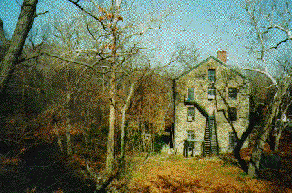
| The closest resemblance in form, location and appearance to a watermill in New York is the Snuff Mill, located in New York's Botanical Garden.
The Snuff Mill was part of the Lorillard Estate. In the surrounding area there were the homes or the service buildings of the Lorillard family where peasants worked for them in the manufacturing a of tobacco. They were also famous for their rose gardens.
|
|
|
The Lorillard Snuff Mill dates from 1792-1870.
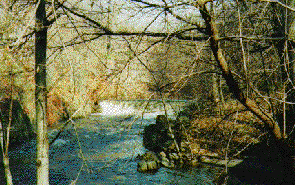
The Snuff Mill is bordered on the Bronx River, which is close by to a waterfall. Similar to the watermill, the Snuff Mill is located next to a river where one can acknowledge the stream that flows right next to the mill, which comes from the waterfall. Having access to water was very important for mills because it helped with the manufacturing of resources. |
| The Snuff Mill is a wonderful site to see, it has preserved that farm like quality, which connects to the Middle Ages environment. It produces images that takes us back to the medieval period, images like the trees, the mill, and the river. Its location and the preservation of the mill reflects the time of the watermills, and in this sense it is a reflection of the Middle Ages in New York. |
BIBLIOGRAPHY
- Friedman, Ellie. "Personal Interview". 27 November
1996.
- Holt, Richard. The Mills of Medieval England. New York:
Basil Blackwell, 1988.
- "Waterwheel." The New Encyclopaedia Britannica.
1995 ed.
IV: MILL LINKS
Back to Medieval New York Page
This Page is part of the Medieval New York Web Project, a project of students in the Introduction to Medieval History courses taught by Paul Halsall in the History Department of Fordham University in
1996-1997.
© Copyright to the student creator of each page.
The Internet History Sourcebooks Project is located at the History Department of Fordham University, New York. The Internet
Medieval Sourcebook, and other medieval components of the project, are located at
the Fordham University Center
for Medieval Studies.The IHSP recognizes the contribution of Fordham University, the
Fordham University History Department, and the Fordham Center for Medieval Studies in
providing web space and server support for the project. The IHSP is a project independent of Fordham University. Although the IHSP seeks to follow all applicable copyright law, Fordham University is not
the institutional owner, and is not liable as the result of any legal action.
© Site Concept and Design: Paul Halsall created 26 Jan 1996: latest revision 12 April 2024 [CV]
|
