Internet Modern History Sourcebook
The Long 19th Century
Notes:
| WEB |
Link to a World Wide Web site |
| MEGA |
Link to a site which offers a guide to the net. |
| RG |
Reading Guide to a text |
| SUMMARY |
Summary (notes) sheet of period/issue |
Paul Halsall,
Sourcebook Compiler
Research Help: Although I am more than happy to receive notes if you have comments on this web site, I
cannot answer specific research enquiries [and - for students - I cannot, or rather will
not, do your homework.] See the HELP! page
for more suggestions on texts and research.
IMPORTANT: New Structure for the Modern History Sourcebook: As of January 20 1999, the Internet Modern History Sourcebook has been completely reorganized. Each of the main sections had became too large
[nearly 300k] to maintain as one file. To see the new arrangement go to the Main Index. The four older index files - Early Modern | Three Revolutions | 19th
Century (this page) | Modern World - will all remain
available indefinitely, and the URLs of individual files will not alter. But no new texts
(after 12/31/1998) will be added to these large index pages. For new texts, use the new
structure, or check the New Additions page.The new structure also includes a comprehensive Full Texts index, a HELP! page, and a Search page.
Contents
- Main
- Early Modern Europe
- I: Reformation Europe
- Precursors and Papal Critics
- Luther
- Calvin
- Radical Reformers
- English and Scottish Reformation
- Catholic Reformation
- Conflict
- Women and Reformation
- II: The Ancien Regime
- The Early Modern World System
- Structures of Life
- Structures of Politics - Absolutism
- England, Holland, and America - Alternative Polities and Economies
- Scientific, Political, and Industrial Revolutions:
The Transformation of the West
- The Long 19th Century: The Hegemony of the West [this page]
- War, Conflict and Progress: The
Emerging World
- VII: The End of European Hegemony
- World War I
- The Russian Revolution
- An Age of Anxiety?
- The Depression
- Nazism and World War II
- The Holocaust
- VIII: World Since 1945
- A Bipolar World
- America as World Leader: External Power, Internal Change
- Europe, Yalta to Malta
- Decolonization
- Globalization
- Modern Latin America
- Social Movements
- Post-War Popular Culture
- Post-World War II Philosophy
- Post-World War II Religious Thought
- Science and Technology
- New Additions Page
From July 1, 1998 additions to the Modern History Sourcebook will be recorded in this list of document accessions.
VI: The Century of Ideology and Power
TheCouncil of Vienna : System and Challenges
Nationalism
Nationalism was the most successful political force of the 19th century. It
emerged from two main sources: the Romantic exaltation of "feeling" and
"identity" [see Herder above all on this] and the Liberal requirement that a legitimate state be based on a "people" rather than, for example, a dynasty, God, or
imperial domination. Both Romantic "identity nationalism" and Liberal
"civic nationalism" were essentially middle class movements. There were two main
ways of exemplification: the French method of "inclusion" - essentially that
anyone who accepted loyalty to the civil French state was a "citizen". In
practice this meant the enforcement of a considerable degree of uniformity, for instance
the destruction of regional languages. The US can be seen to have, eventually, adopted
this ideal of civic inclusive nationalism. The German method, required by political
circumstances, was todefine the "nation" in ethnic terms. Ethnicity in practice
came down to speaking German and (perhaps) having a German name. For the largely
German-speaking Slavic middle classes of Prague, Agram etc. who took up the
nationalist ideal, the ethnic aspect became even more important than it had been
for the Germans. It is debateable whether, in practice, all nationalisms ended up as
Chauvinistic and aggressive, but the very nature of nationalism requires that
boundaries be drawn. Unless these boundaries are purely civic, successful
nationalism, in many cases produced a situation in which substantial groups of outsiders
were left within "nation-states".
- WEB Nationalism Links [At Surrey]
- Nationalism and Music [At this Site]
A multimedia exploration of themes in the developmental stages of nationalism.
- Kenan Malik: One Man Talking:
The World's Better off Without Rare Languages [At Utne Reader][Modern text]
- Voltaire (1694-1778): Patrie, in The
Philosophical Dictionary, 1752 [At this Site]
Voltaire's attack on national chauvinism - and his views than people should be citizens of
the world. It was this view that was rejected by nationalists.
- Analyses
- Non-National Forms of Government
- Cultural Nationalism: The Nation as Positive Focus of Identity
- Liberal Nationalism: The Nation as a Basis for Liberal Democracy
- Johann Gottlieb Fichte (17621814):: Address To The German
Nation, 1807 [At this Site]
- Johann Gottlieb Fichte (17621814): Addresses to the German
Nation, 1806 [At this Site]
Political nationalism as a response to Napoleon.
- Giuseppe Mazzini (1802-1872): An Essay On the Duties of Man
Addressed to Workingmen [At Hanover]
Mazzini is perhaps the premier representative of Liberal Nationalism.
- Giuseppe Mazzini (1802-1872): On Nationality as a Key to
Social Development, 1852, excerpts [At this Site]
- Louis Kossuth (1802-1894): Speech in Washington DC,
January 7, 1852 [At Hnet]
Kossuth was a leading Hungarian Nationalist.
- Heinrich von Gagern: German Student Movement
- Daniel O'Connell (1775-1847): Justice for Ireland,
Speech to House of Commons, Feb 4, 1836 [At this Site]
- Theodor Herzl (1860-1904): On the Jewish State, 1896,
excerpts [At this Site]
- Theodor Herzl (1860-1904): The Jewish State, 1896 [At this
Site]
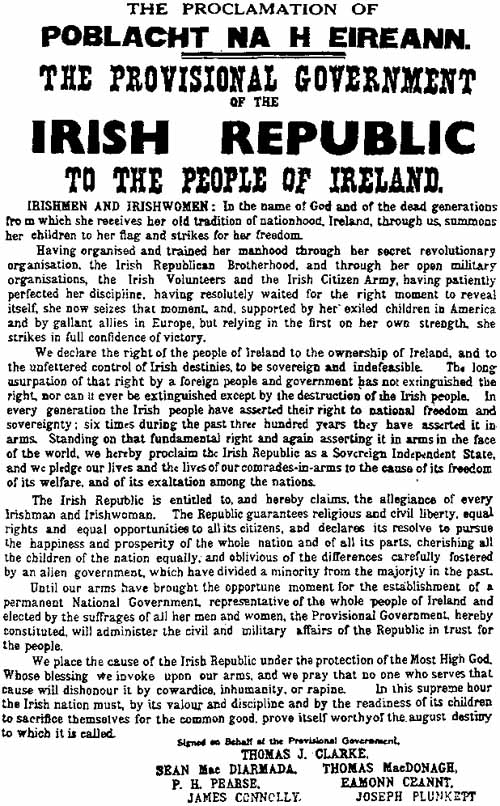
- Proclamation of the Irish Republic, Easter 1916 [readable
image file of poster] [At this Site]
- Henry W. Massingham: Ireland, 1916--And
Beyond, The Atlantic Monthly, December1916 [At The Atlantic]
- Triumphal Nationalism: The Nation as a Claim to Superiority
Conservatism
Liberalism
- Jeremy Bentham (1748-1832): Principles of Morals
and Legislation (chapters 1-4) [At UTM]
- Jeremy Bentham (1748-1832): Offences Against Oneself,
c. 1785 [At Columbia],
One of the earliest modern considerations of homosexuality from a Liberal perspective.
- Sydney Smith (1771-1845): Fallacies of Anti-Reformers,
1824 [At this Site]
- Thomas R. Malthus (1766-1834): First Essay on Population,
1798, excerpts [At this Site]
- Thomas Malthus (1766-1834): An Essay on the
Principles of Population, 1798 [At McMaster][Full Text]
- Thomas Malthus (1766-1834): The Corn Laws [At
Yale][Full Text]
- Thomas Malthus (1766-1834): The Grounds of an Opinion on
the Policy of Restricting the Importation of Foreign Corn [At Yale][Full Text]
- Thomas Malthus (1766-1834): The High Price of Provisions [At Yale][Full Text]
- Thomas Malthus (1766-1834): An Inquiry into the Nature and
Progress of Rent [At Yale][Full Text]
- The Peterloo Massacre, 1819 [At this Site]
- David Ricardo (1772-1823): The Iron Law of Wages, 1817,
excerpts [At this Site]
- David Riccardo (1772-1823): Principles
of Political Economy [At McMaster][Full Text]
- Pamphlet: In Defence of Laissez-Faire, c. 1840
[At this Site]
A British argument against the Ten Hour Acts.
- John Stuart Mill (1806-73): On
Liberty, extracts [At WSU]
- John Stuart Mill (1806-73): On Liberty, extracts [At
Baylor]
- John Stuart Mill (1806-73): On Liberty [At this Site][Full
Text]
- John Stuart Mill (1806-73): Representative
Government, 1861 [At HK][Full Text]
- John Stuart Mill: Representative
Government, 1861, full text [At Constitution.org]
- John Stuart Mill (1806-73): Utilitarianism,
1863 [At Virginia Tech][Full Text]
- John Stuart Mill (1806-73): Utilitarianism,
1863 [At HK][Full Text]
- John Stuart Mill (1806-73): Liberalism Evaluated, 1873,
from his Autobiography [At this Site]
Mill discusses how his faith in Liberalism slipped away and he began tending towards
Liberal Socialism (i.e., that of Hobhouse rather than the Fabians).
- John Henry Newman (1801-1890): Who is to Blame? [At this Site]
Newman on the nature of constitutional government.
- Henry David Thoreau (1817-1862): On Civil
Disobedience [At ArtBin][Full Text]
- Lysander Spooner: Vices
Are Not Crimes: A Vindication of Moral Liberty, 1875 [At Drug Library]
- Joseph Chamberlain: The Radical Programme, 1885 [At
this Site]
- W. L. Blease: The New Liberalism, 1913 [At this Site]
On the emergence of social reformist/welfare liberalism, as in the British government of
1906.
- The Earl of Rosebery: The State of Liberalism,
1908 [At this Site]
- L. T. Hobhouse: Liberalism, 1911 [At this Site]
An early 20th century restatement of Liberalism which takes account of the Marxist
challenge.
19th-Century
Feminism
- WEB See Library of Congress: National Women's
Suffrage Association Collection, 1848-1921 [At Library of Congress]
Full texts of 167 books and other documents.
- Mary Wollstonecraft : Vindication of the
Rights of Women, excerpts [At Baylor]
- Mary Wollstonecraft: Vindication of the Rights of Women [Full
Text][At this Site]
- Seneca Falls Declaration, 1848 [At this Site] and here [At LSU] and here [At Civnet]
- John Stuart Mill (1806-73): The Subjection of Women [At
this Site][Full Text]
- Sojourner Truth (1797-1883): 'An't I a Woman?', 1851 [At
this Site]
A rough-hewn account.
- Sojourner Truth (1797-1883): 'Ain't I a Woman?', 1851
[At this Site] or in audio [At MIT]
The usual cleaned-up version.
- Oliver Gilbert: Narrative
of Sojourner Truth, based on information provided by Sojourner Truth, 1850 [At CMU]
- Woman's Rights Petition to
the New York Legislature, 1854 [At Furman]
- Report of the Select
Committee [On the Women's Rights Petition], In Assembly, March 27, 1854 [At
Furman]
- Catherine Booth (1829-1890): Female Ministry: or, Woman's
Right to Preach the Gospel, 1859 [At Indiana][Full Text]
- Helen Taylor (1831-1907): The Claim of Englishwomen
to the Suffrage Constitutionally Considered, 1867 [At Indiana]
- Susan B. Anthony (1820-1906): On Women's Right to Vote,
1873 [At this Site]
- 2ND Patricia Cline Cohen: The Murder of Helen Jewett
The Life and Death of a Prostitute in Nineteenth-Century New York, Chapter 1 [At NY
Times: you will be asked to "sign up" to access the text]
- Hearing of the Women
Suffrage Association, before the House Committee on the Judiciary, January 18, 1892
[At Hanover]
- Maria Eugenia Echenique: The
Emancipation of Women, 1876 [At WSU] - An Argentinian feminist.
- Frances E. Willard (1839-1898): Address to Women's National
Council, February 22-25, 1891 [At this Site]
- Emmeline Pankhurst (1858-1928): Militant Suffragism,
1913 [At this Site]
It's hard to believe she ended up as a Conservative.
- Emmeline Pankhurst (1858-1928): My Own Story, 1914
[At this Site]
Long excerpts from the leading British feminist activist.
- Margaret Sanger (1883-1966): Autobiography, excerpts [At this
Site]
On why she became a crusader for birth control.
- Margaret Sanger (1883-1966):Woman and
the New Race, 1920 [Full Text][At ALL]
Note: this link is to an edition published as an "Eugenics classic" by the
"American Life League". The text is intact (Chapter was 8 checked).
- Margaret Sanger (1883-1966): The Pivot of Civilization,
full text [Gutenberg]
- The Passage of the 19th Amendment, articles from the New
York Times, 1919-1920 [At this Site]
- Ada E Leslie: Letters from a Victorian
Governess/Companion, to Royal families written during the period 1883-1894 from
India/Prussia/Greece [At demon.uk]
- Prohibitionism
- Abraham Lincoln: Temperance Address:
Delivered before the Springfield (Illinois) Washington Temperance Society,22d
February, 1842 [At Drug Library]
- H. H. Kane: A
Hashish-House in New York, Harper's Monthly, Vol. 67 (November, 1883),
944-49. [At Drug Library]
- F. E. Oliver, M.D. : The Use
and Abuse of Opium, Massachusetts State Board of Health, Third Annual Report (Boston: Wright and Potter, State Printers, 1872), 162-77. [At Drug Library]
- Anonymous: Confessions
of a Young Lady Laudanum-Drinker, The Journal of Mental Sciences January 1889
- The Woman's Crusade of
1873-74 [At Drug Library]
A high point of anti-liquor/drugs activity.
- Woman's Christian Temperance Union: Growth of
Membership and of Local, Auxiliary Unions, 1879-1921 [At this Site]
- 2ND Richard Hamm: American Prohibitionists
and Violence, 1865-1920 [At Schaffer Drug Library]
1848 : Europe in Revolt
Britain
- WEB A Regency Repositry [At Geocities]
Texts and information about early 19th century England.
- WEB The
Victorian Web [At Brown]
Texts and information about mid and late 19th century England.
- WEB Literature of the Victorian
Period [At ACCD]
Listing of the major British authors, with dates of their works, and links to the works
when online.
- WEB 19th Century British and
Irish Authors [At Nagoya]
Splendid online guide to texts and sites on 19th century authors
- WEB The Gaskell Page [At
Nagoya]
A Comprehensive web page dedicated to the works of Elizabeth Gaskell (1810-65). It
includes ALL of Mrs. Gaskell's writings as etexts, as well as a lot of ancillary material
about 19th-century England.
- WEB Domestic Life in 19th Century
England [At U Washington]
- WEB Penny Magazine [At Rochester]
The text of a magazine directed at the English working class in the 1830s.
- WEB Interpreting The Irish
Famine, 1846-1850 [At Virginia]
A large collection of online original texts from Ireland, England, and America on the
Irish Famine. Includes a great deal on emigration to America.
- Radicalism
- Liberal Reformism
- Social Class
- Victorian Sensibility
France
Austria-Hungary
Germany
- WEB German Text Archive:
Kaiserreich [At HNet]
- Documents of German Unification, 1848-1871 [At this
Site]
- Johann Gustav Droysen: Speech to the Frankfurt Assembly, 1848
- Friedrich Wilhelm IV, King of Prussia: Proclamation of 1849
- Otto von Bismarck: Letter to Minister von Manteuffel, 1856
- Field Marshal Helmuth von Moltke: 1866
- Otto von Bismarck: 1866
- The Imperial Proclamation, January 18, 1871
- Max Schneckenburger: The Watch on The Rhine, 1870 [At
this Site]
- Ernst Moritz Arndt: The German Fatherland [At this
Site]
- A War Correspondent in the Franco-Prussian War, 1870 [At
this Site]
- Unification of Germany
and Italy in Maps, 1850-1873 [At Clinch Valley College]
- Otto von Bismarck (1819-1898): Memoirs,
excerpts [At Hanover]
- Otto von Bismarck (1819-1898): Speech on the Polish
Question, to the Lower House of the Prussian Parliament, January 28, 1886 [At HNet]
- George Makepeace Towle: Bismarck in the Reichstag and at
Home, 1880 [At this Site]
- Maurice Leudet: A Day with Kaiser Wilhelm II, 1898 [At
this Site]
- Mrs. Alfred Sidgwick: Student Life at the German
Universities, 1900 [At this Site]
Italy
Other Western European Countries
- Switzerland
- Netherlands
- Denmark
- Sweden
- Norway
- Spain
- Portugal
Eastern European Countries
- Entire Region
- Greece
- Romania [Moldavia/Wallachia/Transylvania]
- Bulgaria
- Hungary
- Poland
- Bohemia
- Russia
Power and Ideology in the US:
North vs. South
- WEB Nineteenth Century Documents Project [At Furman]
Many online texts, with a a special emphasis on the Civil War and Southern History. Many
texts are taken from newspaper editorials.
- WEB Making
of America [At Michigan]
5000 imprints from 1850-75 on line, but as image files rather than text.
- WEB Documenting
the American South, [At UNC]
- Inaugural Addresses of US Presidents,
1789-1997, Index [At this Site]
- Economic Development
- Expansion and Manifest Destiny
- WEB Documents Relating to American
Foreign Policy--Pre-1898 [At Mt. Holyoke]
- WEB British American Diplomacy,
1782-1863 [At Yale]
- WEB West Web [At CSI/CUNY]
Superb resource for all aspects of the American West.
- Borders of the Contiguous States [At WWU]
An animated presentation of state borders.
- The Sex Ratio Males
per 100 Females, United States, 1790-1990, animation [At WWU]
- The Northwest
Ordinance, 1787 [At Civnet] or here,
1787 [At Yale] or here [At American Revolution]
- Virginia
Resolution, 1798 [At American Revolution]
- Kentucky
Resolution, 1799 [At American Revolution]
- Treaty of San Ildefonso :
October 1, 1800 [At Yale]
Preliminary and Secret Treaty between the French Republic and His Catholic Majesty the
King of Spain, Concerning the Aggrandizement of His Royal Highness the Infant Duke of
Parma in Italy and the Retrocession of Louisiana.
- Louisiana Purchase
Treaty , First
Convention, and Second
Convention, 1803 [At Yale]
- WEB War of 1812 and Associated
Documents [At Yale]
The failed effort to grab Canada.
- Treaty of Ghent,
1814 [At Yale]
Ending the 1812 War.
- Exchange of Notes
Relative to Naval Forces on the American Lakes: 1817 and Associated Documents
[At Yale]
- United States-Spain: Treaty of 1819 [At this Site]
By which the US acquired Florida.
- Monroe Doctrine, 1823¸ [At
Yale] and here [At Northpark] and here [At Civnet] or here [At
American Revolution]
- Cherokee Nation v. the State
of Georgia, 1831 [At Mt. Holyoke]
- Black Hawk [Ma-ka-ta-i-me-she-kia-kiak] (1767-1838): Surrender Speech, 1832
[At Civnet]
- Washington Irving: A Tour on
the Prairies, 1835 [At nakedword]
- US- Mexico, Treaty of Velasco,
14 May 1836
- WEB Texas From Independence to
Annexation, 1836-1846 [At Yale]
- The Texas Declaration of
Independence, March 2, 1836 [At Texas Republic]
- John L. O'Sullivan: The
Democratic Principle 1838 [At Furman]
- John L. O'Sullivan: On
Manifest Destiny, 1839 [At Mt. Holyoke]
- Treaty with Great
Britain, in Regard to Limits Westward of the Rocky Mountains, 1846
- The Treaty of Guadaloupe Hidalgo, 2 Feb 1848 [At this
Site]
The United States siezes roughly half the land area of Mexico.
- Oklahoma
- Kansas-Nebraska Act, 1854 [At
Yale]
- Gadsden Purchase Treaty,
December 30, 1853 [At Yale]
- Treaty for the Final
Settlement of the Claims of the Hudson's Bay and Puget's Sound Agricultural Companies,
July 1, 1863
- Treaty With Russia,
1867 [At Yale]
The United States' aquistion of Alaska.
- William Barret Travis: Letter from the
commandancy of the Alamo, 1836 [At American Revolution] and here [At LSU]
- Frederick Jackson Turner (1861-1932): The Significance of the
Frontier in American History, 1893, excerpts, [At this Site]
- Frederick Jackson Turner (1861-1932): The Significance of the
Frontier in American History, 1893 [At Virginia]
- Frederick Jackson Turner (1861-1932): The Frontier in American History,
1893, [Full Text][At Virginia]
- Annexation of The Hawaiian Islands, 1898 [At this Site]
- Elinore Pruitt Stewart: Letters
of a Woman Homesteader [At UVA][Full Text]
- Virginia Reed Murphy: Across the Plains in the
Donner Party: A Personal Narrative of the Overland Trip to California
- The Conflict over Slavery
- WEB American Slave Narratives: An
Online Anthology [At Virginia]
- WEB Exploring Amistad: Race and the
Boundaries of Freedom in Antebellum Maritime America [At Mystic Seaport]
- WEB Statutes of the
United States Concerning Slavery, 1794-1850 [At Yale]
- Treaty Between United
States and Great Britain for the Suppression of the Slave Trade, April 7, 1862, and Additional Article to the
Treaty for the Suppression of the African Slave Trade, February 17, 1863 [At Yale]
- Benjamin Drew: The
Refugee: Narratives of Fugitive Slaves in Canada [At American Revolution]
- Frederick Law Olmsted (1822-1903): A Journey in the
Seaboard Slave States, 1856 [At American Revolution]
- Nat Turner (1800-1831): The Confessions,
1831 [At American Revolution]
- American Anti-Slavery Society: Declaration of Sentiments,
1833 [At Civnet]
- Angelina E. Grimké: Appeal
To The Christian Women of the South, 1836, full text [At Furman]
Text of one of the few abolitionist treatises published by a Southern
white woman.
- Rev. Dr. Richard Furman: Exposition
of the Views of the Baptists, Relative to the Coloured Population in the United States,
2nd ed, 1838 [At Furman][Added 9/2/98]
A defence of slavery on Biblical principles.
- African Methodist Episcopal Church Conference: Motions
on Slavery and Temperance, 1840 [At CSUSM]
- Frederick Douglass (1817-1895): From The Autobiography, 1845 [At
American Revolution]
- Frederick Douglass (1817-1895): Autobiography, 1845 [At this
Site][Full Text]
- Frederick Douglass (1817-1895): The Hypocrisy of American
Slavery, July 4, 1852 [At this Site]
- Frederick Douglass (1817-1895): The
Anti-Slavery Movement in 1855, [At Northpark]
- James Stirling: The Life of Plantation Field Hands, 1857
[At this Site]
- The Fugitive Slave Act, September 18, 1850 [At this
Site] or here [At Yale] or here [At American
Revolution]
- A Violation of Justice: The
Fugitive Slave Law of 1850 [At Virginia]
- Henry Carey: Excerpts
from: The Slave Trade, Domestic and Foreign, 1853 [At American Revolution] and here [At LSU]
- John C. Calhoun: The Southern
Address, 1849 [At Furman]
- William Henry Seward: "Higher
Law" Speech, 1850 [At Furman]
- Calhoun and Seward wordlists, side-by-side [At Furman]
- Henry David Thoreau (1817-1862): A Plea
for Captain John Brown, 1853 [At HK][Full Text]
- Massachusetts Personal
Liberty Act, 1855 [At Civnet]
Aimed at hleping runaway slaves.
- Dred Scott v. Sanford,
1857 [At Civnet]
Infamous Supreme court decision defining an enslaved person as "property".
- The Opinions of
the Supreme Court in the Dred Scott Case, full texts, [At American Revolution]
- The Civil War, Reconstruction, and Jim Crow
- MEGA Civil War Resources on the Web [At VMI]
- MEGA U.S.
Civil War on the Web [At CWC]
- Abraham Lincoln (1809-1865): "A House Divided",
1858 [At Civnet]
Delivered June 17, 1858, at the close of the Republican State Convention.
- Democratic Party Platform,
1860 [At Yale]
- James Russell Lowel: The Election in
November, The Atlantic Monthly, October, 1860 [At The Atlantic].
Powerful endorsement of Lincoln.
- Abraham Lincoln (1809-1865): First Inaugural Address,
March 4, 1861 [At this Site]
- Carl Schurz: Abraham Lincoln:
An Essay,1891 [At nakedword]
- Confederate Documents
- Union Documents
- Abraham Lincoln (1809-1865): Special Session Message,
July 4, 1861 [At this Site]
- Battle Hymn of the Republic [At U
Oklahoma]
- McClellan's Letter to President
Lincoln July 7, 1862 [At U Oklahoma] or here [At American
Revolution]
- Abraham Lincoln (1809-1865): Emancipation
Proclamation, 1863 [At Yale] or here [At Civnet] or here [At American
Revolution]
- Abraham Lincoln (1809-1865): The Gettysburg Address [At American Revolution] or here, [At Civnet]
- Abraham Lincoln (1809-1865): Proclamation on the
Wade-Davis Bill, July 8, 1864 [At American Revolution]
- The
Wade-Davis Manifesto, August 5, 1864 [At American Revolution]
- Abraham Lincoln (1809-1865): Second Inaugural Address,
March 4, 1865 [At this Site]
- Abraham Lincoln (1809-1865): Last Speech, April 11,
1865 [At American Revolution]
- The Military History of the Civil War
- The Social History of the Civil War
- Sullivan Ballou: Letter
to His Wife, 1861 [At Civnet]
- Abraham Lincoln: Letter to Mrs. Bixby, 1864 [At
this Site]
The letter to a woman who lost all her sons in battle, as used in the film Saving
Private Ryan.
- DeAnne Blanton: Women Soldiers
of the Civil War, Prologue: Quarterly of the National Archives Spring 1993, vol. 25,
no. 1 [AT Nara][Modern Text]
- WEB Letters from an Iowa
Soldier during the Civil War [At UCSC]
- Reconstruction
- Proclamation Declaring The Insurrection At An End,
1866 [At this Site]
- Thaddeus Stevens (1792-1868): Speech,
December 18, 1865 [At American Revolution]
- Address of a
Convention of Negroes held in Alexandria, Virginia, August 1865 [At American
Revolution]
- Report of
the Joint Committee on Reconstruction, June 20, 1866 [At American Revolution]
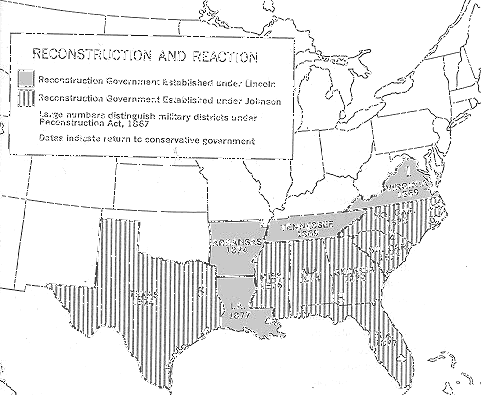
- Map: Reconstruction and Reaction, [At this Site][Added
7/3/98]
- Frederick Douglass (1817-1895): An Appeal to Congress
for Impartial Sufferage, January, 1867 [AT LSU] or here [At U Oklahoma]
- Frederick Douglass, Reconstruction, The
Atlantic Monthly, December 1866, [At The Atlantic]
- Immigration and Its Effects
- WEB New York, NY, Ellis Island --
Immigration: 1900-1920 [At UC-Riverside]
Photographic presentation.
- WEB Ellis
Island [At Yahoo]
- WEB Ethnic Mosaic of the Quad Cities (Rock
Island and Moline in Illinois, and Davenport and Bettendorf, Iowa) [At Augustana]
- WEB Chinatown [At PBS]
- WEB Hispano America USA [At Neta.com]
- WEB Interpreting The Irish
Famine, 1846-1850 [At Virginia]
A large collection of online original texts from Ireland, England, and America on the
Irish Famine. Includes a great deal on emigration to America.
- WEB The Mary Anne Sadlier Archive [At Virginia]
Mary Anne Sadlier (1820-1903), an Irish-American immigrant, wrote sixty volumes of work --
from domestic novels to historical romances to children's catechisms.
- WEB Irish Passenger Lists [At
geneology.org]
- WEB White Trash: The Construction of An
American Scapegoat [At Virginia]
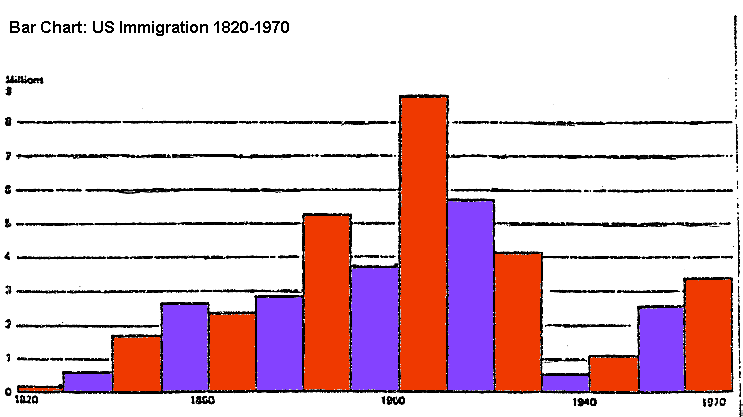
- Image: Bar Chart: US Immigration 1820-1970, [At this
Site]
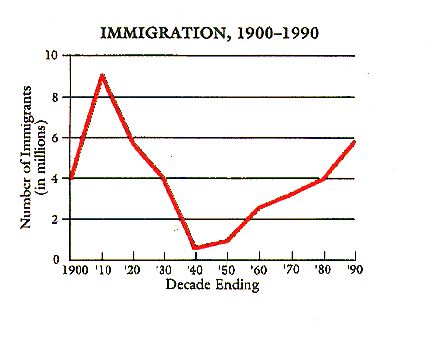
- Image: Graph: US Immigration 1900-1990, [At this
Site]
- Scottish Immigration to the American Colonies, 1772
[At this Site]
- Convention for the
Mutual Abolition of the Droit d'Aubaine and Taxes on Emigration Between the United
States of America and his Royal Highness the Duke of Nassau; May 27, 1846.[At Yale]
One of a series of such documents at the Avalon Project's German-American Diplomacy,
1785-1847. [At Yale]
- A Rough Journey
to America, 1850, [At Letters Magazine]
- Immigrant Wealth,
1883, [At Letters Magazine]
Letter from an Englishman after moving to South America, 1883. Not a US immigrant, but
these "letters home" were a major creator of emigration pressures.
- Mark Twain [pseud of Samuel Clemens](1835-1910): The Gentle, Inoffensive
Chinese, 1871, from Roughing It, Volume II, Chapter XIII. [At Schaffer Drug
Library]
- San Francisco
Chinatown Opium Den – 1870's [Image][At Drug Library]
- Chinese Miners
in the Gold Fields - 1860 [Image][At Drug Library]
- Chinatown
Declared a Nuisance! [At Drug Library]
This is the full text of a sixteen-page pamphlet, "Chinatown Declared a
Nuisance!"; distributed by the Workingmen's Committee of California, it called for
the abatement of Chinatown as a health menace.
- California: Anti-Coolie
Act, 1862 [At Drug Library]
"An Act to protect free White labor against competition with Chinese collie labor,
and to discourse the immigration of the Chinese into the state of California, April 26,
1862"
- Albert S. Evans: A
Cruise on the Barbary Coast, Chapter 12 of A la California. Sketch of Life in the
Golden State, c, 1871.
- Allen S. Williams: The
Demon of the Orient, 1883 [At Drug Library]
- Emma Lazarus: The New
Colossus, 1883 [At Civnet]
The poem on the Statute of Liberty.
- Jacob Riis (1849-1914): How
the Other Half Lives; Studies Among the Tenements of New York, 1890 [At Yale]
- Francis A. Walker: Restriction of
Immigration, The Atlantic Monthly, June 1896 [At The Atlantic]
Warnings about "vast inpourings of southern European immigrants"
- Robert DeCourcey Ward: Immigration and
the South, The Atlantic Monthly, November1905 [At The Atlantic]
Against the North's "unloading of second-rate immigrants by sending them South."
- John W. Foster: The
Chinese Boycott, The Atlantic Monthly, January 1906 [At The Atlantic]
Criticizes America's discrimination against Chinese immigrants in America as racist. This
behavior incited a Chinese boycott of American trade.
- William Z. Ripley: Races
in the United States, The Atlantic Monthly, December 1908 [At The Atlantic]
The "problem" of Mediterranean, Slavic, and Oriental races upon the character of
the nation.
- Don D. Lescohier: Immigration and
the Labor Supply, The Atlantic Monthly, November 1905 [At The Atlantic]
Immigrants would undermine the improved labor standards that American workers were
struggling to establish.
- Randolph S. Bourne, Transnational
America, The Atlantic Monthly, July 1916, [At The Atlantic]
On the failure of the "Melting Pot".
- The Maturation of American Culture
- WEB Hypertexts in American Culture [At Virginia]
- 2ND Edward Simmonds: A Student's History of
American Literature [At Bibliomania]
- Ralph Waldo Emerson (1803-1882): Concord
Hymn July 4, 1837 [At U Oklahoma]
- Ralph Waldo Emerson (1803-1882): Self-Reliance, 1841 [At
Civnet]
- Ralph Waldo Emerson (1803-1882): The
Transcendentalist, 1842 [At HK]
- Ralph Waldo Emerson (1803-1882): The
Young American, 1844 [At HK]
- Ralph Waldo Emerson (1803-1882): Nature;
adresses, and lectures [At HK]
- William Ellery Channing (1780-1842): On The Elevation
of The Laboring Classes, 1840 [At this Site]
- Henry David Thoreau (1817-1862): Civil Disobedience,
1846 [At Civnet]
Very long selections.
- Henry David Thoreau (1817-1862): Slavery
in Massachusetts, 1854 [At HK][Full Text]
- Henry Longfellow (1807-1882): The
Song of Hiawatha, 1855 [At HK]
- Walt Whitman (1809-1892): Song of Myself, 1855 [At this
Site]
- James Russell Lowell (1819-1891): On Democracy,
1868 [At this Site]
- Louisa May Alcott (1832-1888): An
Old-Fashioned Thanksgiving [At Eldritch]
- Mark Twain [pseud of Samuel Clemens](1835-1910): The Adventures of
Huckleberry Finn [At Wiretap][Full Text]
- William Graham Sumner (1840-1910): The Challenge of Facts,
pub. 1914 [At this Site]
A prominent American social Darwinist mixes social Darwinism with aspects of a Calvinistic
work ethic, provides Darwinist explantion of the family, and attacks Socialism.
- William Faulkner (1897-1962): A
Rose For Emily [At BNL][Full Text]
- The Legal Framework of American Life
- Blackstone's Commentaries, with
notes by St. George Tucker, 1803, full text [At Constitution.org]
- James Kent: Commentaries on American
Law, 1826, full text [At Constitution.org]
- WEB US
Supreme Court Decisions [At Yahoo]
- Cases of John
Marshall (1755-1835: Chief Justice, 1801-1835)[At American Revolution]
- Ex parte Milligan,
1866 [At Civnet]
The Supreme court insists on the rights of individuals, even during war.
- Morrill Act, 1862
[At Civnet]
Allowed western states to establish land grant college.
- Bardwell v. Illinois,
1873 [At Civnet]
The supreme court agreed that women could be banned from the bar.
- Pendleton Act,
1883 [At Civnet]
Regulated the neutrality of the civil service.
- Muller v. Oregon,
1908 [At Civnet]
Allowed states to create worker protection laws
- Plessy v. Ferguson,
1896 [At Civnet]
Established the legal basis for American apartheid in the South.
- Yick Wo v. Hopkins,
1886 [At Civnet]
Yick Wo v. Hopkins is the first instance of the Court inferring the existence of
discrimination from data about a law's application, a technique that would be used again
in the 1960s to strike down statutes discriminating against African Americans.
- The United States as a World Power
- WEB German-American Diplomacy,
1785-1847. [At Yale]
- WEB Spanish-American Diplomacy 1795 - 1898 [At Yale]
- Treaty of Amity,
Settlement, and Limits Between the United States of America and His Catholic Majesty,
1819 [At Yale]
- WEB Treaties with The Barbary
Powers: 1786-1836 [At Yale]
- The Barbary Treaties : Treaty of Peace, Signed Algiers June 30 and July 3, 1815 [At Yale]
- The Barbary Treaties:
Treaty of Peace and Amity, with Article Additional and Explanatory, Signed at Algiers
December 22 and 23, 1816 [At Yale]
- US Treaty with the Two
Sicilies; December 1, 1845 [At Yale]
- Treaty of Commerce and
Navigation Between the United States and the Ottoman Empire, February 25, 1862 [At
Yale]
- The Gilded Age
- The Emergence of Modern Politics
- Dorothea Lynde Dix (1802-1887): Memorial to the
Massachusetts Legislature, 1843 [At Civnet]
On social reform of prisons and facilities for the mentally ill.
- Horace Mann (1796-1859): Report No. 12 of the
Massachusetts School Board, 1848 [At Civnet]
- People's Party
Platform, 1896 [At Civnet]
Radical rural/farmers' party. The roots of American "populism"..
- Theodore Roosevelt (1858-1919, Pres., 1901-1909): The New Nationalism,
1910 [At Civnet]
The famous speech at Ossowatomie, Kansas, on August 31, 1910, which contains the kernel of
the "Progressive" ideas which would lead to the modern American welfare state.
So a speech outlining modern Aamerican "liberalism" by a Republican.
- Woodrow Wilson (1856-1924, Pres. 1913-1921): First Inaugural, 1913
[At Civnet]
Wilson's vision, in contrast to Roosevelt's, is of a small-unit economy presided over by a
government of limited powers. In other words, a speech echoing major themese in modern
American conservatism by a Democratic president.
- Theodore Roosevelt: Political
Assessments in the Coming Campaign, The Atlantic Monthly, July 1892 [At The
Atlantic]
Canada: Another North American Society
- WEB Religion, Society and Culture in
Newfoundland and Labrador [At Memorial U.]
An enormous archive of material on both religion and secular culture.
- Edward Haies: Sir Humphrey Gilbert's Voyage To
Newfoundland, 1583 [At this Site]
- Samuel de Champlain (c.1567-1635): Voyages, excerpts,
1604 [At American Revolution]
- Samuel de Champlain (c.1567-1635):: The Foundation of
Quebec, 1608 [At this Site]
- Memoir for the
Marquis de Seignelay Regarding the Dangers That Threaten Canada and the Means to Remedy
Them, January 1687 [At American Revolution]
- George III (b.1738-r.1760-1820): The
Royal Proclamation, October 7, 1763 [At Solon]
- Canada: The
Constitution Act, 1867 (The British North America Act), [At Solon Law Archive][Added
7/20/98]
- Benjamin Drew: The
Refugee: Narratives of Fugitive Slaves in Canada [At American Revolution]
- Ralph Centennius: The Dominion
in 1983, written in 1883. [At Gaslight]
Latin America
- WEB Latin
American Studies [At UTexas]
Perhaps the main guide on the web.
- WEB The Buried Mirror: Etexts
A major collection of sources and secondary material on Latin American history.
- WEB Latin American
National Histories [At MS State]
- Independence
- Political Development
- United States Imperialism
- Immigration
- Immigrant Wealth,
1883, [At Letters Magazine]
Letter from an Englishman after moving to South America, 1883. Not a US immigrant, but
these "letters home" were a major creator of emigration pressures.
- Mexico
- Alexander Von Humboldt: Problems and Progress in
Mexico, c. 1800 [At this Site]
- The Treaty of Guadaloupe Hidalgo, 2 Feb 1848 [At this
Site]
The United States siezes roughly half the land area of Mexico.
- Benito Juarez (1806-1872, Pres. of Mexico, 1861-65, 1867-72): Apuntes
Para Mis Hijos (Notes for My Children) c. 1857 [At MS State]
- Channing Arnold & Frederick J. Tabor Frost: The Rule of
Porfirio Diaz, 1909 [At this Site]
- Mexico: Constitución
de los Estados Unidos Mexicanos, 31 de enero de 1917, [At Solon Law Archive]
- George M. McBride: Haciendas from The Land Systems
of Mexico, 1923 [At this Site]
- Postal Convention
Between the United States of America and the Republic ofMexico, December 11, 1861
[At Yale]
- Francisco Madero: The Plan of San Luis Potosi, November
20, 1910 [At this Site]
Which marks the beginning of the Mexican revolution.
- Argentina
- 2ND Heath Douglas: A Brief History of
19th Century Argentina [At MS State]
- Independence and the Civil War, 1810-1820
- Buenos Aires under Governor Bernardino Rivadavia, 1825-27
- Juan Manuel de Rosas 1793-1877 [picture of his grave, in
England]
- Gaucho culture
- The Constitution of 1853
- Buenos Aires as new capital in federation of 1880
- British influence: Railways, investments and capital
- Development of the Pampas: An agricultural revolution, end of 19th century
- Italian Immigration
- Maria Eugenia Echenique: The
Emancipation of Women, 1876 [At WSU] - An Argentinian feminist.
- Brazil
- Pope Leo XIII: Encyclical: In Plurimus (On the Abolition of Slavery in Brazil), 1888. [At American]
The pope gives a history of slavery in the modern period, condemns Muslim slavery and
condones anti-slavery activity by popes. He neglects to mention the permission for the
onset of the African slave trade provide by Pope Nicholas V.
- Pierre Denis: The Coffee Fazenda of Brazil,
excerpts. 1911 [At this Site]
- H. M. Tomlinson: The Sea and the
Jungle, 1912 [At Eldritch Press]
"Narrative of the voyage of the tramp steamer Capella from Swansea to Para in the
Brazils, and thence 2000 miles along the forests of the Amazon.."
- Chile
- Columbia/Panama
- Cuba
- Nicaragua
- Peru
- Venezuela
Australia and New Zealand
Responses to Economic Growth:
Socialism and
Marxism
- WEB See Guide to Types of Socialism [At DSA]
- SUMMARY: Socialism,
Marxism, Trade Unionism
- Early Socialism
- Robert Owen (1771-1858): A New View of
Society, Or, Essays on the Principle of the Formation of the Human Character, and the
Application of the Principle to Practice, 1813-16 [At McMaster][Full Text] or here [At Yale]
- The Peterloo Massacre, 1819 [At this Site]
- Samuel Bamford (1788-1872): Passages in the Life of a
Radical-on the Peterloo Massacre, 1819 [At this Site]
- WEB The Peterloo Massacre, 1819
[At spartacus.schoolnet.co.uk]
- Chartism: The People's Petition, 1838, excerpts [At this
Site]
- Claude-Henri de Rouvroy St. Simon (1760-1825): Lettres d'un
habitant de Genèeve a ses contemporains [At Warwick]
- Claude-Henri de Rouvroy St. Simon (1760-1825): Series of the
Development of Human Intelligence [At Warwick]
- Claude-Henri de Rouvroy St. Simon (1760-1825): The Failure of
European Liberalism, 1824 [At Warwick]
- Charles Fourier (1772-1837): Theory of Social Organization,
1820 [At this Site]
A proponent of "phalanxes" as a form of industrial organization. They are best
exemplified in modern Israeli kibbutzim.
- Louis Blanc (18111882): The Organization of Labour, 1840,
excerpts [At this Site]
- Marxism
- WEB Marx/Engels
Internet Archive [At Marx.org]
Almost all the major texts (mostly English so far) by Karl Marx, Friederich Engels, and
major texts by James Connolly, Daneil DeLeon, Hal Draper, Georgi Dimitrov, Alexandra
Kollontai, Antonio Labriola, Lenin, Anatoly Lunacharsky, Rosa Luxemburg, Mao Tsetung, Jose
Carlos Mariategui, William Morris, David Riazanov, Anton Pannekoek, Max Shachtman, Stalin,
Leon Trotsky. The site also contains a major image archive and a search engine.
- G.W.F. Hegel (1770-1831): Introduction
to the Lectures on the Philosophy of History,(1840 edition) [At WSU]
- Karl Marx (1818-83): Full Texts [index at Hanover]
- Karl Marx (1818-83) and Frederich Engels (1820-1895): Communist
Manifesto, 1848, extracts [At WSU]
RG Study Guide [At WSU]
- Karl Marx (1818-83) and Frederich Engels (1820-1895): Communist Manifesto, 1848 [At
Yale][Full Text]. German Edition [At
ArtBin][Full Text]
- Karl Marx (1818-83) and Frederich Engels (1820-1895): The
Communist Manifesto,1848 [At Warwick]
An easy-to-cite version.
- Karl Marx (1818-83): On
Alienated Labour, from Economic and Philosophic Manuscripts, 1844 [At WSU]
- Karl Marx (1818-83) : A
Contribution to the Critique of the Political Economy 1859 [At Warwick]
- Karl Marx (1818-83): The
Fetishism of Commodities, from Das Kapital, Vol 1: chap 3 [At WSU]
- An Interview with Karl
Marx, The Chicago Tribune, January 5, 1879 [At CMU]
- Frederich Engels (1820-1895): Speech at the
Graveside of Karl Marx, 1883 [At Warwick]
- Friederich Engels (1820-1895): The Origin of the Family,
Private Property, and the State, 1884 [At Colorado][Full Text]
- Versions of Socialism
- John Stuart Mill (1806-73): Liberalism Evaluated, 1873,
from his Autobiography [At this Site]
Mill discusses how his faith in Liberalism slipped away and he began tending towards
Liberal Socialism (i.e., that of Hobhouse rather than the Fabians).
- The Gotha Program,
1875 [At Hanover]
- German Social Democrat Party: The Erfurt Manifesto, 1891,
excerpts [At this Site]
- Edouard Bernstein (1850-1932): Evolutionary Socialism,
1909, [At this Site]
- Vladimir Illyich Lenin (1870-1924): Marxism and Revisionism,
1908, excerpts [At Hanover]
- Alexandre Millerand: Reformist Socialism, 1903 [At this
Site]
- French Socialist Progam, 1905, excerpts [At this Site]
- Albert Einstein (1879-1955): Why
Socialism, 1949, excerpts [At WHA]
- Joseph Schumpeter: On the
Concept of Social Value, Quarterly Journal of Economics, 23, 1908-9.
(At Macmaster)
- George Bernard Shaw: An
Unsocial Socialist [Project Gutenberg Release #1654]
- Sidney James Webb (1859-1947): The Historic Basis of Socialism,
1889 [At this Site]
By one of the founders of British non-revolutionary intellectual socialism - known as
"Fabianism".
- William Morris (1834-1896): Why I Am a Socialist, 1884,
excerpts [At this Site]
- 2ND Sketch History of the British
Labour Party [At demon.uk]
- Emma Goldman: Was My Life Worth Living
- 2ND Emma Goldman: A Guide to Her Life and
Documentary Sources [At Berkeley]
- Prince Peter Kropotkin (1842-1921) : Anarchism: Its
Philosophy and Ideal, 1896 [At this Site]
- Socialist Culture
- Anne Maier: Autobiography, 1912, excerpts [At this Site]
- The Internationale [At this Site] WM [MIDI/RA]
Text in English, French, German, and Castilian [plus Billy Bragg's version] with both RA
and MIDI sound files of the music, and two sung versions - one a Chinese military version
and another a Turkish discobeat version!
- The Internationale [with
multimedia]
text in French and German, and with sound files!
- Di Shvue (The Vow) [At
ANU]
The song of the Bund, the dominant party among East European Jews.
- The Red Flag [At This Site][with multimedia]
- 2ND Hal Draper: The Two Souls of Socialism [At Guelph]
- Trade Unionism
Responses to Economic Growth:
Imperialism
- Analyses
- Motives and Attitudes
- China and the West
- See East Asian
History Sourcebook
- The Reception of the First English Ambassador to China,
1792 [At this Site]
- Emperor Qian Long [Ch'ien Lung] (b.1711-1799, r.1736-1796): Letter to George III, 1793 [At this Site]
- The People of Canton: Against the English, 1842 [At
this Site]
- Commissioner Lin Cixu [Lin Tse-hsu]: Letter to the
English Ruler [At Brooklyn College] or Shorter Version [At calyx]
- Commissioner Lin: Letter to Queen Victoria, 1839 [At this
Site]
Another version.
- 2ND Ellen N. La Motte: The Opium Monopoly,
1920 [At Drug Library]
- The Taiping Revellion, 1851-1864, excerpts [At this Site]
- Emperor Kuang Hsu: Attempted
Reforms, 1898 [At this Site]
- Emperor Kuang Hsu: Abolition
of the Examination System, 1898 [At this Site]
- Isaac Taylor Headland, 1859-1942: Court life in
China: the capital, its officials and people, (New York, F.H. Revell, c1909), full
text [At this Site][Full Text]
Contemporary discussion of reform efforts in late imperial China, with a significant
discussion of the lives of elite women.
- Yan Phou Lee: When I Went to School in China, 1880
[At this Site]
A late Confucian education.
- John Hay to Andrew D. White, First Open Door note on
China, Department of State, Washington, September 6, 1899 [At LSU] or here [At
American Revolution]
- Kaiser Wilhelm II (1859-1941, Emperor 1888-1918): German Interests in
China, 1900 [At HNet]
- Map of Lost
Chinese Territory
- The Atlantic: The
Break-up of China, and Our Interest in It, The Atlantic Monthly, August, 1899
[At The Atlantic]
- Fei Ch'i-hao: The Boxer Rebellion, 1900 [At this
Site]
A long account of anti-Missionary atrocities by a Chinese Christian.
- Yao Chen-Yuan: My Adventures During the Boxer War,
1900
- Pierre Loti: When the Allies Entered Peking, 1900 [At
this Site]
In response to the Boxer rebellion.
- John W. Foster: The
Chinese Boycott, from The Atlantic Monthly, January 1906 [At this Site]
Criticizes America's discrimination against Chinese immigrants in America as racist. This
behavior incited a Chinese boycott of American trade.
- Paul S. Reinsch: A Parliament for
China, The Atlantic Monthly, December, 1909 [At The Atlantic]
- Proclamation of The Abdication of the Manchus, 1912
[At this Site]
- Ching Chun Wang: A
Plea for the Recognition of the Chinese Republic, The Atlantic Monthly,
January 1913 [At The Atlantic]
- India Under the British
- WEB Indian History Sourcebook
- Robert Clive (1725-1774):: The Battle of Plassey, 1757
[At this Site]
- Robert Clive (1725-1774): Letter to William
Pitt on India, 1759 [At CCNY]
- Robert Clive (1725-1774):: Speech in Commons on India,
1772 [At this Site]
- India: Regulating Act, 1773 [At this Site]
- Edmund Burke (1729-1797): Speech in Commons on India,
1783 [At this Site]
- Raja Rammohan Roy: A
Second Conference Between an Advocate for, and An Opponent of the Practice of Burning
Widows Alive, 1820 [At WSU]
See also An Account
of Sati from Vikrama's Adventures [At CCNY]
- Sir William Bentinck (1774-1839): On Ritual Murder in India ,
1829, excerpts [At this Site]
Bentinck was first Governor-General of India, in 1833.
- Thomas Babington Macaulay (1800-1859): On Empire and
Education, 1830s, [At this Site]
- Mountstuart Elphinstone: Indian Customs and
Manners, 1840 [At this Site]
Includes graphic account of suttee.
- Sir Monier Monier-Williams: Camp Life in India, 1850
[At this Site]
- Charles Creighton Hazewell: British India, The
Atlantic Monthly, November 1857, [At The Atlantic]
- Charles Creighton Hazewell: The Indian Revolt, The
Atlantic Monthly, December 1857, [At The Atlantic]
- Elisa Greathed: An Account of the Opening of the Indian
Mutiny at Meerut, 1857 [At this Site]
- Robert Traill Spence Lowell: The Relief of Lucknow [At this Site]
- Sir Monier Monier-Williams: The Towers of Silence,
1870 [At this Site]
The Parsee's in Bombay.
- Dadabhai Naoroji: The Benefits of British Rule, 1871
[At this Site]
- Field Marshal Lord Roberts: When Queen Victoria
Became Empress of India, 1877 [At this Site]
- Rev. Arthur Male: The
Hill of Bones, Afghanistan 1878 [At this Site]
- Africa
- The Middle East
- See Islamic History
Sourcebook
- Sir Richard Francis Burton: A Pilgrimage to Mecca, 1853
[At this Site]
- Edmondo de Amicis: One Day in Morocco, c. 1870 [At this
Site]
- The Story of the Suez
Canal, from All the Year Round, January 8, 1876 [At this Site]
- Alfred Egmont Hake: The
Death of General Gordon at Khartoum, 1885 [At this Site]
- George E. Thompson: The
Great Market of Tripoli, c. 1890 [At this Site]
- Charles James Wills: A Persian Wedding, 1885 [At this Site]
- S. G. W. Benjamin: Life
in Persia, 1885 [At this Site]
- Samuel G. Wilson: New
Year's Calls and Gifts, Persia 1895 [At this Site]
- Colonel L. du Couret: Justice in Arabia,
c. 1890 [At this Site]
- Eustache de Lory: The
Persian Bazaars, 1910 [At this Site]
- American Imperialism
- WEB Documents Relating to American
Foreign Policy--1898-1914, [At Mt. Holyoke]
- Josiah Strong: On
Anglo-Saxon Predominance, 1891 [At Mt. Holyoke]
- Albert Beveridge (1862-1927): The March of the Flag,
September 16, 1898 [At this Site]
- John Hay to Andrew D. White, First Open Door note on
China, Department of State, Washington, September 6, 1899 [At LSU] or here [At
American Revolution]
- US Recognition of Cuban Independence, 1898 [At this
Site]
- Treaty of Peace Between
the United States and Spain, 1898
By which the US acquired Cuba, Puerto Rico and the Phillipines. [At Yale]
- Edwin Wildman: A Visit to Aguinaldo, Leader of the
Philippine Rebels, 1898 [At this Site]
- R. L. Bullard: Preparing Our Moros for Government, 1906
[At this Site]
- The Atlantic: The
Break-up of China, and Our Interest in It, The Atlantic Monthly, August, 1899
[At The Atlantic]
- The Platt Amendment, 1901 [At this Site]
- The Platt Amendment, 1903
[At Mt. Holyoke]
- The Roosevelt Corollary
- Convention Between the US and Panama (Panama Canal), 1903
[At this Site]
- Theodore Roosevelt (1858-1919, Pres., 1901-1909): Annual Message to Congress 1905
- Francisco Garcia Calderón: Imperialism of Decadence,
1913 [At this Site]
- Rubén Darío (1867-1916): To
Roosevelt [At WSU]
- Calvin Coolidge: Intervention
in Nicaragua [At Mt. Holyoke]
- The Philippines
- Timeline of US
Intervention in Latin America [At Kansas]
- Celebrations and Objections
- The Japanese Exception
- See East Asia
History Sourcebook
- WEB Guide
to Japan: History. [At Japan Guide]
- WEB Meiji Japan [At Sage.Edu]
- Sarashina: The Diary of
Lady Sarashina (1009-1059)[At Hanover College]
- Tokugawa Iemitsu: Closed Country Edict 1635 [At CCNY]
- Kaibara
Ekken or Kaibara Token: Greater Learning for Women, 1762 [At WSU]
- Tsuentomo Yamamoto : The Way of the Samauri [At CCNY]
- Honda Toshiaki: A Secret Plan for Government,
excerpts, 1798 [At this Site]
- Commodore Matthew Perry: When We Landed in Japan,
1854 [At this Site]
- Townsend Harris: The President's Letter [At this Site]
Harris was the first US ambassador to Japan.
- Francis Ottiwell Adams: The Schools of Japan [At
this Site]
Description from the mid 19th century
- Japan: Constitution, 1889
[At Hanover College]
- Sir Edwin Arnold: A Japanese Dinner Party, 1890
[At this Site]
- Alice M. Bacon: How Japanese Ladies Go Shopping, 1890
[At this Site]
- Lt. Tadayoshi Sakurai: The Attack upon Port Arthur,
1905 [At this Site]
The Japanese adopted Western Imperialism very quickly.
- Okuma: Fifty Years of New Japan, 1907-08, excerpts
[At this Site]
- Theodore Roosevelt (1858-1919, Pres., 1901-1909): The Threat of Japan, 1909 [At
Mt. Holyoke]
- Natsume Soseki (1867-1916): Kokoro,
translation by Edwin McClellan. [At Eldritch]
- Lafcadio Hearn (1850-1904): Writings
on Japan [At Eldritch]
The Second Industrial Revolution and Advanced Capitalism
- Growth: Free Markets and Government Support
- The Life of the Workers
- New Technologies
- The Steel Industry
- Sir Henry Bessemer (1813-1898): Autobiography,
1905, in chapter files, full text, [At Bibliomania]
- The Chemical Industry
- Electricity
- Efficiency, Automation and the Assembly Line
- Aviation
- The Modern Corporation
- Confidence and Disaster
Contradictions of the
Enlightenment:
Darwin, Freud, Einstein and Modern Art
- SUMMARY: Late 19th Century
Science and Culture
- WEB See History of Science
Sourcebook
- WEB Philosophers, Scientists
and Theologians of the 19th Century [At Cybernex]
Names, dates, and major works (with text links where available)
- The Classical Synthesis
- Michael Faraday (1791-1867): Lectures on the Forces of
Matter, 1859 [At this Site]
- Michael Faraday (1791-1867): The Chemical History of A
Candle, 1860 [At this Site]
- 2ND John Tyndall: Faraday as a
Discoverer, 1894, in chapter files, full text, [At Bibliomania]
- Sir William Thomson (Lord Kelvin)(1824-1907): Tides,
1882 [At this Site]
- Sir William Thomson (Lord Kelvin)(1824-1907): Wave
Theory Of Light, 1884 [At this Site]
- Hermann Ludwig Ferdinand von Helmholtz: On The
Conservation Of Force, 1863 [At this Site]
- Hermann Ludwig Ferdinand von Helmholtz: Ice and
Glaciers, 1865 [At this Site]
- The Advance of Medical Theory and Treatments
- Geology
- Biology: Red in Tooth and Claw
- Charles Darwin (1809-1882): The Voyage of the Beagle,
1845 [At Literature.Org][Full Text]
- Charles Darwin (1809-1882): On the Origins of Species,
1859 [At Literature.Org][Full Text]
- Charles Darwin (1809-1882): On
the Origins of Species, 1859, extracts [At WSU]
- Charles Darwin (1809-1882): On the Origins of Species,
1859, extracts [At Hanover]
- Charles Darwin (1809-1882): The
Descent of Man, 1871 [At Bristol][Full Text]
- Charles Darwin (1809-1882): The Descent of Man, 1871,
excerpts [At this Site]
- Charles Darwin (1809-1882): The Descent of Man,
1871, excerpts on Sexual Selection [At this Site]
- Reactions to Darwin
- Samuel Wilberforce: On Darwin's Origin of
Species, 1860 [At this Site]
A negative reaction.
- St. George Jackson Mivart (1827-1900): On the Genesis of the
Species, 1871 [At this Site]
Mivart was a Catholic convert who wrote a noted reply to the Darwinian thesis, which
he did not dismiss out of hand, in 1871. In 1876, Pope Pius IX conferred on him the degree
of doctor of philosophy.
- J. H. Gladstone: Points of Supposed Collision Between
the Scriptures and Natural Science, 1872 [At this Site]
A lecture given at the behest of the Christian Evidence Society, in support of
Christianity against the assault of the New Science upon Biblical authority.
- Social Darwinism
- Herbert Spencer (1820-1903): Progess: Its Law and Causes,
1857, excerpts [At this Site]
Social Darwinism by its founder. Note the date!
- Herbert Spencer (1820-1903): First Principles,
1862 [At McMaster][Full Text]
- Walter Bagehot: The Use of Conflict, 1872 [At this Site]
An application of evolutionary thought to military conflict.
- Thomas Henry Huxley (1825-1895): The Method of Scientific
Investigation, 1863 [At this Site]
- Thomas H. Huxley (1825-95): Science and Culture,
1880 [At this Site]
- Thomas H. Huxley (1825-95): The Struggle for
Existence, 1888 [At this Site]
- Thomas Henry Huxley (1825-1895): Prolegomena to
Evolution and Ethics, 1894 [At Baylor]
- Thomas Henry Huxley (1825-1895): Evolution and Ethics,
1894 [At Baylor]
- Andrew White: The
Warfare of Science and Theology in Christendom 1898 [At Hanover]
- Karl Pearson: National Life From the Standpoint of Science,
1900 [At this Site]
- William Graham Sumner (1840-1910): The Challenge of Facts,
pub. 1914 [At this Site]
An American social Darwinist mixes on the family and Socialism.
- Lothrup Stoddard: The Revolt
Against Civilization: The Menace of the Under Man, 1922 [At Patrick Henry Online]
Practical social darwinism.
- 2ND Robert M. Young: The Impact of Darwin on Conventional
Thought [At Sheffield]
- Physics: The End of the Classical Synthesis
- Astronomy
- Simon Newcomb (1835-1909): Extent of The Universe,
1884 [At this Site]
- Percival Lowell (1855-1916): Mars, 1895, in
chapter files, full text, [At Bibliomania]
- A.S. Eddington (1882-1944): Stars and Atoms,
1926 in chapter files, full text, [At Bibliomania]
- James Nasmyth: Autobiography,
1897, in chapter files, full text, [At Bibliomania]
- Psychology: The Obscurity of the Mind
- Philosophical Reflections: The End of Reason?
- Literature: Humanity's Heart of Darkness?
- Mathew Arnold (1822-88): Dover
Beach, c. 1851 [At Auburn]
- Oscar Wilde (1854-1900): The
Picture of Dorian Gray [Gutenberg Text][Full Text]
- Joseph Conrad (1857-1924): Heart of Darkness [At CMU][Full Text]
- Joseph Conrad (1857-1924): Heart
of Darkness, 1899 [At Gaslight][Original Magazine Version]
- Joseph Conrad: Lord Jim [At Bibliomania][Full Text]
- Anatoly Vasilievich Lunacharsky: Marcel
Proust, 1924, from Revolutionary Silhouttes [At Artbin]
- Rainer Maria Rilke (1875-1926): Poems, in
English and German [At Norconnect]
- Visual Arts: What to Do After Photography?
Religion in the Face of
Modernity
- WEB Victorian
Religion in Britain [At Brown]
- Catholicism: Reaction and Radicalism
- The Popes: Reaction and Reform
- Renewed Marianism
- Converts
- 2ND Patrick Allitt: Catholic Converts:
British and American Intellectuals Turn to Rome, Chapter 1, with an interesting review by
Peter Steinfels. [At NY Times: you will be asked to "sign up" to access the
text]
- Francis Thompson !859-1907): The Hound of Heaven,
with discussion [At Drexel]
- Lytton Strachey: Cardinal Manning (1807-1982), from Eminent
Victorians, 1918 [At this Site][At this Site]
- 2ND Peter C. Erb: A Question of Sovereignty: The Politics of
Manning's Conversion, 1996 [At Emory]
- MEGA Newman Links Page [At Erasmus]
Links to discussions and all texts online. Rather emphasizes Newman as a
"conservative", and ignores his progressivism, not to mention his probable
homosexuality.
- John Henry Newman (1801-1890): The Theory of
Developments in Religious Doctrine, 1843 [At this Site]
This is a "University Sermon" from 1843 (the last of his Fifteen Sermons
Preached Before the University of Oxford), not the more extended monograph of 1845.
- John Henry Newman (1801-1890): Essay On the
Development of Christian Doctrine, long excerpts. [At Caltech]
- John Henry Newman (1801-1890): Surrender to God (1st
Sunday in Lent), 1848 [At this Site]
- John Henry Newman (1801-1890): The World and Sin (2nd Sunday in Lent), 1848 [At this Site]
- John Henry Newman (1801-1890): Faith and Private
Judgement,1849 [At this Site]
- John Henry Newman (1801-1890): The Second Spring: A
sermon delivered to the First Provincial Council of Westminster, 1852 [At this Site]
- John Henry Newman (1801-1890): The Idea of A
University, 1854 [At this Site]
- John Henry Newman (1801-1890): Sermon on Fasting [At
this Site]
- John Henry Newman (1801-1890): On Consulting the Faithful
in Matters of Doctrine, July 1859 [At this Site]
Newman advances ideas in ecclesiology which were not fully understood until a century
later at the Second Vatican Council.
- John Henry Newman (1801-1890): Apologia Pro Vita Sua,
1864 [At this Site]
Complete text, with the subsidiary documents. This is probably the single most influential
document produced by and about English Catholicism.
- John Henry Newman (1801-1890): A Letter Addressed to His
Grace the Duke of Norfolk on Occasion of Mr. Gladstone's Recent Expostulation, Dec.
27, 1874 [At this Site]
Newman's great Catholic defence of the primacy of conscience against all other authority.
- John Henry Newman (1801-1890): Who is to Blame? [At this Site]
Newman on the nature of constitutional government.
- 2ND See Catholic Encyclopedia: John Henry Newman [At New Advent]
and E. L. Core John
Henry Newman: His Developing Faith, His Life as a Catholic [At Victorian Web]
- WEB Gerard Manley Hopkins Page [At
Creighton]
- Gerard Manley Hopkins (1844-1889): Selected
Poetry [At Toronto]
- Gerard Manley Hopkins (1844-1889): Poems, complete 1918
edition, [At Bartleby]
- MEGA Chesterton Links Page [At Erasmus]
Texts and further information on G.K.Chesteron, as well as Newman, Belloc, Hopkins, and
Knox.
- WEB G. K. Chesterton Page, including Chesterton's Works on the Web [At
Durham]
- Gilbert Keith Chesteron: Heretics, 1905, full
text, [At CCEL]
- Gilbert Keith Chesteron: Orthodoxy, 1909,
full text, [At CCEL]
- WEB Mgsr. Robert Hugh Benson (1871-1914) [At
Notre Dame]
- Mgsr. Robert Hugh Benson (1871-1914): Papers of a Pariah,
1907 [At Notre Dame]
- Mgsr. Robert Hugh Benson (1871-1914): Confessions of a Convert,
1913 [At Notre Dame]
- St. George Jackson Mivart (1827-1900): On the Genesis of the
Species, 1871
Mivart was a Catholic convert who wrote a noted reply to the Darwinian thesis, which
he did not dismiss out of hand, in 1871. In 1876, Pope Pius IX conferred on him the degree
of doctor of philosophy.
- Converts and Decadence
- Canon John Gray
- Andre Raffalovich
- Oscar Wilde
- Baron Corvo
- Radicals
- Missionary Expansion
- Protestantism: Activism, Rationalism, and Fideism
- Walter Rauschenbusch: The Social Gospel, 1908 [At
this Site]
- William James (1842-1910): The
Varieties of Religious Experience, 1902 [At Psychweb][Full Text]
- Biblical Criticism
- Muscular Christianity
- The Oxford Movement
- John Keble (1792-1866): Sermon
on National Apostasy, 1833 [At Victorian Web]
Preached at the Assize Sermon in Oxford, it was sensation and is seen as the beginning of
the Oxford Movement. See article by Glenn Everett on Tractarianism [At Victorian Web] or the Catholic Encyclopedia on The Oxford Movement
- The Tracts for the Times, 1833-1841 [At this Site]
Listing of all tracts, with links to online texts were available.
- Tracts for the Times 1: Thoughts on the Ministerial
Commisson, 1833, [by John Henry Newman][At this Site]
- Tracts for the Times 2: The Catholic Church, 1833
[by John Henry Newman][At this Site]
- Tracts for the Times 3: Thoughts on Alteration in the
Liturgy, 1833 [by John Henry Newman][At this Site]
- Tracts for the Times 4: Adherence to the Apostolical
Succession the Safest Course. On Alterations in the Prayer-book, 1833 [by John
Keble] [At this Site]
- John Henry Newman (1801-1890): Select
Writings [At LibertyNet]
- Negating the 39 Articles [At this Site]
- Pope Leo XIII (b.1810-r.1878-1903): On the Nullity of
Anglican Orders, Apostolicae Curae, 1896 [At this Site]
- Archbishops of England: Reply to Leo XIII [At this
Site]
- Quakers
- Fundamentalism
- Missionary Expansion
- Eastern Orthodoxy: Christian Life Under Tsars and Sultans.
- Judaism and Modernity
- Humanist Consideration of Religious Thought
- Ludwig Büchner: Force and Matter--Empirico-Philosophical
Studies Intelligibly Rendered, 1855 [At this Site]
This is one of the most successful, and early, statements on Materialism stemming from the
conclusions of the New Science.
- Ernst Haeckel: The Confession of Faith of a Man of Science,
1892 [At this Site]
- Andrew Dickson White: A History of the Warfare
of Science with Theology in Christendom, 1896, full text, [At Wiretap]
- Albert Einstein (1879-1955): Science and Religion, 1939
[At St. Cloud]
- Bertrand Russell (1872-1970): Why I am not
a Christian [At HK]
- Bertrand Russell (1872-1970): A Free Man's
Worship, 1917 [At this Site]
An unflinching examination of the human situation from an atheistic viewpoint.
- Bertrand Russell (1872-1970): A Free
Man's Worship, 1903 [At Drew]
- Charles Peirce: The Fixation of Belief [At this Site]
- Miguel de Unamuno y Jugo (1864-1936): The Tragic Sense of Life in Men and in Peoples,
1913
- Miguel de Unamuno y Jugo (1864-1936): The Agony of Christianity, 1925.
Back to Index
© This text is copyright. The specific electronic form, and any notes and questions
are copyright. Permission is granted to copy the text, and to print out copies for
personal and educational use. No permission is granted for commercial use.
If any copyright has been infringed, this was unintentional. The possibility of a site
such as this, as with other collections of electronic texts, depends on the large
availability of public domain material from texts translated before 1920. [In the US, all
texts issued before 1923 are now in the public domain (although later editing may be
copyright). Texts published before 1964 may be in the public domain if copyright was not
renewed after 28 years. This site seeks to abide by US copyright law: the copyright status
of texts here outside the US may be different.] Efforts have been made to ascertain the
copyright status of all texts on this site, although, occasionally, this has not been
possible where older or non-US publishers seem to have ceased existence. Some of the
recently translated texts on this site are copyright to the translators indicated in each
document. These translators have in every case given permission for non-commercial
reproduction. This site is intended for educational use. No representation is made about
the copyright status of offsite links: note that for the Modern History Sourcebook,
unlike the Medieval Sourcebook, many texts are offsite. Notification of
copyright infringement will result in the immediate removal of a text until its status is
resolved.
© Paul Halsall January 1997 - July 1998
[email protected]
The Internet History Sourcebooks Project is located at the History Department of Fordham University, New York. The Internet
Medieval Sourcebook, and other medieval components of the project, are located at
the Fordham University Center
for Medieval Studies.The IHSP recognizes the contribution of Fordham University, the
Fordham University History Department, and the Fordham Center for Medieval Studies in
providing web space and server support for the project. The IHSP is a project independent of Fordham University. Although the IHSP seeks to follow all applicable copyright law, Fordham University is not
the institutional owner, and is not liable as the result of any legal action.
© Site Concept and Design: Paul Halsall created 26 Jan 1996: latest revision 11 August 2025 [CV]
|