'Jesus Is': Depicting Contested Archetypes of Christ
This series, featuring paintings on the subject of Jesus, engages the contextual debates over contested archetypes of Jesus in the real world. The project examines how physical accuracy is not often the objective when portraying Jesus, as many Christians throughout the world use images of Jesus that depict him in a manner representative of their community.
Artist Laura Oldfather draws from the plethora of races, gender identities, political identities, and abilities that Jesus is imagined in—though she began with a consideration and depiction of historically accurate (Levantine) Jesus, which surfaces primarily in efforts to combat the overwhelming tendency of the West to depict him as white.
The paintings were shown at a April 25 gallery show at Fordham's Lincoln Center campus and will be displayed in the Bl. Rupert Mayer, SJ, Chapel until May 9.
About the artist: Laura Oldfather is an artist and theologian living in New York City, where she relishes the abundance of community and delights in seeing Jesus all over. She graduated from Fordham in 2025 with a BA in theology and a minor in journalism, and is planning to attend Union Theological Seminary in the fall for a MA in religion. In addition to being a Duffy Fellow, Laura works for Fordham Campus Ministry.
Jesus Is
-
Debates on Jesus’s status of migration often center on our current definitions of words like migrant, immigrant, and internationally displaced person, and how well they match up with the language of the Bible. I am less concerned about the exact classification one uses to explain how Jesus moved throughout his life to escape persecution, and more concerned about the fact that he did, as well as what this means for us today. First, what do the Gospels say?
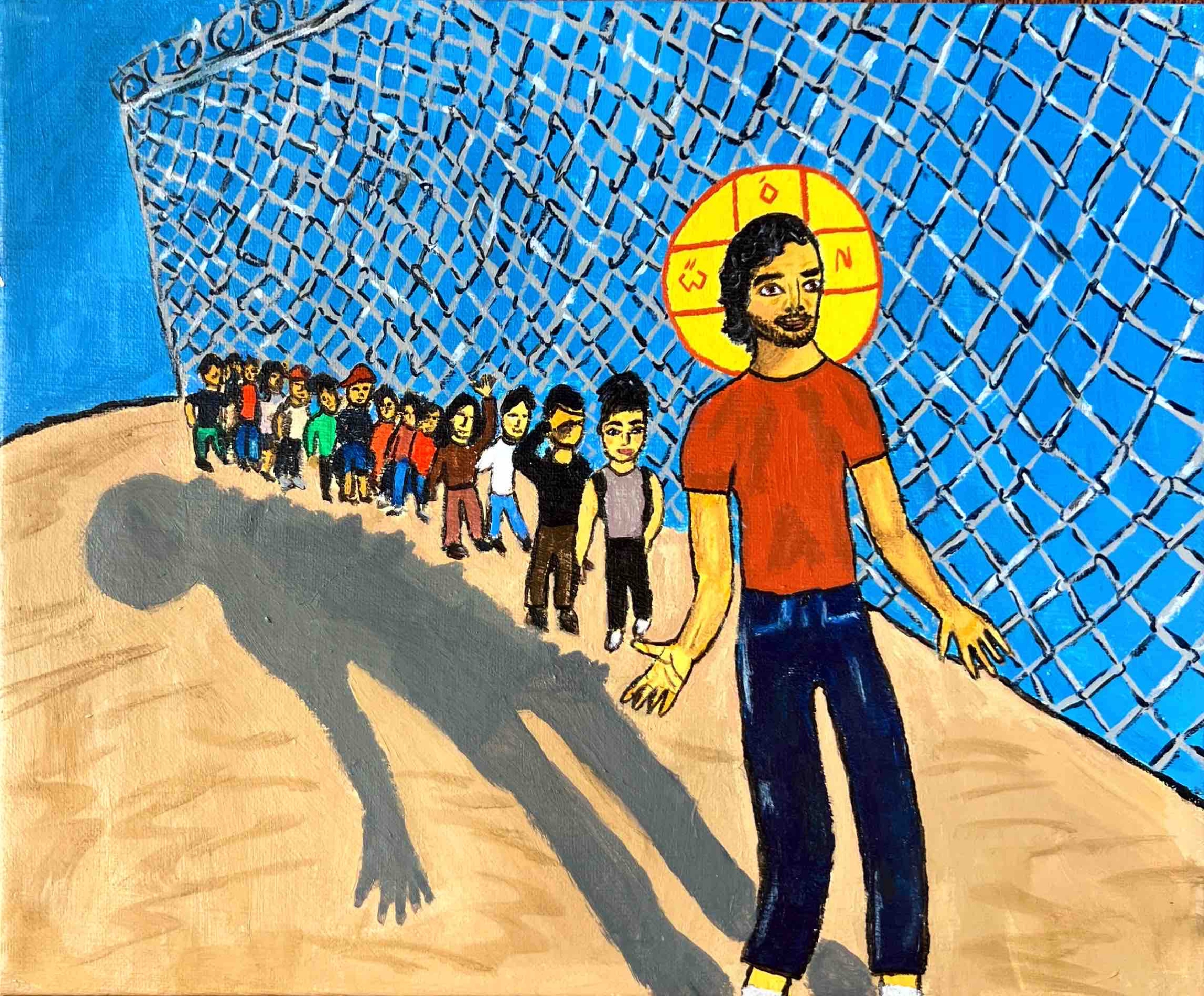
Prior to Jesus being born, Mary and Joseph both lived in Galilee, but “at that time the Roman emperor, Augustus, decreed that a census should be taken throughout the Roman Empire” (1). Everyone had to return to their "ancestral towns” for the census, “and because Joseph was a descendant of King David, he had to go to Bethlehem in Judea, David’s ancient home” (2). The following story of migration is only detailed in the Gospel of Matthew (the first Gospel). After Jesus was born, the wise men appeared in Jerusalem, and asked about the Messiah. King Herod (king of Judea) was disturbed about the power threat and wanted to know where Jesus was, in order to kill him. The wise men followed a star to Bethlehem, and after finding Jesus and bestowing his gifts and praise, they did not take the same journey back, in order to avoid Herod. Then, “after the wise men were gone, an angel of the Lord appeared to Joseph in a dream. ‘Get up! Flee to Egypt with the child and his mother,’ the angel said” (3). The family stayed in Egypt while Herod was alive, avoiding the soldiers Herod sent to Bethlehem to kill all boys two years old and under. When Herod dies, an angel tells Joseph to return to Israel with his family. “But when he learned that the new ruler of Judea was Herod’s son Archelaus, he was afraid to go there. Then, after being warned in a dream, he left for the region of Galilee” (4). The family settles in Nazareth. Though Jesus moves around the regions throughout his life, the context in which he is seen as a (child) migrant is the fleeing to Egypt on account of the threat of persecution, and enactment of infanticide (5).
What we do know about this scene is that this is a family with little money and resources, being persecuted by a government that feels threatened by Jesus’s existence. I drew on several photos from the US/Mexico borders for inspiration and reference for this painting. The photos were all published by various news outlets, attached to articles. Most were from early 2023, around the confusion and rush to the border around the end of Title 42 (6). One in 2023 was about the law Texas governor Greg Abbott signed that allowed “any Texas law enforcement officer to arrest people who are suspected of entering the country illegally” (7). There was a court order to block it in February 2024, shortly before it was set to go into effect, but as of April 24, 2026, the law “can go into effect after a federal appeals court on Friday lifted a lower court ruling that had stopped it for years” (8). Jesus fleeing political persecution and how we respond to the most vulnerable among us is inextricable from an understanding of contemporary American politics that desires to be in tune with Christianity.
1. Luke 2:1. New Living Translation, Tyndale House Publishers, Inc. 1996.
2. Luke 2:4
3. Matthew 2:13
4. Matthew 2:22
5. “New Testament Maps.” Yale Bible Study, Yale Divinity School. https://yalebiblestudy.org/resources/new-testament-maps/
6. Debusmann Jr, Bernd. “US border crisis: El Paso readies for rise in crossings as end of Title 42 looms.” BBC. May 2023. https://www.bbc.com/news/world-us-canada-65552877
7. Gonzalez, Valerie and Weber, Paul. “Texas gov. signs measure turning police into border patrol.” Mercury News, Associated Press. December 2023. https://www.mercurynews.com/2023/12/18/texas-gov-signs-measure-turning-police-into-border-patrol/
8. Serrano, Alejandro. “Texas police can arrest people suspected of entering country illegally, federal court rules.” The Texas Tribune. April 2026. https://www.texastribune.org/2026/04/24/texas-immigration-law-sb-4-5th-circuit-court-of-appeals-ruling/#:~:text=A%202023%20Texas%20law%20that,had%20stopped%20it%20for%20years.
-
This painting is inspired in large part by the famous and very controversial 1975 sculpture entitled “Christa” by Edwina Sandys. The sculpture measures 4x5 feet and is 250 pounds of bronze, mounted on a white lucite (acrylic plastic) cross. After hanging in her apartment for years, the statue was first shown at St. John the Divine (Manhattan) in 1984 during Holy Week. Upon its installation, controversy ensued, and the suffragan bishop of the Episcopal Diocese of New York called the statue “theologically and historically indefensible” and ordered Ms. Sandys to remove it (overruling the dean of the cathedral) (1).
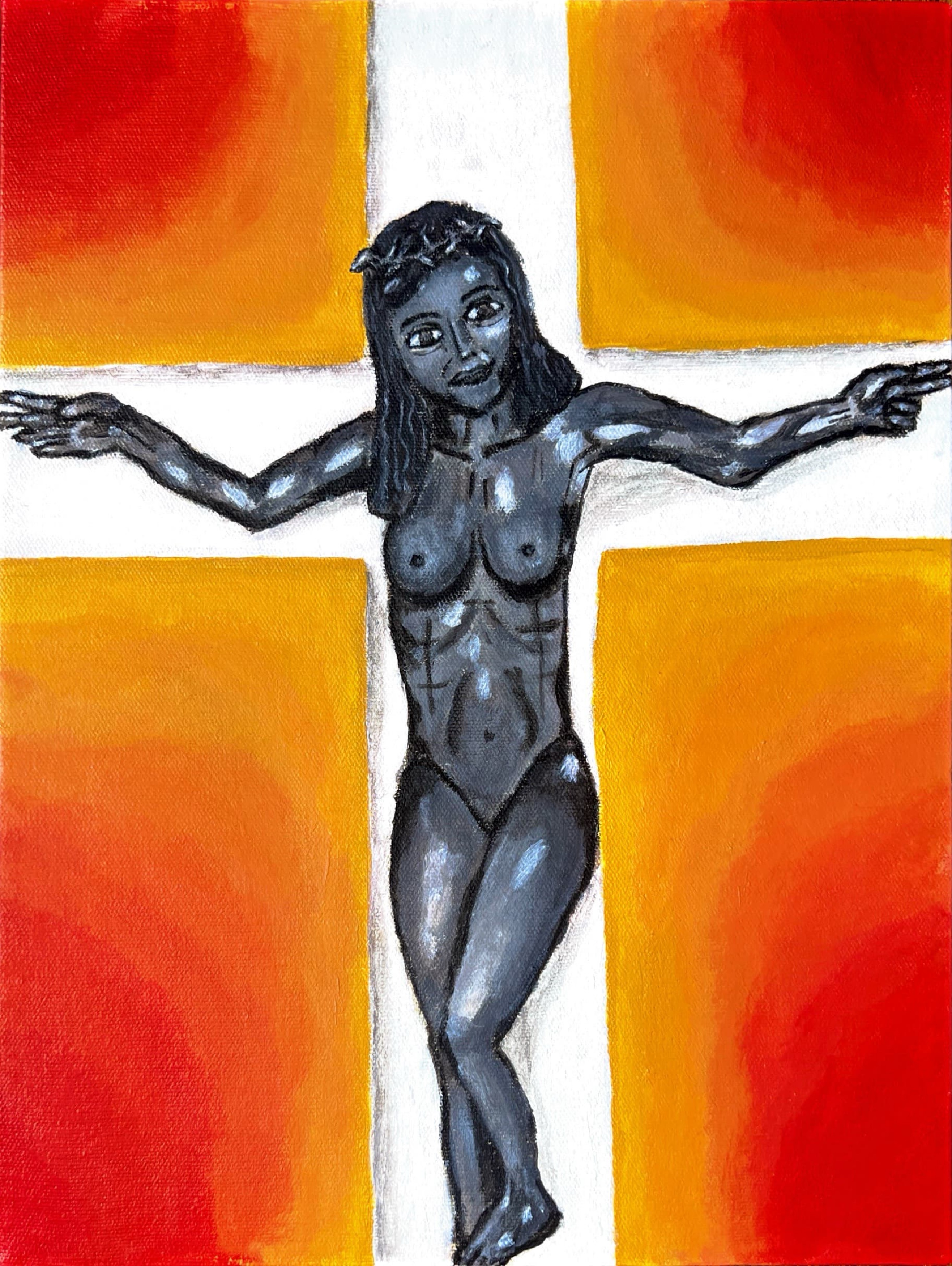
The statue has been exhibited at various galleries around the world, and in 2016, the statue was permanently reinstalled at St. John the Divine under new leadership – on the altar in the Chapel of St. Saviour as the centerpiece of “The Christa Project: Manifesting Divine Bodies” (2). Though it was much better received by both the bishop of the diocese and the dean of the cathedral, the statue has never received a unanimous approval of the public. In 2023, while on display at St. John the Divine, the statue was stolen. It was returned a few days later with a note reading, “This does not belong in God’s house” (3).
In a 2015 interview Sandys reflected on the message and reception of the statue 50 years after its unveiling, saying “I didn’t make Christa as a campaign for women’s rights or Women’s Lib as such but I have always believed in equality and I am glad that Christa is just as relevant today as it was in 1975.” Sandys explained in this interview that this interpretation of the crucifixion is not just for women,“Men also suffer and that is one of the meanings of Jesus on the Cross” (4). For my painting, I chose to render Christ in grayscale both as an homage to the statue and in part to choose a most encompassing shade of skin. Male Jesus is the main focus of this project, and he is portrayed in a range of bodies. The point of the “Christa” statue is to reveal the suffering we all have in common, and this interpretation shares that goal.
In my research, I came across some medieval debates about if God could and/or should have been born a woman. The first thing that scholar Joan Gibson asserts in her article, “Could Christ Have Been Born a Woman? A Medieval Debate" is that this is not a question we’ve just thought of in the last century. She writes that “an examination of the medieval debate on the sex of God reveals that contemporary discussion is far from a historical oddity. Rather it fits within a long series of Christian approaches to God through the female” (5). Referencing Augustine's De agone christiano – which was slightly prior to and influential in medieval thought – Gibson explains, “His choice to assume human nature through birth rather than through a separate creation signifies the worth even of women and female bodies, and intensifies the possibility of salvation for all by stressing the universality of the promise” (6). Though the discussions are interesting, the works that were published and remain from that time were exclusively written by a privileged class of men. They often precipitate on the idea that God is a He, strictly existing within the confines of human gender binaries. This is à la Aristotle, of the argument that women are less perfect men, and Christ would have been as close to perfection as possible. Bonavarture wrote that Christ should have been a woman because they are the weaker sex and therefore God could have better shown His power by a woman’s defeat of the devil (7). I will digress with the Mary Daly quote, “If God is male, then male is God” (8).
1. Barron, James. “An ‘Evolving’ Episcopal Church Invites Back a Controversial Sculpture.” New York Times. October 2016. https://www.nytimes.com/2016/10/05/nyregion/an-evolving-episcopal-church-invites-back-a-controversial-sculpture.html
2. Barron, 2016
3. Richardson, Kemberly. “Suspect returns controversial sculpture to Manhattan cathedral with note.” Eyewitness New ABC. December 2023. https://tinyurl.com/2n8bum2d
4. Reynolds, Nettie. “Christa Interview with Edwina Sandys by Nettie Reynolds.” Feminism and Religion. October 2015. https://feminismandreligion.com/2015/10/06/christa-interview-with-edwina-sandys-by-nettie-reynolds/
5. Gibson, Joan. “Could Christ Have Been Born a Woman? A Medieval Debate.” Journal of Feminist Studies in Religion 8, no. 1 (1992): 65–82. http://www.jstor.org.avoserv2.library.fordham.edu/stable/25002171.
6. Gibson, 68
7. Gibson, 72
8. Daly, Mary. “Beyond God the Father: Toward a Philosophy of Women’s Liberation.” Beacon Press. 1973.
-
There are many images of Black Jesus that exist for a plethora of reasons. In the United States, Black Jesus is a figure that arises primarily in response to the proliferation of white Jesus as a tool of racial capital (1). One of the white supremacist beliefs that Black Liberation theology combats is the idea that African-descended peoples were cursed by God to suffer servitude for a period of time (the Hamitic thesis, where Black people are marked as Ham’s son Canaan’s descendents, fated to serve as slaves to the descendents Ham’s brothers) (2). This belief spread in Europe from the 1500s to justify the trade of Black people and attempt to reconcile the incomprehensible horror of this slavery with a Gospel that calls for the love and care of all.
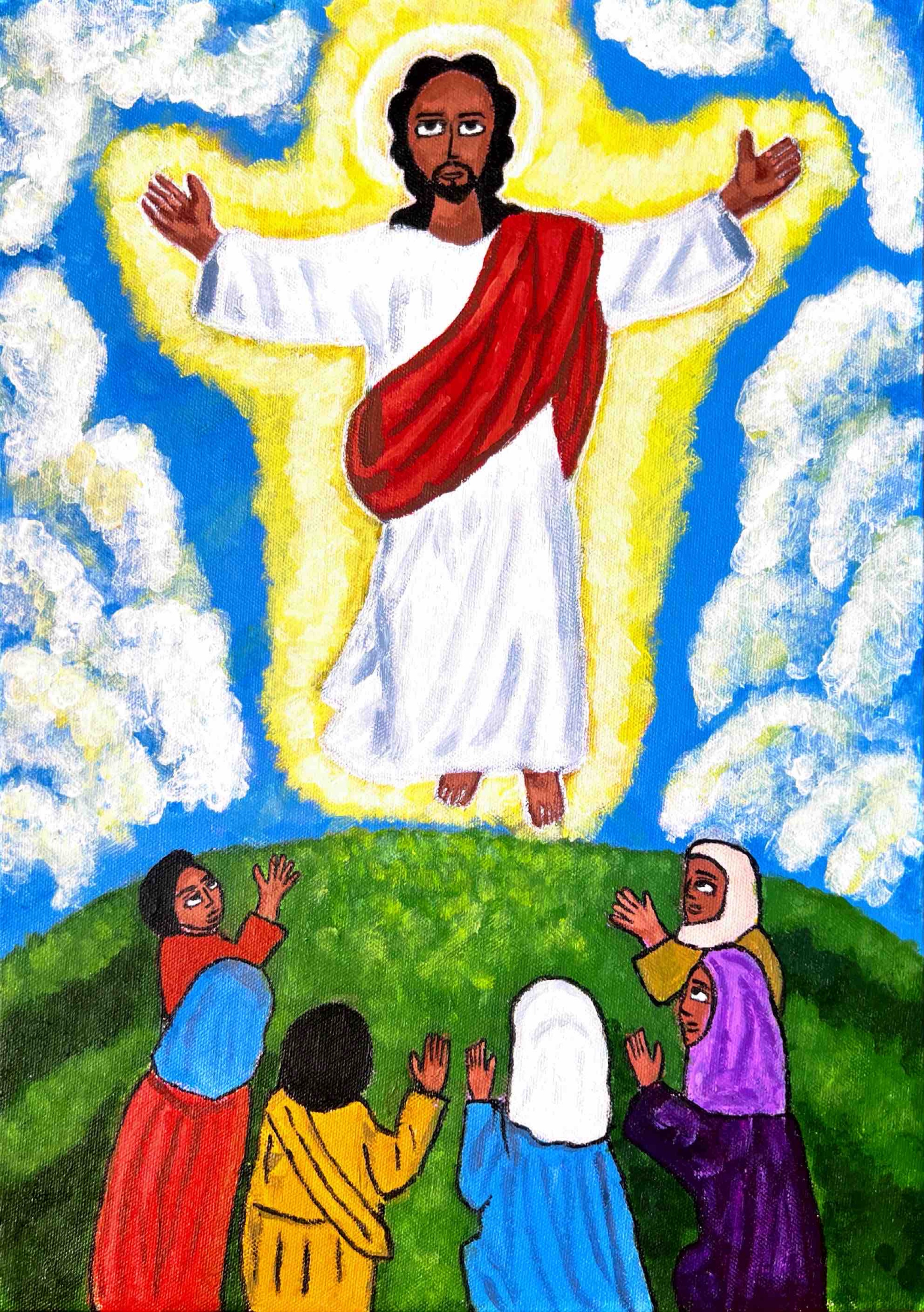
Black liberation theology gained traction in the 18th and 19th century, as people and ideas traveled between Africa and the United States. As those enslaved in the United States began to have access to Bibles, they began to identify with the characters and histories of Biblical enslavement – Israelites forcibly displaced, in comparison to the European’s Pharaoh-like inhumanity. This idea, grounded in further biblical reality and prophecy than I will include here, contributed to the spread of images of Black Jesus and religious movements of Black unity like Rastafarianism (3).
Ethiopian images of Jesus and the Gospels, have however, existed for as long as Christianity. These images were not widely proliferated (until the last hundred or so years) on account of both their geographical remoteness and the holiness of the images that prohibited them from being displayed during ordinary Orthodox liturgy, let alone in a household context (4). These icons can be distinguished by features such as a limited palette of specific pigments of red, yellow, black, and indigo, the lattermost being imported from India. According to iconographer Dr. Christopher Gosey, “The primary distinction of Ethiopian icons lies in the canonical rules governing every inch of subject matter. These unwritten rules, firmly established by the 17th century, are still adhered to by artists” (5). The rules relate to the composition of the art, and stylizations such as large eyed figures for emotional connection, as the icons are for spiritual devotion not realism. Though there are many Ethiopian icons of Christ and the saints that are hundreds of years older and more, there are at least as many modern recreations. This painting is based on a combination of several references, and while it draws on the style, does not strictly adhere to Ethiopian iconography rules.
1. Blum, Edward J., Keri Day, Rabia Gregory, Paul Harvey, Elizabeth McAlister, and Charles Price. “The Colors of Christ in the Diaspora of Africana Religions.” Journal of Africana Religions 2, no. 3 (2014): 379. https://doi.org/10.5325/jafrireli.2.3.0379.
2. Price, Charles. “The Cultural Production of a Black Messiah: Ethiopianism and the Rastafari.” Journal of Africana Religions 2, no. 3 (2014): 424. https://doi.org/10.5325/jafrireli.2.3.0379.
3. Price, 423
4. Gosey, Christopher. “Icons and the Hidden Empire.” Journal on Religion, Art and Architecture, Fall 1996. https://stambroseraleigh.org/wp-content/uploads/2021/08/Gosey_Magazine_Ethiopian_Icon_Article.pdf
5. Gosey, 18
-
White Jesus. Many know him simply as Jesus. He looms, ever serene, ever powerful, ever idolatrous and propaganda of the supremacist empire. His has a long history and an extensive present. One of the original driving factors for his ostensibly credible existence was a falsified document, produced around the 15th century but claiming to be a letter from Publius Lentulus, procurator of Judea to the Roman Senate during the reign of Tiberius Caesar (1). The Letter of Lentulus describes Jesus with “hair the color of an unripe hazelnut, smooth almost to his ears, but below his ears curling and rather darker and more shining, hanging over his shoulders, and having a parting in the middle of his head” (2). The description continues with Jesus's ruddy cheeks and grayish eyes, all physical characteristics typically consistent with someone with lighter skin than the Palestinian Jew had. A notable characteristic described in this painting is a forked beard, “not long but divided in two at the chin” (3). This apocryphal letter was popular in medieval and Renaissance Europe, and was influential in many representations of Christ (4).
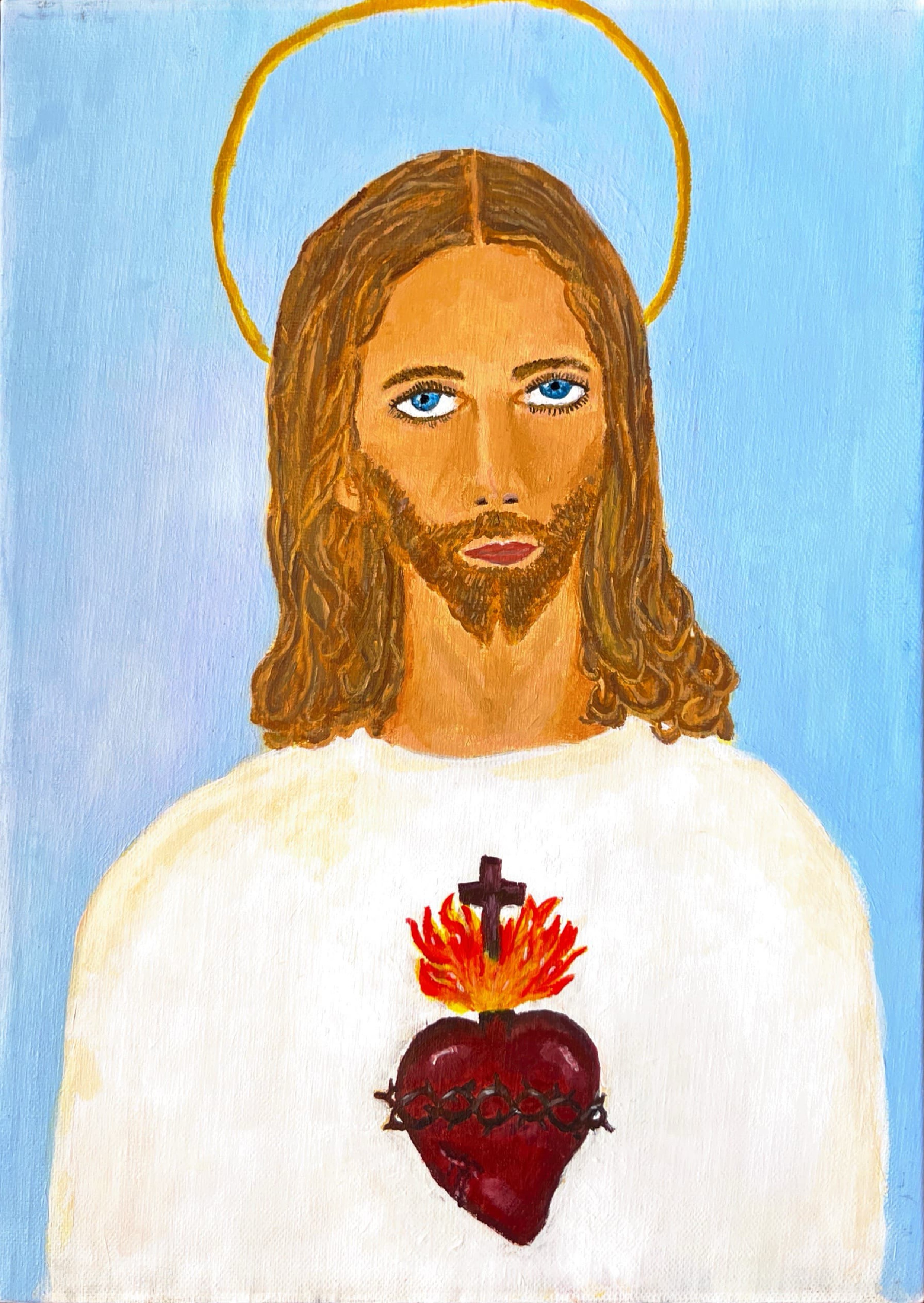
How then, did we get to the white Jesus of America today, so ubiquitous with the white Christian nationalism of American evangelicalism, that he has become a tool of an empire that opposes many of the very principles white Jesus’s namesake warned against? Edward Blum and Paul Harvery assert in their 2014 article, “The Colors of Christ in the Diaspora of Africana Religions” that “Jesus Christ did not become a power broker in the realm of race making and racialization until the late eighteenth century” (5). According to Blum, European Catholics had a range of Jesus imagery, but it was the American technologies of mass production in the nineteenth century that catapulted white Jesus to the face of American nationalism, despite the Protestant opposition to Catholic imagery. “By then [the twentieth century], though, the irony was complete, for a country settled in part by Protestant iconoclasts seeking an escape from papist imagery and ritual had become the largest producer and exporter of internationally marketed sacred imagery in world history” (6). Images like Warner Sallman’s 1941 Head of Christ, a portrait of Christ with the features of light hair, pale skin, ruddy cheeks, and a forked bear, are proven to have shaped racial and aesthetic beliefs about Jesus, with a significant number of Americans believing Sallman’s portrait to be true to history, or even photographic (7).
Despite all the evidence against him, white Jesus’s image continues to function around the world. In Haiti, white Jesus stares serenely from paintings and public art around the country. According to Elizabeth Mcailister’s article, “The Color of Christ in Haiti,” “In the vast majority of Haitian art, even when the disciples or the three magi are depicted with dark complexions, the same canvas portrays Jesus with a much lighter complexion in comparison” (8). Though the United States often seems at the center of this phenomenon, empires do not exist in a vacuum. The proliferation of white Jesus everywhere, as it conceals the true history of Christ and masks the power of Jesus to identify with the oppressed, is harmful. Accepting whiteness as the baseline, and assuming portraits of white European Jesus as the standard are dangerous on accounts of both idolatry and falsely aligning Jesus with the oppressors of history, rather than squarely among the oppressed, where he existed (9). These images are not isolated or inconsequential. In the words of Dr. David de La Fuente, “Evocative as Head of Christ might be, it makes a claim about the person of Christ that betrays his historical particularity” (10). An essential facet of American Christian nationalism is the ever-looming threat of opposition. A militant Jesus can seem just in the face of perceived danger, and white Jesus’s name has been invoked in all sorts of derogatory politics. A Jesus who is so far removed from his context that he becomes an entirely different figure is one who threatens the most vulnerable and oppressed, the margins of the margins where historical Jesus operated.
1. Lutz, Cora E. “The Letter of Lentulus Describing Christ.” The Yale University Library Gazette 50, no. 2 (1975): 91–97. http://www.jstor.org.avoserv2.library.fordham.edu/stable/40858588.
2. Lutz, 93
3. Lutz, 93
4. Kirkham, Victoria. “Laura Battiferra’s ‘Letter from Lentulus’ and the Likeness of Christ in Renaissance Italy.” I Tatti Studies 22, no. 2 (2019): 239–72. https://www-jstor-org.avoserv2.library.fordham.edu/stable/26909346.
5. Blum, Edward J., Keri Day, Rabia Gregory, Paul Harvey, Elizabeth McAlister, and Charles Price. “The Colors of Christ in the Diaspora of Africana Religions.” Journal of Africana Religions 2, no. 3 (2014): 379. https://doi.org/10.5325/jafrireli.2.3.0379.
6. Blum, 380
7. De la Fuente, David. “The Saturated Flesh of Christ: Christology, Aesthetics, and Subjectivity in Jean-Luc Marion and M. Shawn Copeland” 2023 Bloomsbury Academic.
8. Mcalister, Elizabeth. “The Color of Christ in Haiti.” pg 411
9. De la Fuente, 193
10. De la Fuente, 188
-
In a slightly different vein than the other works in this series, this painting was inspired by an exhibit of work from artist Wilfredo Lam entitled “When I Don’t Sleep, I Dream” at the Museum of Modern Art (MoMA). Lam (1902-1982) was a Cuban artist of African and Chinese descent, whose paintings “expanded the horizons of modernism by creating a meaningful space for the beauty and depth of Black diasporic culture” (1). When he was 21, Lam was awarded a grant to go to Europe to study painting, and he first went to Spain to study portraits. He later went to Paris, where he met Picasso and their contemporaries, and became a member of the Surrealist movement (2). The artists had to flee in 1940 because of the German troops, first to Marseille, and then Lam returned to Cuba when he was denied entry into the countries his counterparts were entering (United States, as well as Mexico). During his practice in Cuba, Lam began to turn to themes of transformation, drawing elements of various Afro-Carribean religions. Though he was very much involved in the surrealist and affiliated movements, because of his mixed identity Lam has been disregarded from mainstream art history (3). According to the curators of the MoMA exhibit, this was “the first retrospective in the United States to feature the full trajectory of Lam’s remarkable vision, inviting us to see the world anew” (4), and that the issues he focused on and the art he made is still very relevant today, making the public display of his work imperative.
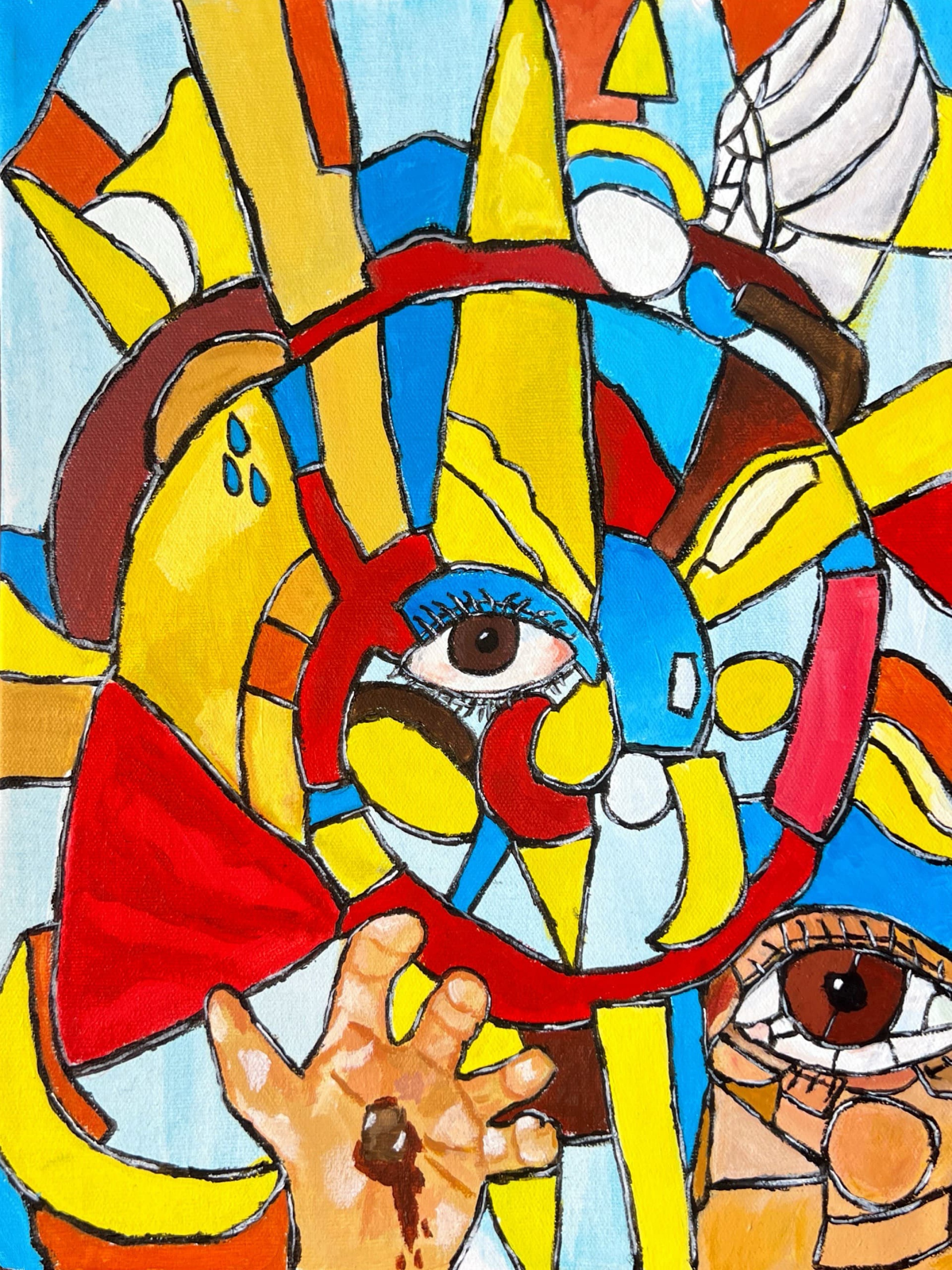
The crucifixion of Jesus is another omnirelevant concept. I’ve seen it portrayed in a variety of ways, with countless “relatistic” portrayals of various Jesuses, and a few abstract versions as well. My goal here was leaning into some of the elements that I felt like couldn’t be portrayed in another way. The main compositional element of the painting is a spiral, and the various colorful shapes are meant to be evocative of stained glass. The tears of Mary are in the top left, and the two eyes are loosely based off of the famous icon “St. Catherine’s Pantocrator,” or the “Sinai Pantocrator,” from 550 AD. This icon portrays the human and divine natures of Christ, where the face is not symmetrical, noticeably the eyes as one is supposed to be the eye of man and the other the eye of God (5). Through the various other elements within the stained glass, the painting attempts to put on canvas some of the fear, confusion, and uncertainty of the crucifixion, both the historical event and the experience of so many people who pray, contemplate, and reflect on the crucifixion.
1. “When I Don’t Sleep, I Dream.” Museum of Modern Art. Exhibitions and events. Nov 10, 2025–Apr 11, 2026. https://www.moma.org/calendar/exhibitions/5788
2. MoMA, 4:20
3. “Wilfredo Lam: The Power of Art, Exile, and Transformation.” The Museum of Modern Art. November 2025. https://www.youtube.com/watch?v=MTnxXkttgdo&t=34s
4. MoMa Exhibitions, 2026
-
Though images of today conjure up an image of Jesus that is clean and pure, images we associate with holiness, Jesus was very much a person existing in the first century, who even from his birth came into the world with none of the comforts of modern sanitation or care. Throughout his life with the people on the margins of society and into his gruesome and painful death, he was very much embodied in the flesh. Even my paintings are sterile – homeless Jesus lies unmoving on a bench, smelling of nothing but acrylic and linen.
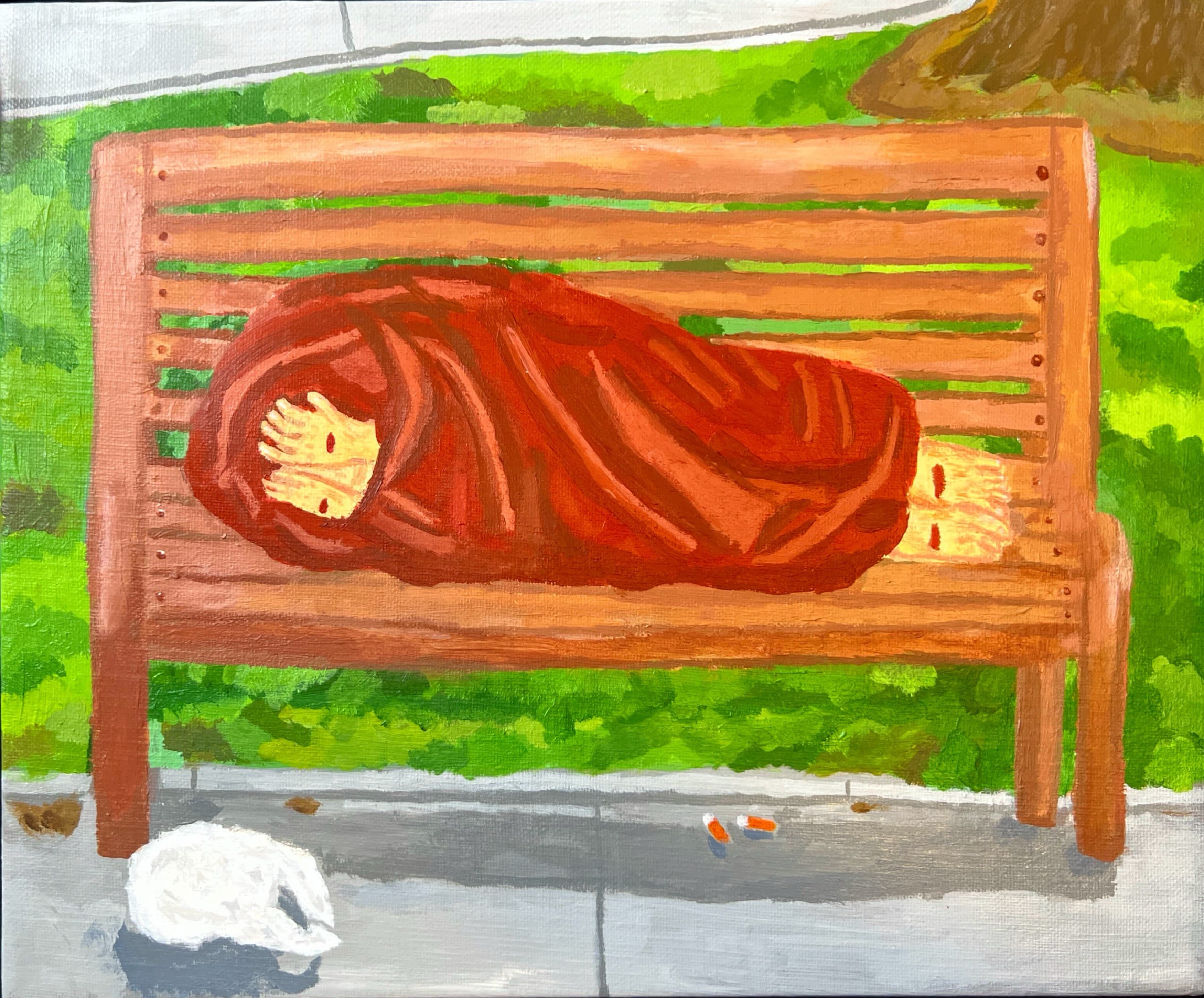
Like disabled Jesus, homeless Jesus recognizes the identity of Jesus as someone among those whose physical dignity has been compromised. God comes in the form of those who are weak and poor to shame those who are strong and wealthy in this world (1). Jesus Christ is a subversion of power. Thomas Dicken, author of “Homeless God” puts it this way: “The perverse core of Christianity lies in being a weak force.” God has chosen the weak things of the world. Weak theology is a theology of the cross. Prayer is crucial in our relation to God, but prayer needs to itself be understood as “weak” (2).
I drew inspiration from the controversial Homeless Jesus statues, first at St. Peter’s University in Toronto (3). The creator is Catholic sculptor Timothy Schmalz. His intent was to represent the Gospel of Matthew and the idea that “ whatever you did for one of the least of these brothers and sisters of mine, you did for me” (4). The reactions have been as strong as the piece itself. Following the 2014 installation of one of these statutes outside a church in North Car, a woman called the police on Jesus. According to NPR, Schmalz offered the first casts to St. Michael's Cathedral in Toronto and St. Patrick's Cathedral in New York. They both declined (5). The idea behind this painting was the same. Unhoused people often challenge our convictions of loving our neighbors, because sometimes our neighbors are smelling, rude, or otherwise unpleasant. Striving to love as radically as Jesus means challenging these preconceived judgements about others.
Inextricably from identifying Jesus among the homeless is understanding Jesus’s identity as a victim of sexual abuse. For the authors of the paper, “Rocío Figueroa Alvear and David Tombs. “Recognising Jesus as a Victim of Sexual Abuse: Responses from Sodalicio Survivors in Peru,” the evidence comes directly from the text. “When we refer to Christ as a victim of sexual abuse, we are recognising that the Gospels make clear that the crucifixion of Jesus involved severe sexual humiliation when he was stripped and exposed naked” (6). Their argument is that when Jesus is recognized as a victim of a similar type to those in the Church who have been abused, “the need to consider the implications of this for other forms of sexual abuse becomes unavoidable and long overdue.” Though the intricate reality of homelessness and sexual abuse is not explicitly part of this painting, it was prevalent in the numbers and research I did for the painting. 90% of homeless women have experienced physical or sexual abuse; 70% of homeless mothers in were physically assaulted by someone they knew. There is an inexhaustible amount of ways to conceive of Jesus as a person on the margins, throughout history and in the present. The scope of this project was just eight paintings, and this is another piece of evidence that this project, like all research, could always be expanded upon.
1. 1 Cor. 1:27
2. Dicken, Thomas M. “The Homeless God.” The Journal of Religion, vol. 91, no. 2, 2011, pp. 127–57. JSTOR, https://doi-org.avoserv2.library.fordham.edu/10.1086/658106 . Accessed 24 Mar. 2026.
3. Burnett, John. “Statue Of A Homeless Jesus Startles A Wealthy Community.” NPR. April 2014. https://www.npr.org/2014/04/13/302019921/statue-of-a-homeless-jesus-startles-a-wealthy-community
4. Matthew 25:40
5. Burnett, 2014
6. Rocío Figueroa Alvear and David Tombs. “Recognising Jesus as a Victim of Sexual Abuse: Responses from Sodalicio Survivors in Peru.” Series Editor: David Tombs © Centre for Theology and Public Issues, University of Otago, 2019. www.otago.ac.nz/ctpi. First published 15 February 2019. This version 5 April 2019.
7. Rocia and Tombs, 3
8. https://www.safeaustin.org/homelessness-among-abuse-survivors-a-deepening-crisis/
-
“It is not enough to simply state that Jesus reveals divine love (in a beautiful painting or otherwise), for God’s givenness in Christ as a saturated phenomenon appears not merely in an absolute sense, but in concrete cultural and historical circumstances — that is, in the flesh of a Palestinian Jew during the era of the Second Temple amidst the reality of the Roman Empire” (1).
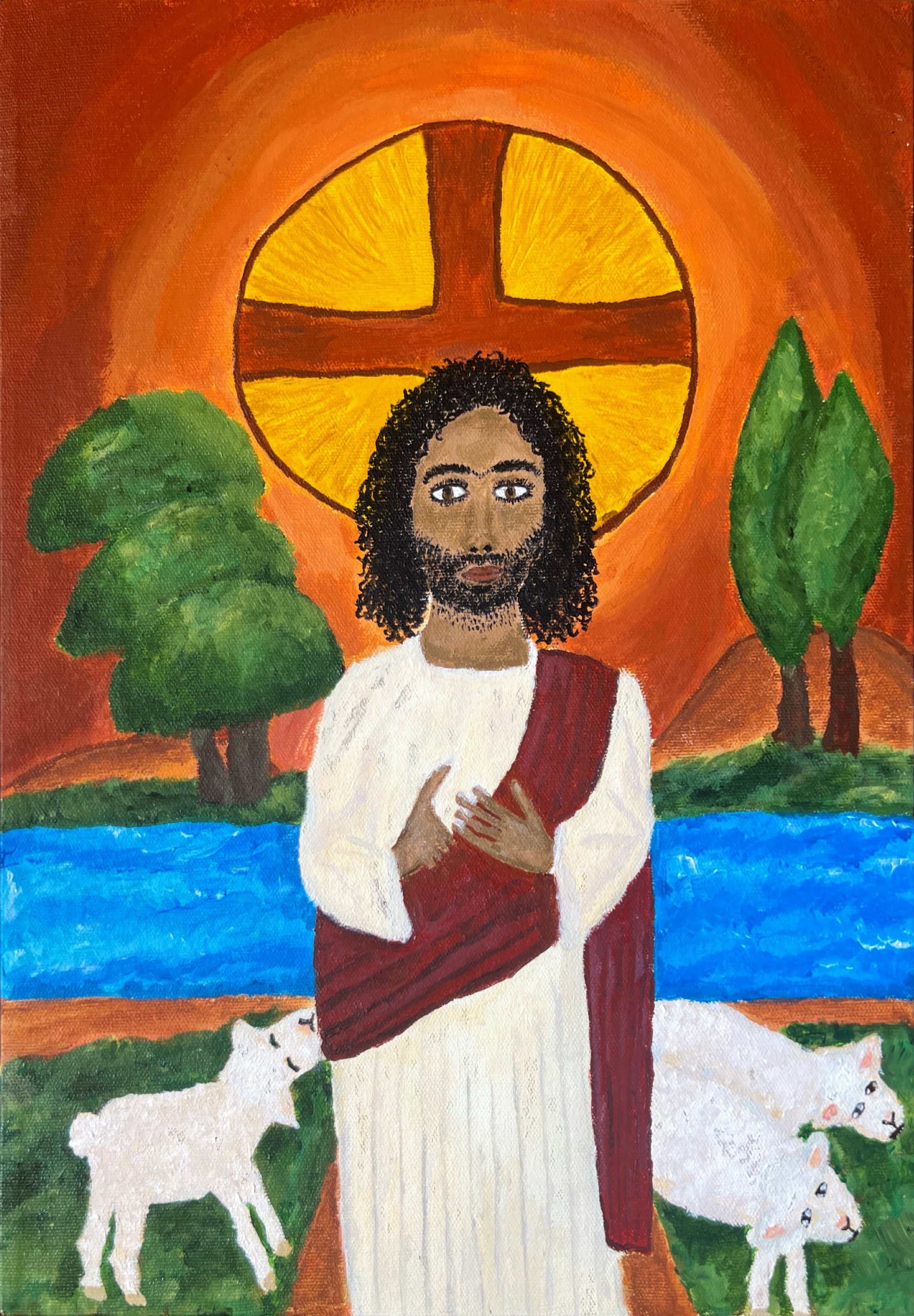
This is the first painting I completed at the start of this fellowship in July, 2025. I began with a consideration and depiction of historically accurate (Levantine) Jesus, which surfaces primarily in efforts to combat the overwhelming tendency of the West to depict him as white. According to theologian James Cone, “There can be no Christian theology which does not have Jesus Christ as its point of departure” (2). The region in which Jesus was born, lived, and preached, was the Levant, which consists of Palestine, Israel, Jordin, Lebanon, and Syria. Beginning with the birth of Jesus, we find ourselves in Bethlehem, in Judea. This puts us in the West Bank of Palestine, an area under siege right now. The young family then fled to Egypt (modern day Egypt) to escape Herod’s persecution, and later returned to Nazareth in Galilee (on our maps Northern Israel) (3).
Jesus’s life under the Roman Empire was also marked by political strife (4), and it is therefore impossible for us to look at the life of Christ without confronting the genocide happening in the very land he was born. In deciding the classification of the atrocities committed by Israel, the United Nations “examined the Israeli military operations in Gaza, including killing and seriously harming unprecedented numbers of Palestinians; imposing a total siege, including blocking humanitarian aid leading to starvation; systematically destroying the healthcare and education systems in Gaza; committing systematic acts of sexual and gender based violence” as well as “directly targeting children; carrying out systematic and widespread attacks on religious and cultural sites; and disregarding the orders of the International Court of Justice” (5) The figure of Jesus today therefore cannot be stripped of his geographical and political identity, someone whose message was loving one's enemies and who sacrificed his life for the sins of others.
In this painting, the person of Jesus is modelled after people from the region of the Middle East and North Africa, and the background elements and clothes are based on Syrian (6) and Coptic (7) icons. I tried to combine the stylistic elements from these icons with a Levantine Jesus of the same style as the depictions of white Jesus that permeate our society.
1. De la Fuente, David. “The Saturated Flesh of Christ: Christology, Aesthetics, and Subjectivity in Jean-Luc Marion and M. Shawn Copeland” 2023 Bloomsbury Academic. 192
2. Cone, James. “A Black Theology of Liberation.” Orbis Books, 1986. 5
3. “New Testament Maps.” Yale Bible Study, Yale Divinity School. https://yalebiblestudy.org/resources/new-testament-maps/
4. Whittaker, John. “Christianity and Morality in the Roman Empire.” Vigiliae Christianae 33, no. 3 (1979): 209–25. https://doi-org.avoserv2.library.fordham.edu/10.2307/1583439.
5. “Israel has committed genocide in the Gaza Strip, UN Commission finds.” September 2025. https://www.ohchr.org/en/press-releases/2025/09/israel-has-committed-genocide-gaza-strip-un-commission-finds
6. “Department of Syriac Studies” Syriac Orthodox Patriarchate of Antioch, His Holiness, Mor Ignatius Aphrem II, January 2015 https://dss-syriacpatriarchate.org/syriac-arts/various-icons/?lang=en#
-
“Jesus Christ the disabled God is consonant with the image of Jesus Christ the stigmatized Jew, person of color, and representative of the poor and hungry – those who have struggled to maintain the integrity and dignity of their bodies in the face of physical mutilation of injustice and rituals of bodily degradation” (1).
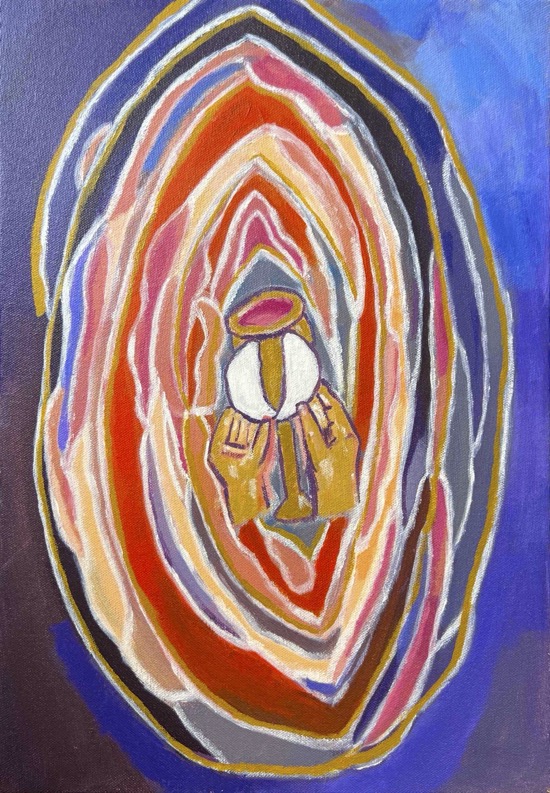
As various disability liberation theologians point out, understanding Jesus, and God, as part of and in communion with the disabled is not a conflation or overstep, it is canon (2). It is, however, as all theology of the trinity, not immediately straightforward or simple. Various ideas are put forth in the attempt to understand and access God from a framework of disability, and then those are critiqued themselves to be more inclusive. Disabled Christ (Abstract), examines ideas of disability liberation theology, primarily highlighting the ideas of the wound on Jesus’s side as a receptive force in the church, and the significance of the form in which we receive Jesus’s – literally broken.
One point of contention when understanding Jesus as physically disabled – the stigmata. The wounds of crucifixion, on the hands and feet of Jesus, as well as the spear opening on his side that Thomas probes, and the injuries from the crown of thorns. Jesus was resurrected with all of these bodily impairments, and thus too shall disabilities remain in heaven. The problem with this logic for disability theologians can be distilled twofold for our purposes. First, the wounds of crucifixion are the direct result of sin. The physical manifestation of his self-emptying love is not extractable from torturing, death, suffering, and human sin. Though some impairments result from tragic events, being disabled is not a sin, having a disability does not equate a lifetime of suffering, and disability theologians argue that lineage can further unwanted associations between the two. This leads to the second problem with focusing on Jesus’s bodily wounds as a reason for disabilities existing in heaven, which is that a main problem disabled people face is not their condition but ableism, discrimination, and lack of access. Many disabled people were born with their disability, coming from God and unrelated to sin. The reason they would not be disabled in heaven is not because they would be healed, but because the lack of access and discrimination in our earthly world would not exist in heaven.
Furthermore, this painting examines the idea of disabled people created Imago Dei – in God’s image. Disabled Liberation theology argues that we are created in the image of a disabled God. The portrayal of God as completely self-sufficient and independent is not in accordance with God becoming human through Jesus. Powell argues that, “too often this sociocultural value for humanity is projected with superlative status for God” (3). In fact, the Eucharist as a sacrament, is a time when the Church gathers around the broken body of Christ, perpetually remembering his sacrifice for our sins and continual disability (4).
In terms of the wound on Jesus’s side, the painting entitled “The Incredulity of Saint Thomas” by Caravaggio (5) visualized the idea of Thomas probing the wound in Jesus’s side, in order to see proof that Christ was truly killed and risen again. The specific action happening is the penetration of Thomas’s finger into the opening in Jesus’s body, suggestive of a heterosexual relation of sex. Though this raises questions of a potentially intersex understanding of Jesus, the main conflation has been the opening as the womb of the church that Jesus births. This strengthens the association of women's lives with both physical pain and death (the crucifixion) and their role as simply a receptive womb in comparison to phallic agency (6). While this idea of the womb-wound is flawed, the concept was one I wanted to examine in my painting. I think that with intention, it is possible to think about the idea of the womb without subscribing uncritically to all of the potentially harmful aspects of this metaphor, or believing that wombs are equivalent with femininity or a lack of agency.
1. Eisland, Nancy. “The Disabled God: Toward a Liberatory Theology of Disability.” Abingdon Press, 1994. Pg 102
2. Powell, Lisa. “The Disabled God Revisited:Trinity, Christology, and Liberation.” T&T Clark Bloomsbury Publishing Plc. 2023. Pg 37
3. Powell, 55
4. Powel, 2
5. https://scotland.op.org/caravaggios-doubting-thomas/
6. Powell, 88