AI won’t deliver until we expand access and education
AI’s potential has yet to be translated into performance, but the problem isn't the technology. Translating AI’s incredible capabilities into real-world value will depend on the capabilities of the human beings who use it—and the principles that guide its use.
Lerzan Aksoy, Dean, Gabelli School of Business



In my conversations with executives across industries, I hear the same expectation again and again: That investments in artificial intelligence will unlock new levels of productivity and growth. But the evidence suggests AI’s potential has yet to be translated into performance.
A recent enterprise study from M.I.T. found that, despite staggering investment, the vast majority of generative AI initiatives— 95%—have not produced measurable financial returns for businesses. At the macro-level, the anticipated gains are even harder to detect. An analysis from the Federal Reserve found that AI has yet to make a meaningful contribution to overall economic productivity, and Goldman Sachs’s chief economist recently observed that it contributed “basically zero” to GDP growth last year.
Embracing AI’s potential
The problem is not the technology. As dean of the Gabelli School of Business at Fordham, I know that today’s AI models are already capable of helping organizations solve complex problems with greater clarity and speed. The problem is education and access. Translating AI’s incredible capabilities into real-world value will depend on the capabilities of the human beings who use it and the principles that guide its use.
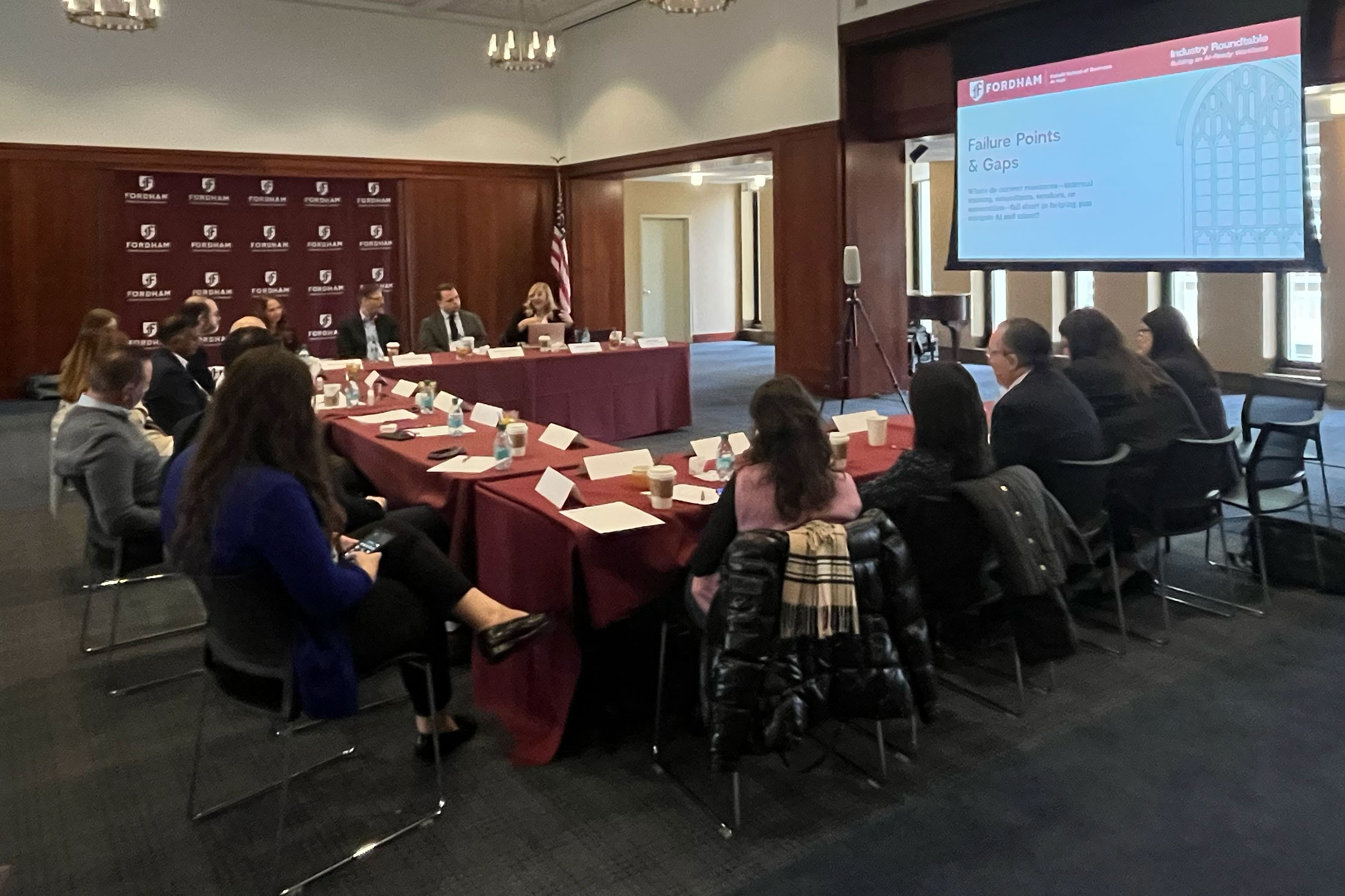
Insights from business leaders reinforce this picture. At an industry roundtable at the Gabelli School, I spoke with executives at top companies who overwhelmingly agreed that the core challenge is not the sophistication of the technology, but whether leaders are prepared to embrace its potential.
What does that mean in practice? It means fundamentally rethinking how work gets done. For example, I recently met an executive at a large financial services firm who told me about how the firm had used AI to make targeted improvements to its sales process. The firm asked the tool to analyze thousands of client interactions and identify the key behaviors of the most effective sales professionals. Managers then fed those insights back into training programs, improving performance at scale. The technology itself was not the breakthrough, but the way leaders deployed it and empowered their teams to act on what the data revealed was.
During the roundtable, executives also reported a challenge with workforce readiness. Adaptability is essential for workers in the age of AI. So, too, is the ability to think critically about how and when to apply the technology, and the judgment to recognize its limitations as well as its strengths.
This is where universities have a critical role to play. In a world where AI can handle many routine tasks, distinctly human skills like sound reasoning, ethical decision-making, and communication have become even more valuable. As business educators, we must teach our students to not only use AI, but to lead with it responsibly.
A hub for ethical, people-first AI
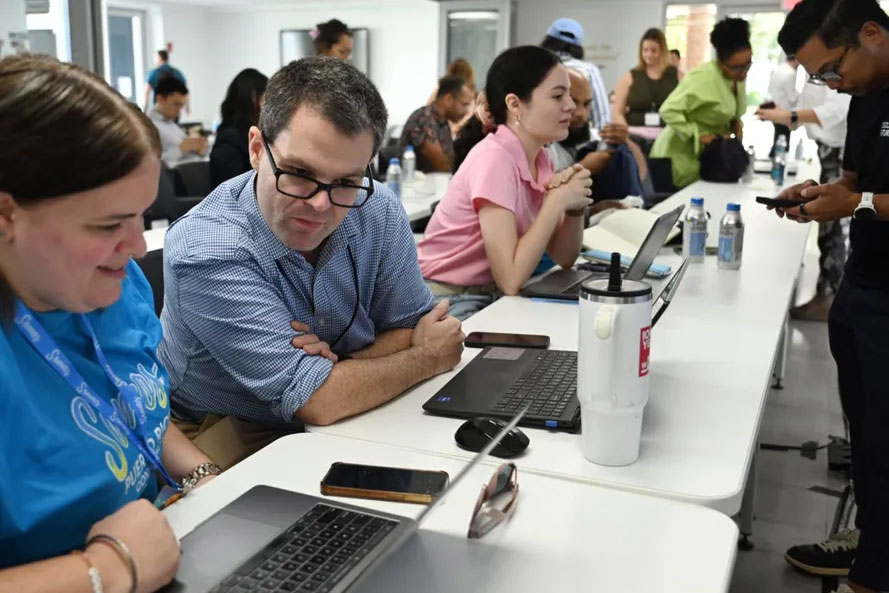
Of course, preparing students is only part of the equation. Organizations also need support, particularly those that may lack the resources to implement AI effectively on their own. That is precisely why we launched the AI Business Hub at the Gabelli School. The Hub is designed to help organizations develop AI-ready talent, integrate AI responsibly, and build partnerships that accelerate impact. When the physical space is complete, it will be dedicated to upskilling and reskilling the workforce, while also powering innovation through applied research.
Ensuring the power of AI is accessible to all is critical. To that end, we are expanding access to AI education through initiatives like a new Coursera-based certification program. Beginning with our undergraduate seniors and extending to community partners and small- to medium-sized enterprises, this program is designed to make AI literacy more broadly available. Because if AI is to deliver on its promise, it must be guided by a diverse set of competent, responsible leaders.
As Pope Francis reminded us in Laudato si’, “We have to accept that technological products are not neutral… Decisions which may seem purely instrumental are in reality decisions about the kind of society we want to build.”
Transformation is coming. The shape that it takes—and who benefits—will not be defined by AI’s capabilities, but by the judgment, responsibility, and sense of purpose we bring to it.
Lerzan Aksoy is Dean, George N. Jean Ph.D. Chair, and Professor of Marketing at Fordham University’s Gabelli School of Business. Learn more about how Fordham is moving from inquiry to impact.