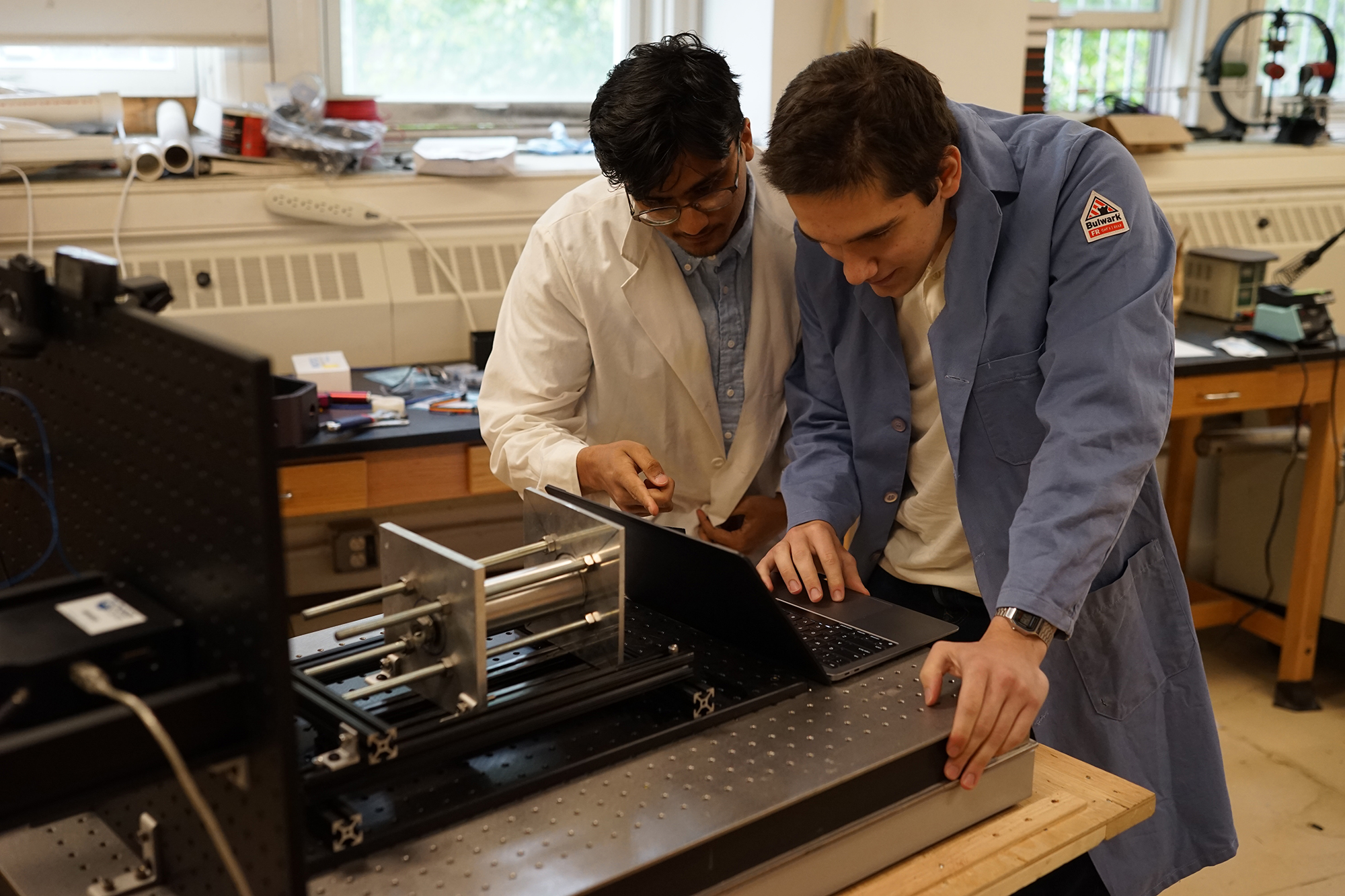
 Saba Mumladze and Azhar Ahmed examine a hybrid rocket engine in a Fordham physics lab. (Photos by Kelly Prinz)
Saba Mumladze was interning at Vaya Space when he started looking into new ways to test hybrid rocket engines.
The usual method is time consuming. “We basically build the rocket, we test the rocket a thousand times, and eventually we figure out how we can predict how it's going to work,” says Mumladze, an engineering physics major. “But that process is expensive and inefficient.”
His goal was to find a better approach. Working with Vaya Space, he began investigating how the flame inside the hybrid engine—which combines solid and liquid or gas propellants—could provide data to create a more accurate formula for success. If they knew how hot the flame was, they could predict flight patterns without building every engine from scratch. But taking the temperature of a rocket flame is no easy task.
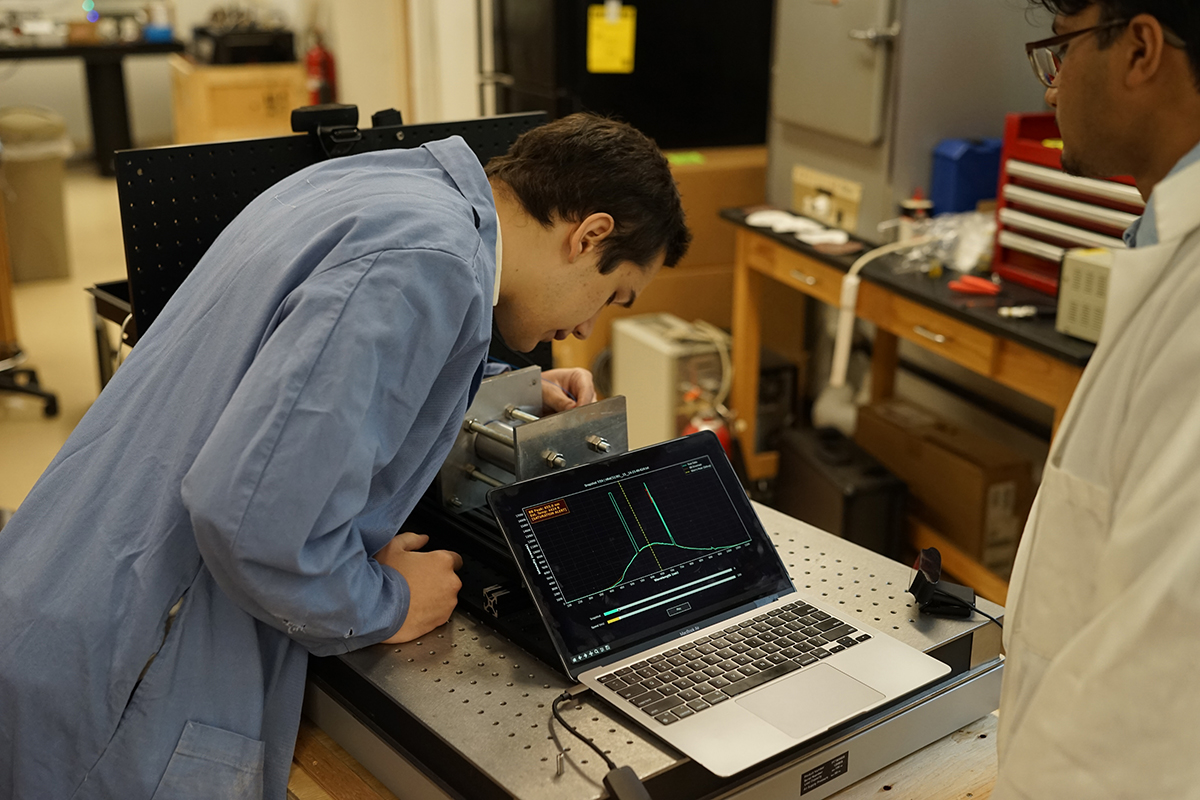 Saba Mumladze and Azhar Ahmed check the connections from the rocket engine to the computer.
Finding a Small Solution to a Big Problem
After taking an optics class with Professor Stephen Holler, Mumladze had a eureka moment: What if they used photons? Could those tiny particles of light and electromagnetic energy help scientists gather information about the flame’s temperature?
“I started tackling this alone, and it was really hard, and I realized I really needed someone that was better at physics than I am,” he said.
Enter Azhar Ahmed, a physics major at Fordham who had already conducted research projects involving optical fibers.
Together, the two have been building a hybrid rocket engine in a Fordham lab. It works with nitrous oxide and includes a fiber optic cable for collecting the photon data.
“As a physics major, a lot of my intuition has been grounded in math, in perfectionism, in being very meticulous,” Ahmed says. “Saba throws that out the window and is like, ‘Why don’t we just try it?’”
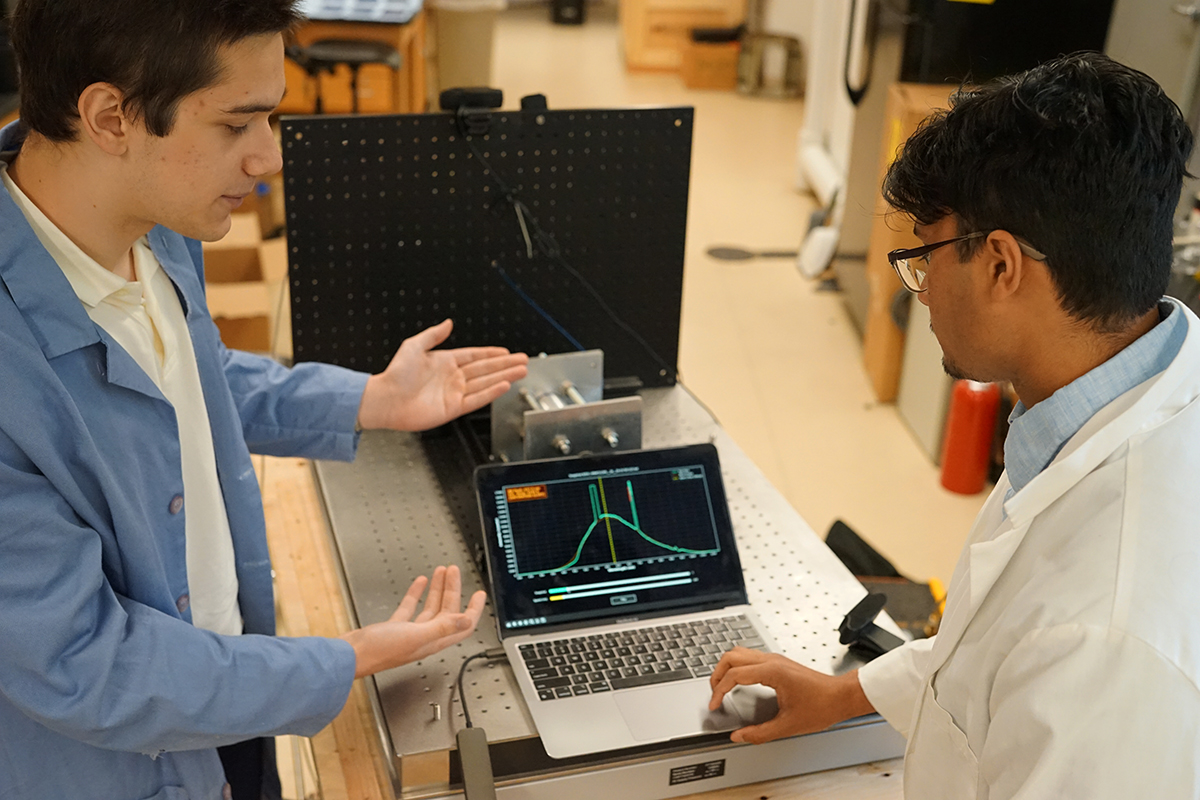 Saba Mumladze and Azhar Ahmed explain the readings from inside the rocket engine.
How the Society of Physics Launches Ideas—and Friendships
Research isn’t the only way this dynamic duo has teamed up. Ahmed and Mumladze have been the president and vice president, respectively, of Fordham’s chapter of the Society of Physics Students (SPS).
The club draws many students from Fordham’s Gabelli School of Business, and even non-science majors in the arts and humanities are building their own projects, Mumladze says. “It’s just a very warm and welcoming community. And they pick up technical skills that they find applications for in their humanities classes.”
Being a member of SPS also allows students to join professional organizations and attend conferences where they can make connections with industry leaders.
“I went to TechCon, which is a push to improve interest in semiconductor physics and photonic integrated circuits,” Ahmed says. “I met many workers at Intel, at TSMC, at Global Foundries, Microsoft—think of all the biggest tech companies, and they were all there talking to students about how they can get involved in this space.”
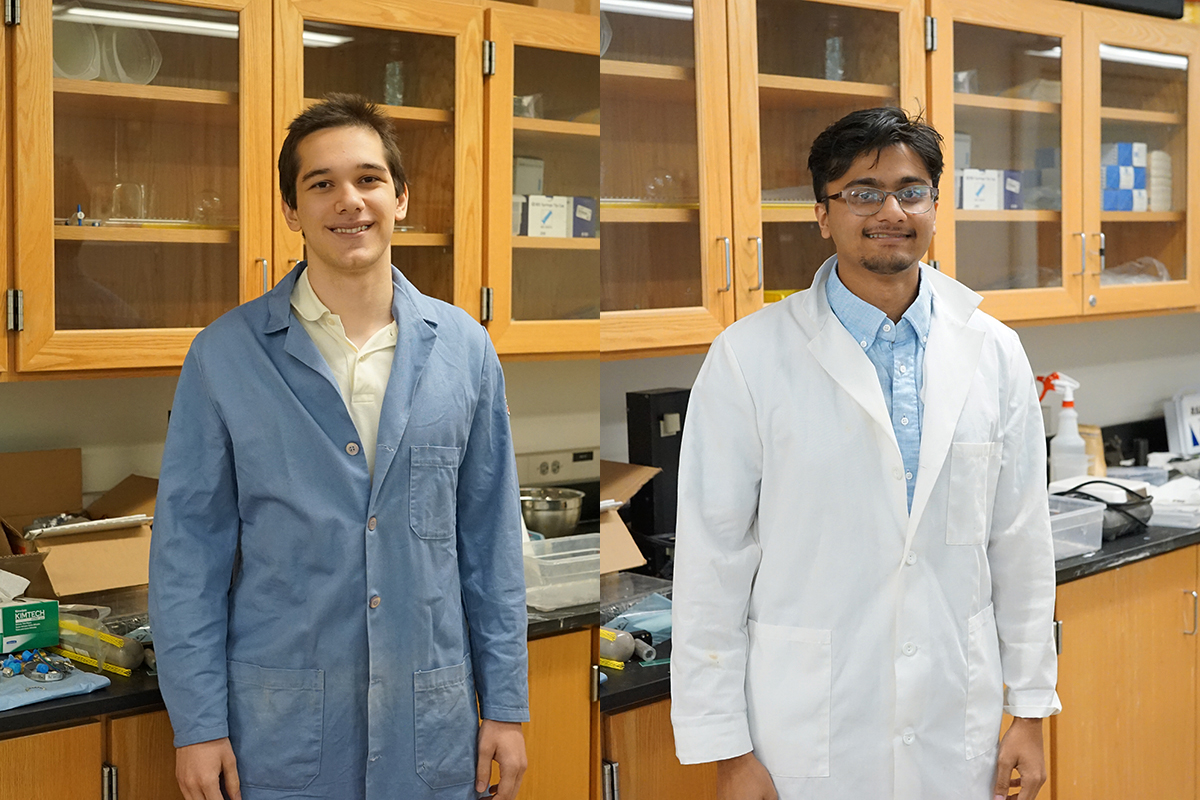 Saba Mumladze and Azhar Ahmed
Turning Hands-on Experience into Future Paths
Ahmed credits his Fordham experiences, including summer research opportunities at the University of Michigan and at Washington University, with helping him earn a spot in an electrical and computer engineering graduate program at the University of Illinois.
The same photons helping Saba gauge the temperature of rocket flames could be a key to powering AI data centers and mobile phones more efficiently, Ahmed says. In graduate school, he’ll be working on photonic integrated circuits, which could replace heat-intensive electronic ones.
“Once you scale them up, you can use them in data centers and other television systems and communications networks, which is so much better,” he says. “Photons are a lot more useful because you use less heat, which means AI data centers could be a lot less intensive on the energy grid and a lot more environmentally friendly.”
As for Mumladze, he’s a part of Fordham’s 3-2 cooperative program in engineering. After earning a bachelor's degree from Fordham in just three years, he'll be continuing his work at Columbia University, where he expects to earn a second bachelor's degree in just two years. After that, he hopes to continue his research at the graduate level.
And he plans to stay in touch with his Fordham lab partner and the professor who sparked the dynamic duo’s interest in engineering physics.
“Azhar tries to pull me towards these photonic integrated circuits and then I’m tugging him into space,” Mumladze says with a laugh. “Ultimately what ends up happening is Professor Holler secretly tugs us all into optics!”