Christian Arrechea didn’t always know he wanted to go into psychology—at first he thought he’d like to be a marine biologist.
But the more he learned, the more Arrechea discovered the possibilities the major might offer him.
“There’s so many routes to go down using psychology,” he said. “There were a lot of different opportunities.”
For Arrechea, one of those routes emerged as a passion—working with young people on their mental health. But he didn’t know where to begin.
The Importance of Mentorship
That all changed once Arrechea forged a relationship in meetings with his advisor at Fordham. There, Arrechea didn’t just get inspiration for his future path—he got the blueprint.
“She was like, ‘You need to do this, this, this, and this.’ And I was sitting there with a notebook open, writing all this stuff in,” Arrechea said. “If it wasn’t for that conversation, I don’t know if I would have been able to get [my plan for my major] off the ground.”
Gaining Hands-on Experience
After working with Fordham’s Career Center, Arrechea landed an internship in the psychology department at RWJ Barnabas Children’s Specialized Hospital, where he works directly with kids diagnosed with conditions like ADHD and obsessive-compulsive disorder.
He also co-led a research project through the psychology department’s innovative YPAR course. That stands for Youth Participatory Action Research, and it pairs Fordham students with Bronx high schoolers to identify issues in their community and create action plans to combat them.
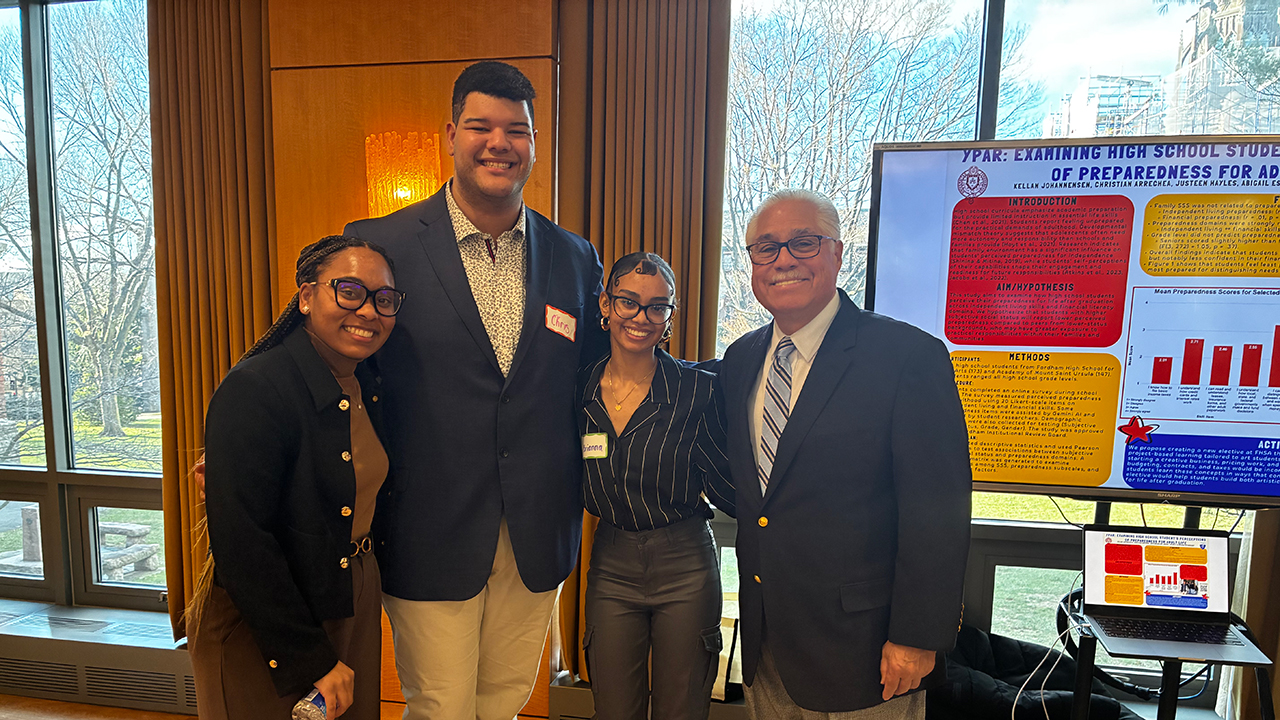 Christian Arrechea presents his YPAR research at Fordham.
Arrechea’s group focused on high school students’ perceptions of preparedness for adult life, particularly regarding financial literacy. Beyond teaching him concrete research skills, the challenging course helped Arrechea further his interest in supporting young people—and showed him how his field can help him make an impact.
“Now that I’m taking these types of courses, it’s really showing what Fordham is about,” he said. “It’s caring for the whole person, and caring for others.”
Combining Mental and Spiritual Health
While he’s building a strong foundation as a researcher, Arrechea also describes himself as a person of faith. To him, those disciplines aren’t contradictory—they’re two sides of what it means to care for the whole person.
“I think it’s an overlooked intersection of studies between ministry and psychology. You can understand more of a person if you get both sides,” he said. “Sometimes it’s not always a spiritual thing, sometimes it’s a mental thing.”
Arrechea was personally inspired by his own youth pastor, who provided him with direction and guidance when he was feeling lost.
“I think mental health and ministry going hand-in-hand really help,” he said. “I was like, ‘If I can do that for other people, that’d be really cool.’”
As Arrechea continues to explore his future, he says his mentorship and internship experiences at Fordham have boosted his confidence in himself and just how open his possibilities are.
“Not only did my professors make themselves available to discuss future plans, but the multitude of different classes helps you with figuring out what exactly you want to do with your psych degree,” he said. “I definitely feel a lot more prepared.”