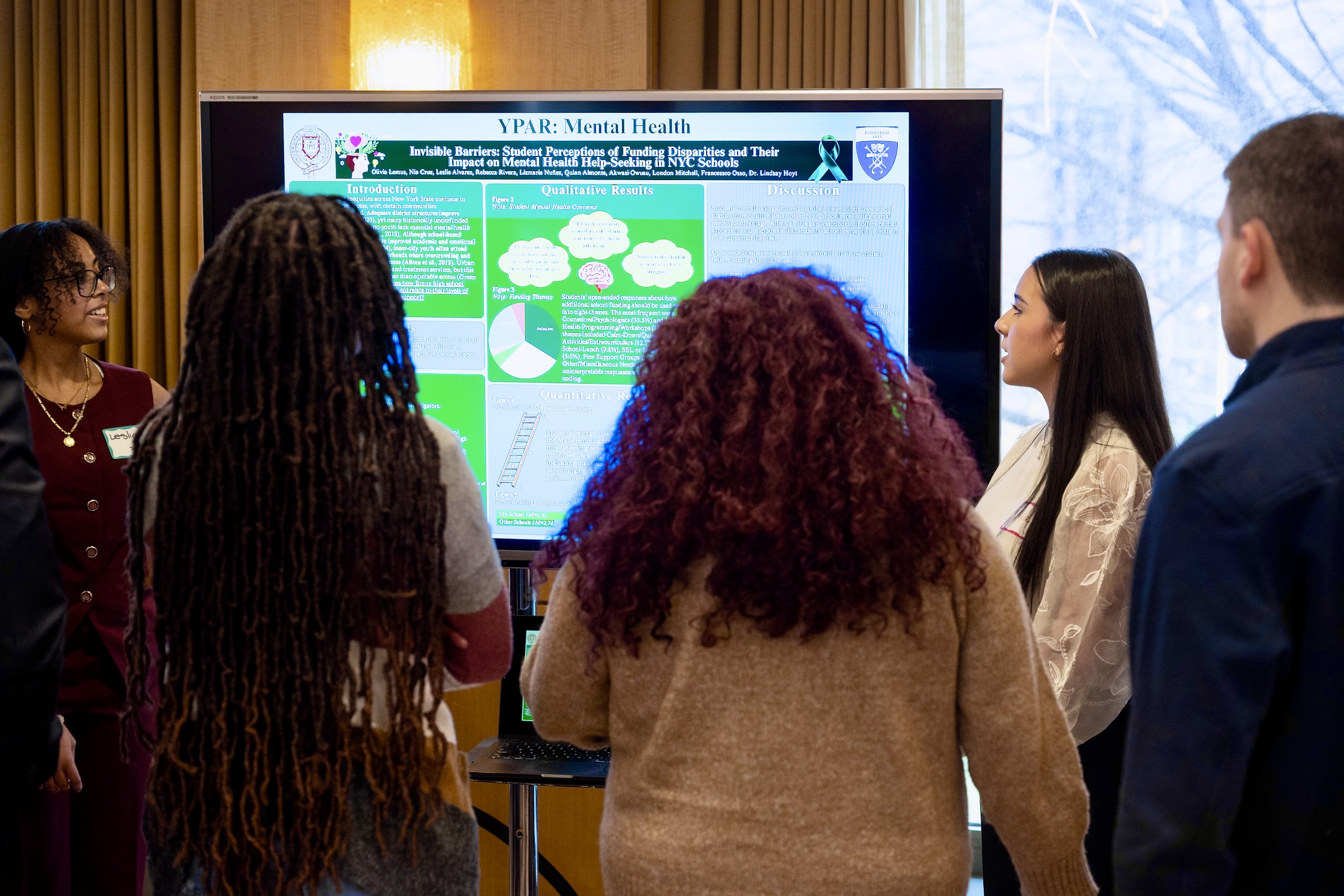
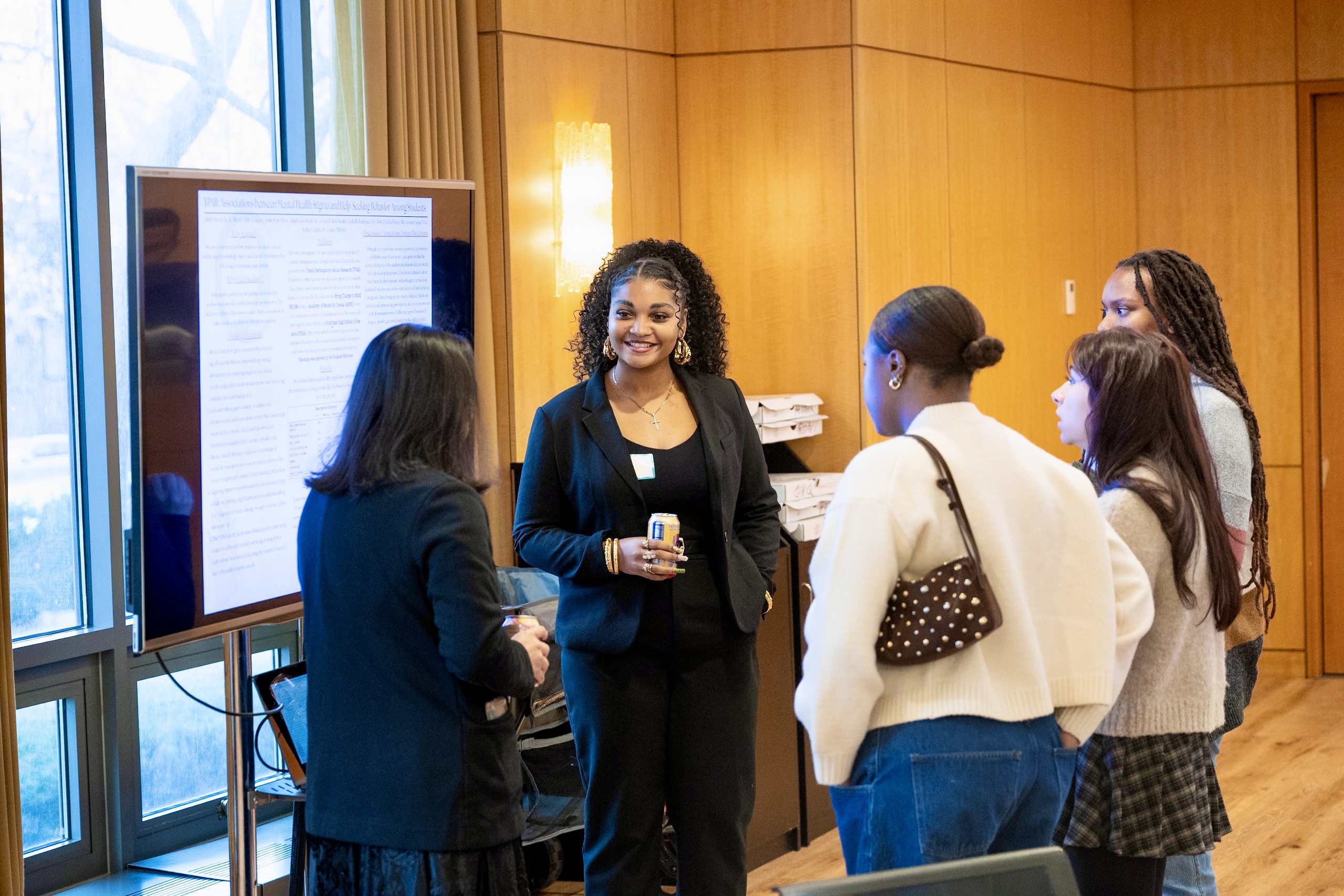
 Fordham students present their research at the YPAR showcase. Photos courtesy of Lindsay Till Hoyt
Why is psychology one of the most popular majors at Fordham?
In a shifting job market that often falsely pits STEM against the humanities, the study of human behavior straddles both fields. As psychology’s ranks continue to grow at colleges nationwide, Fordham students know that the real power of the degree lies in stepping out of the classroom and into the community.
For those hoping to get a leg up in the field, Fordham’s Youth Participatory Action Research course offers a unique opportunity to conduct hands-on research with real-world impact in local neighborhoods.
What Is YPAR—and Why Is it Distinctive?
Youth Participatory Action Research (YPAR) is both the name of the Fordham course and a methodology that empowers young people to conduct studies on issues that matter most to them. In a YPAR model, the usual roles are flipped—young people aren’t just the subjects being studied; they’re co-investigators who help lead the research themselves. The goal is to implement concrete solutions.
“It’s contrary to how most people do research,” said Lindsay Till Hoyt, PhD, the course’s teacher and architect. “Most developmental psychologists do research on young people—whereas the whole idea of YPAR is to do research with young people.”
How Does it Work?
Fordham’s yearlong YPAR course matches students with Bronx schools and community partners to brainstorm, build, and execute long-term research projects based on real issues chosen with local high schoolers.
Mhya Tejada is a Fordham student who got to work with teens at her former high school, Mount Saint Ursula in the Bronx.
“Some of the kids noticed bullying at their school,” she said, “so we wanted to do a project on how violence affects students’ daily lives and mental health.”
Tejada and her research partners helped the high school students draw on their own personal experiences to develop the questions that would go on to form the basis of their data for the project.
Who Takes the Class
The class is an interdisciplinary capstone course taken mostly by junior and senior psychology majors who work in small teams. Students typically have some experience in research methods and statistics, which helps them put all the pieces together. Readings on any given week might deal with areas like sociology, gender studies, and public health.
The Professor
Hoyt directs the applied developmental psychology program at Fordham and runs the Youth Development, Diversity, and Disparities (3D) Lab. Her research focuses on how biological, behavioral, and social factors affect adolescent and early adult development. As a member of the national YPAR network, she’s also leading efforts to replicate the course model and bring it to more university campuses.
Most Interesting Assignment
After brainstorming research ideas with the high schoolers, Fordham and high school students pitch specific research proposals in a Shark Tank–style presentation. Each class member gets a set number of coins to “invest” in their favorite ideas—thus setting the topics and teams for the year ahead.
What Students Are Saying
“YPAR definitely helped me build my skills [and realize] what sort of research I would want to do in the future. I enjoyed how different this was to a traditional approach—being informed by the community itself, not just numbers. It shows that if there’s an issue, you can actually do something about it.”
—Mhya Tejada
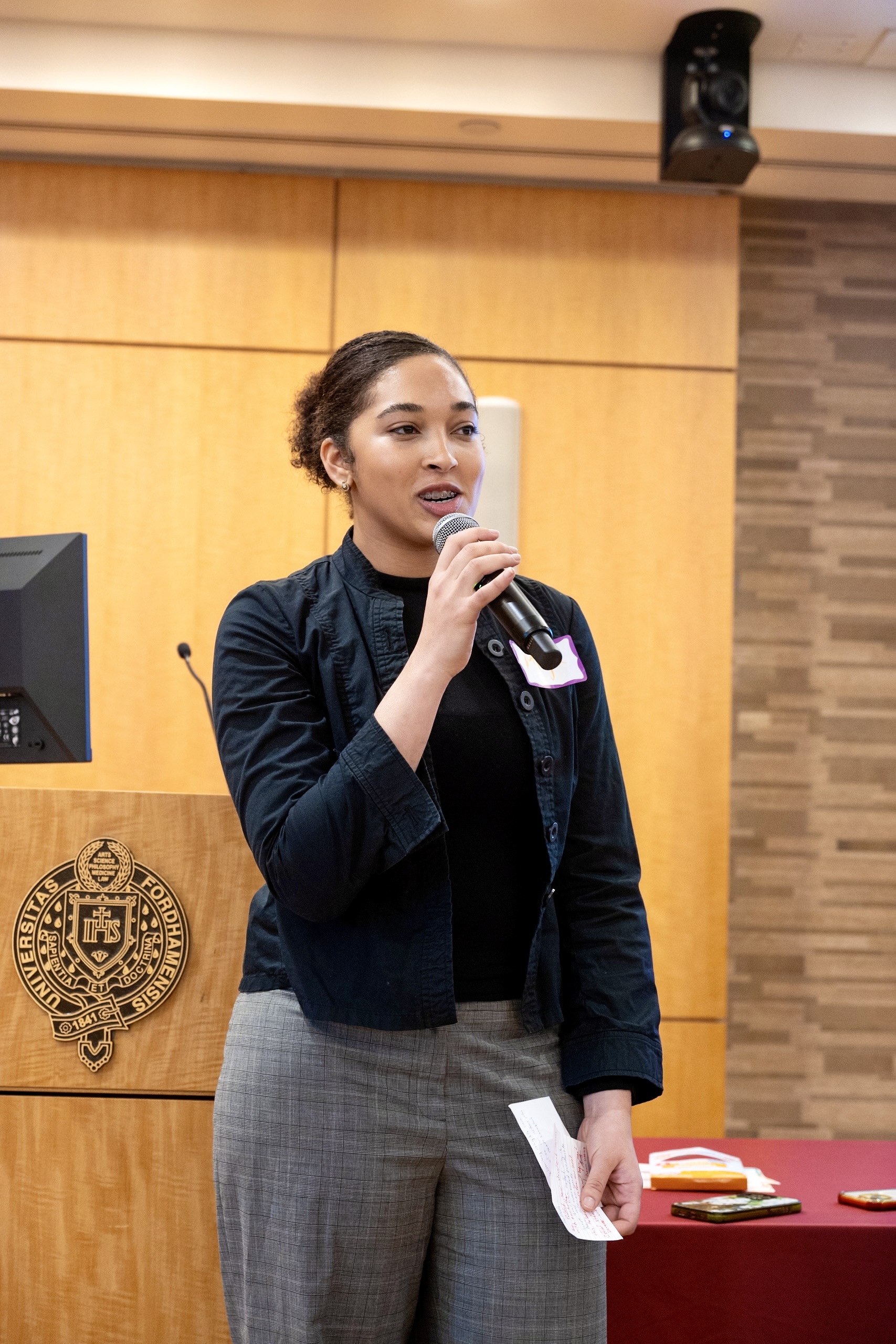
Mhya Tejada presents her research at the YPAR showcase.
“I thought working with the high schoolers was really cool. Everyone is so positive and willing to work together. I’m not the biggest lecture person, so I looked forward to when the high schoolers would come every other week. It was great seeing them come in with so much energy to do this work.”