Urban Studies Undergraduate Program
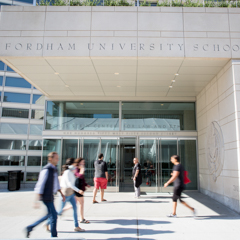
Designed as an interdisciplinary program, the urban studies major offers a broad introduction to the city and the urban environment. Students combine course work and research on urban issues with hands-on experience in New York City as well as other American and international cities. The curriculum prepares majors for graduate school and professional programs in teaching, social work, public policy, architecture and urban planning as well as for careers in government service and community development, the non-profit sector, journalism and law.
The major in urban studies is available at Fordham College at Rose Hill and Fordham College at Lincoln Center. Students in the Fordham School of Professional and Continuing Studies may major in urban studies only if their schedules are sufficiently flexible to permit them to take day courses at the Rose Hill or Lincoln Center campuses.
2026 Trinity Fellowships
Congratulations to Jayna Monroe and Kimberly Lazzara!
Recipients of the 2026/27 Trinity Financial Fellowship
The Trinity Financial Fellowship supports the academic research of outstanding Urban Studies undergraduate majors at Fordham University as they complete their senior internship and thesis.
Participants in the Trinity Financial Fellowship produce senior theses related to social and economic concerns, community and cultural initiatives, the built environment and environmental justice.
Current Fellow Insights
Jayna Monroe
“My name is Jayna Monroe, and I am a senior at FCRH double-majoring in Urban Studies and African-American Studies, with a minor in Economics. Being from a suburb of Baltimore and going to school with a lot of people from the suburbs of DC, Baltimore and DC are discussed as if they are diametrically opposed to one another — often pointing out the stark difference in urban planning, city prosperity, income, and wealth of its residents. Looking into the history, demographics, and wealth of both cities, I reached a deeper conclusion. In my thesis, I plan to explore the differences in urban planning concerns and goals in Baltimore, Maryland versus Washington, DC using the historical African-American makeup as a factor in development. More so, I am exploring why DC sees immense economic prosperity as a city and why its African-American residents experience a greater proportion of success, prosperity, and autonomy compared to their Baltimore counterparts. From this research, I will ascertain how urban planning both shaped the outcome for African-Americans in those cities, and how residents’ prosperity is linked to the type and scale of development seen in those cities today.”
Kimberly Magboo Lazzara
“Hi, my name is Kimberly Magboo Lazzara and I am an Urban Studies major and a Visual Arts minor. For my senior thesis, I will be conducting ethnographic research of immigrant enclaves in the Bronx and aim to highlight the importance of social capital and networks in these communities. In my research, I would like to document personal stories and livelihoods through culturally specific businesses, religious institutions, and community development organizations. Additionally, I want to gain a comprehensive understanding of systematic challenges these communities face and explore solutions that may take form in organizing or culturally informed planning and legislation. Ultimately, I want to connect my research to the broader historical theme of the Bronx serving a refugee for immigrants to succeed and thrive.”
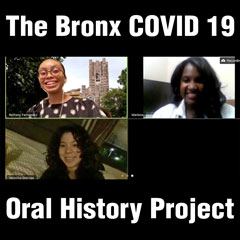
In Bronx and beyond, the pandemic revealed resilience
from the christian science monitor:
“When Bethany Fernandez first began to document oral histories in the Bronx during the pandemic, her own life was “chaotic,” she says – her familiar routines upended, her days confronted with fear and uncertainty.
But the past year and a half has become, almost in a strange way, a time of profound personal growth and self-discovery, says Ms. Fernandez, a lifelong resident of the Bronx, a borough of New York City.
The communities surrounding her were among the most afflicted in the country, and they were being documented relentlessly in the news. But when she decided to join a group of fellow students at Fordham University to launch the Bronx COVID-19 Oral History Project, she found a reality not fully captured in the news, she says.”
“In moments like these, a cynical person might think, ‘Oh, people are going to be selfish’ – resources are scarce, survival of the fittest, or whatever,” says Ms. Fernandez. “But no, it was the complete opposite. People were willing to give, people willing to extend themselves, even if they may not have had that much to give or to extend.”
In two dozen interviews with Bronx teachers, families, artists, and community leaders, people described a similar sense of energy, positivity, and resilience, says Mark Naison, professor of history and African and African American studies at Fordham, who advised the students.
“You know, we found all these people who were doing amazing things to help keep the community alive during this time,” he says.
Read the full article by Harry Bruinius (@HarryBruinius) at The Christian Science Monitor.
-
- Designing the City, Sustainably: Sustainability and Climate Change Resiliency in New York City by Cosima Balletti-Thomas
- Making Sustainability Accessible: Green Affordable Housing Development in the South Bronx by Natalie A. Bartfay
- Raising an Indoor Generation: Outdoor Environmental Education Impact on Adolescent Development by Daisy Elizabeth Bewley
- The Fault with Asphalt: Towards Absorbent Urban Design in New York City by Scott Paul Redfern Brown
- Preparing for Climate Change in New York City: Geographic Information Systems as a Valuable Tool for Natural Hazard Management by Amy Carrillo
- Problems and Possibilities of Private Equity and Environmental Sustainability by Katherine N. Elliot
- The University Greening Movement: Is Carbon Neutrality Enough to Avert a Climate Crisis? by Sean R. Finlay
- Food Choice Reform: Shifting American Culture Toward Sustainable Diets by Colleen McCarthy
- The Breath of the Bronx: Limited Greenspace and Poor Respiratory Health by Eric Patrick McLoughney
- Nature as Privilege: How Environmental Racism Changes the Access to Fresh Air and the Effects on New York City’s Communities by Sarah C. Morrison
- Breaking Ground on New Agricultural Models: Industrial Agriculture and the Local Food Movement by Elizabeth Nealon
- Ecotourism Development in Indigenous Communities: A Mapuche Case Study by Shaelynn Taylor Nuckel
- Fighting Food Insecurity for NYC Children and Youth: Urban Agriculture and Food Justice by Devin C. O'Mara
- Documentaries Making a Difference: Communication Effects of Environmental Film and Television by Lindsey A. Register
- Ethical Implications of Population Growth and Reduction by Tiana Sepahpour
- Wasteful Talent: Eliminating Entertainment Waste and Enhancing Experience by Eric Alexandra Lucia Sottile
- Green Politics: The Impact of Grassroots Organizations on Environmental Political Movement by Eric Andrew Stolar
- This Land is My Land: The Complex Land Ethics at the Heart of the Occupation of Malheur National Wildlife Refuge by Fi V. Whalen
-
- Inch by Inch: Expanding the Community Garden Programs in New York City by Michael Bailey
- A Historical, Political and Social Look into the Problem of Floatable Pollution in NYC's Bronx River by Zoe L. Bellapigna
- Subsidizing Climate Change: How the Agricultural Business is Harming Our Planet by Caroline Berejka
- Radical Social Ecology as Deep Pragmatism: A Call to the Abolition of Systemic Dissonance and the Minimization of Entropic Chaos by Arielle Brender
- A Green Opportunity: Why American Conservatives Will Benefit By Fighting Climate Change by Byrne W. Cronin
- Food Apocalypse: The Future of the American Diet by Kylie Farrell
- A Conservative Concern: Conservative Ideology, The Environmental Crisis, and Why They Can Be A Perfect Pair by Alexandra Ferreira
- Building a Bridge Between Philanthropy and Profit: The History, Economics, and Politics of Environmental Impact in a Commerce Society by Yekaterina Goncharova
- Apicentrism in City Parks: Cultivating Honey Bee Prosperity in the Face of Colony Collapse Disorder by John Hughes
- The Impacts of Green Spaces on Crime in New York City by Matthew Edward Iannone Jr.
- Sustainable Interiors: Green Design Methods and its Influence on Ecopsychology by Tillie M. O'Reilly
- Pacific in Peril: Micronesia’s Food Security, Development, and Health under A Changing Climate by Yota Pacifico Oue
- Turbines Spinning Towards a Better Future: The Expansion of Offshore Wind Farms in the United States by Noah J. Stiles
- The Planet on Our Plates: The History, Economics, and Ethics of an Unsustainable Globalized Food System by Erin Wattley
- Farming the Bronx: The Potential for Controlled-Environment Agriculture to Address Environmental Degradation and Urban Social Issues by Reyna Wang
- Burmese Refugee Health: The Value of Plant-Based Medicine by Natalie Wodniak
-
- Assessing the Effects of Ecotourism on the Developing World: A Galapagos Case Study by Ife Adelona
- The Disappearing Wetland Act: Climate Change, Development, and Protection by Jessica P. Doughty
- Greenways In America: The Ecosystem Services of Urban Greenways and their Neighborhood Benefits by Bryan E. Kiel
- Housing the Homeless: A Framework for Sustainable, Affordable Housing by Brianna Providence
- Urban Parks for All: Reclaiming Public Green Space in New York City by Emily Putnam
- Fracking in Pennsylvania: History, Geopolitics, and Public Health by Kathryn A. Susko
-
- Do or Die: Environmental History, Environmental Politics and Environmental Economics and Their Implications for Mitigating the Effects of Climate Change by Christopher Cannon
- Urban Parks: A Study on Park Inequity and EcoGentrification in New York City by Bernadette Corbett
- A Case for Career and Technical Education (CTE) in Reducing High School Dropout Rates and Youth Unemployment Among Urban Youth by Sharnell Creary
- Mindless Meat: An Exploration of Meat’s Role in Environmental Degradation and World Hunger by Camille A. Danielich
- Rising Temperatures, Rising Stakes: The Role of International Policy Negotiations in the Climate Crisis by Sarah M. Davis
- Improving Transit in Southeast Queens: Upgrading Public Transportation in One of New York City’s Most Isolated Areas by Thomas Dorante
- The Solar Power Difference: How Solar Energy Can Boost Economies and Nicaragua's Rural Communities by Matthew R. Feuer
- Gentrification and Urban Displacement Surrounding Fordham University’s Bronx Community by Ryan Fleites
- Infiltrating Green into the Urban Machine: Creating Equity Through Zero-Acreage Farms in NYC by Hania Hribal-Kornilowicz
- Parks and W[rec]k: Ecosystem Services of Urban Parks by Serena Iacoviello
- Sustainable Development: Challenge, Policy, Solution by Karl W. Knotoff
- Giving Trees: Protecting our Urban Forest by Catherine C. LaPerche
- Climate and Crisis: Environmental Degradation and Humanitarian Disaster in Darfur by Talia Macauley
- New York City Underwater: Climate Change Mitigation and Adaptation by Anna Marshall
- Why Support Donald Trump by Morgan Mungerson
- Wave and Tidal Energy in New York: Sustainable Hydroelectricity for the Grid by Lucas Basil Romanowsky
- Heroin Devastates Hen Hud: A Case Study by Mikela Ryan
- Case Study: Bronx River Alliance Successful Strategies of Urban Non-Profit Environmental Organizations by Danielle Rose Shtab
- East Harlem: An Inquiry into Development by Madeleine Sims
- Feeding America's Growing Cities: The Role of Urban Agriculture in the Future of Food Distribution And Accessibility by Leigh Anne Statuto
- Teacher Voice And The Charter School Experience by Anthoula Vasiliou
- Silent Summer: The EPA Spill & Neglected Navajos - A Review of Environmental Tragedies in Navajo Nation & Their Effect on Diné Life by Jillian Verzino
- Campaigning in 140 Characters (or Less): How Twitter Changed Running for President by Joseph Vitale
- The Gowanus Canal: Delving into the Murky and Mysterious waters Of Brooklyn’s Toxic Canal by Victoria L. Von Ancken
- A Wasteful Disposition: How A Consumerist Society Can Slowly Become Zero-Waste by Paige G. Werman
- Solar Panels: Lighting our Future Path by Charles M. Woessner
- Suzhou in History: City Layout and Urban Culture by Zhiyi Zhou
-
- Nature Deficit Disorder and the Need for Environmental Education by Vanessa J. Dwyre
- Greening a Drug-Addicted Economy: Can Puerto Rico Ease Away from the Toxic Pharmaceutical Industry to a Sustainably Diverse Economy? by Natalie Galarza
- Trouble in Paradise: How the California Drought is Affecting Vineyards and the Wine Industry by Sarah Gonsier
- The Interstate Highway System and Environmental Justice: Disproportionate Environmental Impacts on Low Income and Minority Communities by Dylan T. Katz
- Home Gardens: A Key to a Sustainable Future by Keara C. Galvin
- Hydroponic Farming: An Opportunity for South Bronx Communities by Adam Keally
- Prototyping the Environmental Impacts of 3D Printing: Claims and Realities of Additive Manufacturing by Valerie B. Meyer
- Fishing For a Sustainable Future: Aquaponics as a Method of Food Production by Richard Ramsundar
- From The Web Into The World: An Analysis of Millennial Environmentalism by Edward Van Buren
- Redlining the Green: Environmental Racism and Justice in the Bronx by Kelsey Vizzard