Taking Responsibility
Project Description and Goals
Fordham’s Taking Responsibility initiative responds to the crisis of sexual abuse and concealment within Roman Catholic and Jesuit institutions by bringing rigorous study to the work of accountability and repair. Through research by Fordham faculty and partner institutions, the initiative examines the structural, cultural, and institutional factors that allowed abuse and cover-up to occur. Its goal is to support meaningful change, including recommendations for policies and practices that help Jesuit educational institutions address past harms and better protect children and vulnerable adults in the future.
Project Resources and Outputs
For full access to reports, research materials, and updates, visit:
https://takingresponsibility.ace.fordham.edu/
Phase 1:
Research and Collaboration (2020–2022)
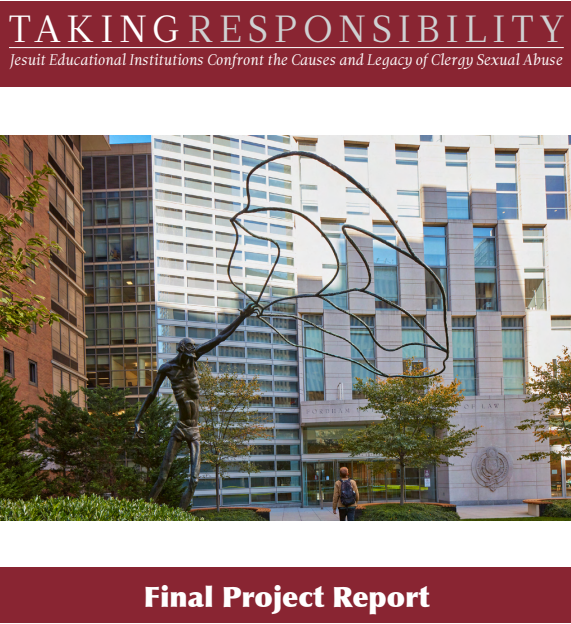
Jesuit Educational Institutions Confront the Causes and Legacy of Clergy Sexual Abuse
During its initial phase, the Taking Responsibility Initiative funded interdisciplinary research at Fordham University and ten Jesuit institutions across the United States. This work examined how the structures, culture, and governance of the Roman Catholic Church contributed to clergy sexual abuse and its systematic concealment.
The initiative supported research, educational resources, scholarly collaboration, and a 2022 conference, while building a network of Jesuit institutions committed to this work. From this, collected research, insights and recommendations were used to create a final report to help address past harms, strengthen accountability, and protect children and vulnerable adults.
Phase 2:
Restorative Pathways (2025–2027)
Now in its sixth year, Taking Responsibility has opened a new chapter with an international initiative titled Restorative Pathways. Building on the final report from the project’s initial phase, this new phase brings together an international team of scholars and practitioners from a range of disciplines to explore the relationship between restorative justice and Jesuit spiritual and intellectual traditions in addressing cases of clergy sexual abuse.
Running from September 2025 through August 2027, the initiative focuses on the development of a practical model to support trust-building and repair in communities affected by abuse. This model will be designed for use across diverse contexts and made available in English, Portuguese, and Spanish.
Taking Responsibility: Restorative Pathways is led by Dr. John Seitz (Fordham University), Dr. Sónia da Silva Monteiro (Universidade Católica Portuguesa), and Dr. Carolina Montero Orphanopoulos (Universidad Católica Silva Henríquez), bringing together expertise in theology, restorative justice, and international Catholic contexts.
If you are a survivor of clerical sexual abuse at Fordham, we strongly encourage you to report your experience to Fordham's Special Committee on Clerical Sexual Abuse and with the victim advocate for the Jesuits USA East Province.