Resources for Teaching
Our teaching resources capture the latest scholarship on teaching and learning alongside creative approaches to pedagogy. Below, explore the range of resources offered through the Center - from recorded workshops to short courses and articles.
Workshops are available to members of the Fordham University community via Panopto. Please click on the links below to access recordings.
-
2025-2026 LIC Fellows
Miguel Alzola, Associate Professor of Ethics, Gabelli School of Business
Student Fellow: Tejas Niroola, Gabelli School of Business class of 2026, Global Business, Finance, and EconomicsResources coming soon!
Jane Bolgatz, Associate Professor of Curriculum and Instruction, Graduate School of Education
Student Fellows: Hannah Feng and Jazlyn Mena
The central test of a graduate dissertation is whether the student can independently explain, defend, and take scholarly responsibility for all of the work represented in their research - this test is complicated when a student uses generative AI tools. Dr. Bolgatz and her student Fellows focused on this challenge, developing a framework for Generative Artificial Intelligence (GenAI) Use in the Dissertation Process. Faculty who work with graduate students in doctoral research will find this resource useful in supporting their students.Curious about this project? Email CEI.
Crystal Colombini, Associate Professor and Director of the Writing Program, Arts & Sciences
Student Fellows: Attacus Jarrett, FCRH class of 2028, Political Science, History; Elysia Esposito, FCRH class of 2028, Psychology, Pre-Law
First-year writing is especially impacted by the rise of GenAI - it is often at the center of public discourse about the threats posed and opportunities presented by GenAI. Dr. Colombini and her student Fellows developed a coherent framework for ethical AI engagement for first-year writing courses, integrating pillars of the Ignatian Pedagogical Paradigm into an ethical AI writing model that centers context, experience, reflection, ethical action, and evaluation in student work. Faculty who teach writing across the disciplines will benefit from this project.Curious about this project? Email CEI.
Daniel Groner, Clinical Professor of Information Technology and Operations, Gabelli School of Business
Student Fellow: Anthony Hayes, Gabelli School of Business class of 2026, Information Systems, Theology
Students and faculty alike are rethinking what it means to learn in the age of AI. The Ask/Build/Complete model, developed by Professor Groner and his student Fellow, outlines how the learning journey can be mapped across three distinct temporal phases to enforce critical thinking and encourage students to engage with course material. The Fellows introduce the model and provide a range of examples in which the model might be applied - everything from fixed projects in an introductory programming course to flipped classroom course design to teaching Plato’s Allegory of the Caves. Faculty who are looking to clarify their teaching with a simple, structured model will benefit from this project.Curious about this project? Email CEI.
Julita Haber, Associate Clinical Professor of Leading People and Organizations, Gabelli School of Business
Student Fellows: Asim Adhikary, Gabelli School of Business class of 2026, Global Business, Marketing, and Economics; Winona Baidya, Gabelli School of Business class of 2027
It’s not uncommon for students to navigate new learning experiences with apprehension and uncertainty. The Fear of Appearing Incompetent (FAI) model offers a research-based classroom experiment to compare the impact of AI-driven versus traditional learning approaches on FAI and learning outcomes such as comprehension. Results suggest that students who engage with GenAI in structured learning design can experience deeper learning and gains in comprehension, while students who use GenAI in unstructured ways demonstrate performance gains that may not be supported by actual comprehension. Faculty who are looking for ways to talk with their students about the potential risk and opportunities of GenAI use in learning will benefit from this project.Curious about this project? Email CEI.
Allie Kosterich, Associate Professor of Communications and Media Management, Gabelli School of Business
Student Fellow: Zainub Shah, Gabelli School of Business class of 2026, Finance
GenAI has the potential to offer moments of productive friction in support of student learning - Dr. Kosterich and her student Fellow embraced this potential. Human Outcomes by Design uses GenAI as a structured partner for feedback, revision, and productive failure. Rather than generating polished answers for students, the tool is designed to introduce purposeful pushback that prompts learners to justify claims, strengthen evidence, revise their thinking, and build resilience through iteration. The broader goal of this project is to help faculty across courses use GenAI to develop human learning outcomes such as feedback tolerance, persistence, and evidence-based reasoning.Curious about this project? Email CEI.
Jenny Meyer, Senior Lecturer of French, Arts & Sciences
Student Fellow: Sarah Rahman, FCLC class of 2026, Communication and Culture, Spanish
Language teachers have been at the forefront of the struggle to maintain educational integrity in the age of AI. Embedded translation softwares and accessible GenAI offer an off-ramp for students to escape the productive struggle of making meaning with words and the primordial relationship between teacher and student. Dr. Meyer and her student Fellow confront this with a model to support language learning and writing that add value to classroom learning, focusing on the language skills acquired at each level and the metacognitive skills involved in their acquisition. Faculty who are looking to make learning and human outcomes explicit to students during in-class, in-person learning activities will benefit from this project.Curious about this project? Email CEI.
John Ruppert, Lecturer of Biology, Arts & Sciences
Student Fellows: Amelia White, FCLC class of 2027, Natural Science, Business Administration; Kazi Diaz Chatiyanon, FCLC class of 2028, Psychology
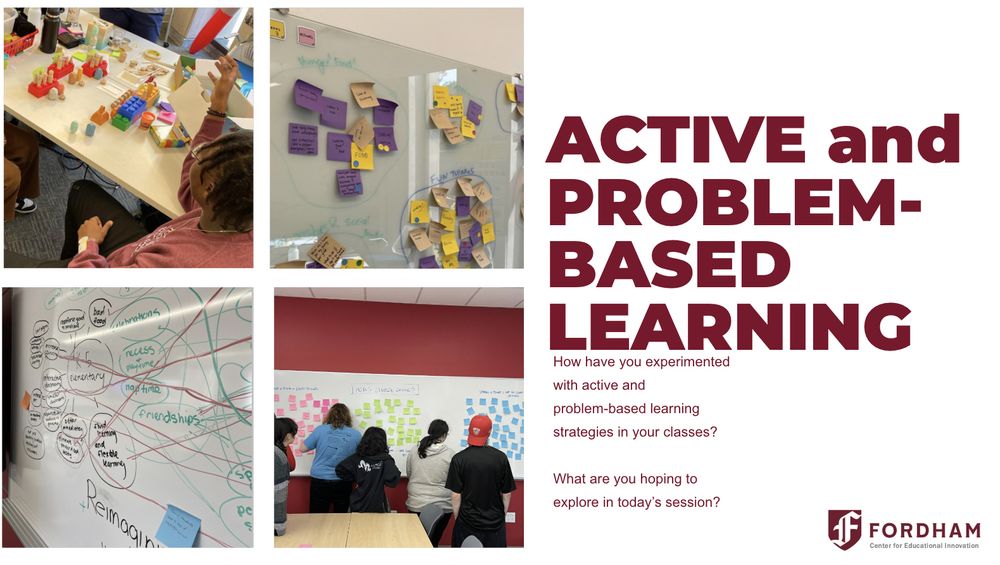
One of the fundamental shifts in pedagogy is moving from content dissemination to problem-based - or case-based learning. This shift can support profound learning on the part of students, and it offers a practical approach to managing GenAI integration in productive ways. The Case-Based Humility model outlines an approach to integrating AI as a problematizing tool, using structured scaffolding to guide students to diversify their thinking around authentically engaging cases relevant to course content. Faculty who are interested in using more case-based or problem-based pedagogies in their courses will find this project useful - the added exploration of how GenAI can support that model of teaching is a beneficial response to the current moment.Curious about this project? Email CEI.
View the Recording
View the Recording
View the Recording
View the Recording
View the Recording
View the Recording
View the Recording