Emily Krebs
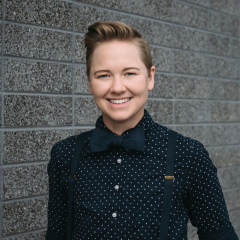
-
PhD - University of Utah
MA - University of Denver
BA - University of Denver -
Dr. Emily Krebs applies critical cultural perspectives to the study of health and science through research on mental healthcare, suicide, and Mad justice. As Director of Fordham’s Disability Studies program, they are also dedicated to accessibility advocacy and student activism. Outside work, Dr. Krebs enjoys rock climbing, biking, and soaking up time in the outdoors with Winston—a border collie that's prominently featured in many photos around the office.
-
Krebs, E. (2025). Countering suicidism: Historical moments as guides for contemporary activist entry. Disability Studies Quarterly, 44(4), n.p. Open access.
Kirby, A., Krebs, E., Hiatt, L., Docherty, A., M., Mihalopoulos, Keeshin, B., Peifer, E., Craker, M., Staley, N., Bakian, A. V., & Coon, H. (2024). “It’s not the ‘being trans,’ it’s everything around that”: Trans community perspectives on suicide prevention. Bulletin of Applied Transgender Studies, 3(1-2), 69-97. Open access.
Safe Hotlines Research Team, in alphabetical order: Al-Anbar, N., Calou, Y., Forster, O., Cuervo, Á. G., HJ, N., Jumarali, S., Kasler, S., Krebs, E., Latty, L., Leigh, J., Lockett, G., Osborn, M., Palmer, J., Pease, M., Ramdeen, J., Smith, Z., Sostre, J., Townsend, S., Trac, O., Wang, S., Webb, J. (2024). The problem with 988: How America’s largest hotline violates consent, compromises safety, and fails the people. Trans Lifeline. (link)
Krebs, E. (2023). Queering the desire to die: Access intimacy as worldmaking for survival. Journal of Homosexuality, 10(1), 168-191. Special Issue on Queer Relationality (Eds. G. A. Yep, F. Z. Chrifi Alaoui, & R. Lescure).
Krebs, E. (2022). A sour taste of crip chronicity: Pandemic time and the “return to normal.” Communication and Critical/Cultural Studies, 19(2), 119-126. Special Forum on Cultural Chronicles of COVID (Ed. M. Levina).
Willer, E. K., Krebs, E., Castaneda, N., Hoyt, K. D., Johnson, J. A., Droser, V. A., & Hunniecutt, J. (2019). Our babies[’] count[er story]: A narrative ethnography of a baby loss memorial walk ritual. Communication Monographs, 87(2), 179-199.
Willer, E. K., Krebs, E., Castaneda, N., & Samaras, A. (2021). Mad to the bone: Learning
outcomes of critical grief pedagogy. Communication Education, 70(1), 27-48.Krebs, E. (2020). Combatting the ills of involuntary intake: A critical rhetorical analysis of
Colorado’s state psychiatric policies. Journal of Applied Communication Research, 48(3),
310-327.Krebs, E. (2019). 13 Reasons Why as a vehicle for public understandings of suicide. Critical
Studies in Media Communication, 37(2), 188-200.Krebs, E. (2019). Baccalaureates or burdens: Complicating ‘reasonable accommodations’ for
college students with disabilities. Disability Studies Quarterly, 39(3), n.p. Open access.Krebs, E., & Schoenbauer, K. (2019). Hysterics and hysterectomies: Using relational dialectics
theory 2.0 to explore the problematics of endometriosis diagnosis. Health
Communication, 35(8), 1013-1022. -
COMC 4246: Media, Disability, Futurity
COMC 4146: Health Communication and Social Justice
COMC 2146: Intro to Health Communication
COMC 2113: Interpersonal Communication