English Graduate Current Courses
2026 - 2027 Graduate Courses
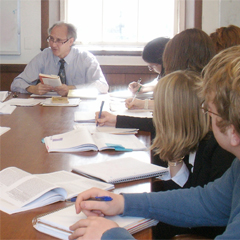
All English graduate courses are held on the Rose Hill campus unless otherwise specified. Undergraduate English Majors in their senior year are welcome to request admission to the 5000-level graduate courses listed below.
If you’d like to take one of these courses, please include the specific course(s) in which you are interested and email [email protected].
Fall 2026
ENGL 5030: Literary multilingualism (Mondays, 2:30 - 5:00 PM)
Sneha Khaund
This course will introduce students to theoretical debates and methods in the field of literary multilingualism. The readings will demonstrate the historical construction and persistence of the “mother tongue” and varied responses to monolingual paradigms, particularly in postcolonial sites. We will examine the significance of vernacular articulations, interplay between dominant and minor languages, and the possibilities as well as limits of translation, among other topics. Authors may include Jacques Derrida, Yasemin Yildiz, Franz Fanon, Édouard Glissant, Aimé Césaire, Naoki Sakai, Francesca Orsini, Rita Kothari, Lital Levy, and others.
CRN 55079
~
Fulfills H3, DI
ENGL 5031: On Beautiful Dregs: Aesthetics and Dialectics (Tuesdays 5:30 - 8:00 PM)
Moshe Gold/Daniel Contreras
Dregs are impurities rising to the top and also describe the worthless residue settling to the bottom. This connection between rising and depths parallels the dialectic between beauty and ugliness. Important questions about the aesthetic, specifically, the beautiful and the ugly, are central to this seminar, in which we will explore the rich philosophical histories of each. We will cross examine literary, cinematic, and artistic works that deliberately challenge our assumptions about aesthetics. We will value artworks (including disturbing novels and artworks and exploitation films) that have a horrible beauty we may wish to run from, yet we simultaneously long to behold.
CRN 55080
~
Fulfills DI
ENGL 5032 Women’s Life Writing (CW) (Wednesdays 5:30 - 8:00 PM, at Lincoln Center)
Stacey D'Erasmo
Master Class: Women's Life Writing
In this class, we will engage with the work of women writing about their lives, as both readers and writers. (Note: the class is open to all genders.) Women shaping the stories of their own lives has been a powerful tradition across centuries and cultures. We will read the work of writers such as Annie Ernaux, Audre Lorde, Melissa Febos, Cathy Park Hong, Natasha Trethewey, and others as well as explore our own life writing.
CRN 55440
~
Fulfills CW
ENGL 5111 Race, Religion, Monstrosity in Medieval Literature (Tuesdays 11:30 - 2:00 PM)
Suzanne Yeager
The medieval taste for the exotic has introduced many audiences to a range of monstrous beings, from ferocious giants and dog-headed men to the peace-loving sciapod. Medieval studies of monstrosity have often been linked solely to the premodern understanding of the exotic East, and have been viewed as attempts to theorize the different human “races” found there. Crusading further complicated the discourses of monstrosity in the perception of non-Christian religious Other who was perceived, as Debra Higgs-Strickland put it, “as ugly as sin.” Yet, the medieval language of monstrosity was not always limited to travel narrative, nor to the pejorative, for it was used to describe heroes, saints, even the Christian deity in far more familiar contexts than many would imagine. In this course we will examine the discourse of monstrosity as a complex critical lens through which premodern writers asked important questions of race, religion, civic virtue, and human morality. In our study, we will read selections from Pliny, Augustine, and a range of texts, including the Beowulf manuscript, medieval Ethiopian texts, premodern English romance, and Mandeville’s account.
CRN 55441
~
Fulfills H1, DI
ENGL 5650: Topics in Writing Studies (Mondays 11:30 - 2:00 PM)
Elisabeth Buck
This course will survey selected issues in writing studies, with an emphasis on intersectionality. Possible topics including public writing, community writing, theories in writing program administration, WAC/WID, all with attention to the needs of increasingly diverse university settings. May be repeated when topics vary but not more than 2 courses (6 credits) may be applied to the certificate.
Special Topic:
The Fall 2026 course section of ENGL 5650 will examine popular culture through a writing studies lens, exploring key questions about how the popular frames, complicates, and intersects with our understanding of literacy. This class will incorporate disciplinary research methods like autoethnography, ethnography, and discourse analysis to guide students through an exploration of popular culture as a literacy practice.
CRN 55083
~
Fulfills Rhetoric & Writing Adv Cert
ENGL 5739: Modernism in English (Thursdays, 2:30 - 5:00 PM)
Anne Fernald
This course looks at literary modernism in English. Our focus is the US, England, and Ireland, but our reading will take us across the globe. We will look at modernism as a part of and a response to a modernizing world, literary experimentation, political engagement and withdrawal. This literature of the first half of the 20th century responded to changing social roles for women and people of color, burgeoning technology, the emergence of mass media, and two world wars. We will read a mix of canonical, less-well-known, and popular writers, including Virginia Woolf, James Joyce, Gertrude Stein, Langston Hughes and many more.
CRN 55443
~
Fulfills H3, DI
ENGL 5917: Traversing Asian America (Fridays, 2:30 PM - 5:00 PM, at Lincoln Center)
Stephen Sohn
This course will serve as a broader exploration of Asian American literature and corresponding Asian American cultural criticism. Each week will center a different literary text, which will be paired alongside a critical or theoretical excerpt. Students will thus get introductions into major approaches to the reading of Asian American literature, including social context methodology (Elaine H. Kim, Shirley Geok-lin Lim), psychoanalysis (David L. Eng; Anne Cheng; Juliana Chang), new and racial formalisms (Colleen Lye; Elda Tsou), feminisms (Rachel C. Lee, King-kok Cheung, erin Ninh), queer studies (Christopher Eng; Cynthia Wu); disability/ debility (James Kyung-jin Lee), posthumanisms (Michelle Huang), amongst others. Primary text materials may include: Tessa Hulls’s Feeding Ghosts; Simon Jimenez’s The Vanished Birds; le thi diem thuy’s The Gangster We are All Looking For; Anthony Veasna So’s Afterparties; Susie Yang’s White Ivy; Jon Pineda’s Sleep in Me.
CRN 55442
~
Fulfills H3, DI
ENGL 6378: Reassessing Renaissance Lyric (Fridays, 11:30 - 2:00 PM, at Lincoln Center)
Heather Dubrow
The past few years have witnessed a resurgence of critical interest in early modern/Renaissance lyric. Many methodological issues it raises are germane to the lyric poetry of other periods as well. The questions we will explore include, among others: What are the potentialities and problems of the new formalism? How if at all should close reading be recuperated? How does the new interest in the material text lead us to interpret the visual appearance of lyric poetry, other results of printing and publishing practices, and the poem as artifact or object? In what ways does lyric gender, and in what ways is it gendered? How does space/place theory, more often deployed in relation to drama and prose fiction, illuminate the workings of the lyric? Whereas the primary focus of this seminar is the period between about 1500 and 1660, it is also designed for those with other interest and areas of expertise. If any participants in the group are poets themselves, they will have opportunities to engage with issues of craft and to submit poems in lieu of one of the shorter assignments. And those primarily interested in lyric poetry written in other periods can focus on those texts in at least two classes and if they wish write their seminar papers partle or entirely on it.
CRN 55444
~
Fulfills H2
ENGL 5001: Research Methods (Wednesdays, 11:30 - 2:00 PM)
Corey McEleney
An introduction to English studies at the graduate level, emphasizing bibliography, scholarly writing, and critical intervention. Although the emphasis of the course will vary according to the aims of the instructor, areas covered may also include book history, textual editing, historical research, and other issues of professional concern to graduate students.
CRN 13250
~
Required for all incoming PhD students.
ENGL 5115: Internship Seminar (Tutorial) TBA
This seminar is open to graduate students pursuing internships in publishing, museum management, or arts administration during the spring 2021 semester. Please contact the Director of Graduate Studies to make sure that your internship qualifies for course credit.
CRN 33500
~
ENGL 5998 Master’s Capstone
TBA
Seminar for MA students who wish to fulfill the Capstone requirement (note: the Capstone requirement may also be fulfilled, as an independent study, during the spring or summer semesters. Please contact the DGS if you are unsure about which semester would be best for your Capstone completion.
CRN 45455
~
ENGL 6004: Colloquium: Pedagogy Theory Practicum (Thursdays, 5:30 PM - 8:00 PM)
Caitlin Cawley
This course introduces students to central histories, issues, and debates in writing and rhetorical studies. By highlighting key theoretical and terminological developments, this course lays the way for informed self-reflective practice based in awareness of the most current scholarly work in rhetoric and composition, thereby helping participants start to define their own identities as teachers of first-year composition as well as literature and other courses.
CRN 13269
~
ENGL 8935: Dissertation Seminar (Mondays, 11:30 - 2:00 PM)
Thomas O'Donnell
This 0-credit seminar is designed as a resource for all doctoral students who have passed the comprehensive exam. Students working on the dissertation proposal are encouraged to take this class. During each meeting students will present and respond to work in progress. Across the semester, the seminar will treat challenges of bibliographic research and strategies of effective writing specific to large projects.
CRN 40212
~
Required for all PhD students preparing the dissertation prospectus.
ENGL 8936: Issues in Scholarship and Academia (Mondays 5:30 PM - 8:00 PM)
Andrew Albin
This 0-credit seminar, open to all doctoral students, provides a forum in which to discuss the issues that shape the pursuit of a career professing literature as well as the pursuit of a career outside of the academy. The semester will provide opportunities for workshopping writing-in-process in a collaborative and supportive environment, and for directed conversation on varied aspects of the academic professionalization.
CRN 14025
~