Progress Toward a 50% Reduction by 2030
Climate Action Plan | NYC Carbon Challenge
Reporting Year: 2025
Progress to date | How reduction was achieved | Inventory
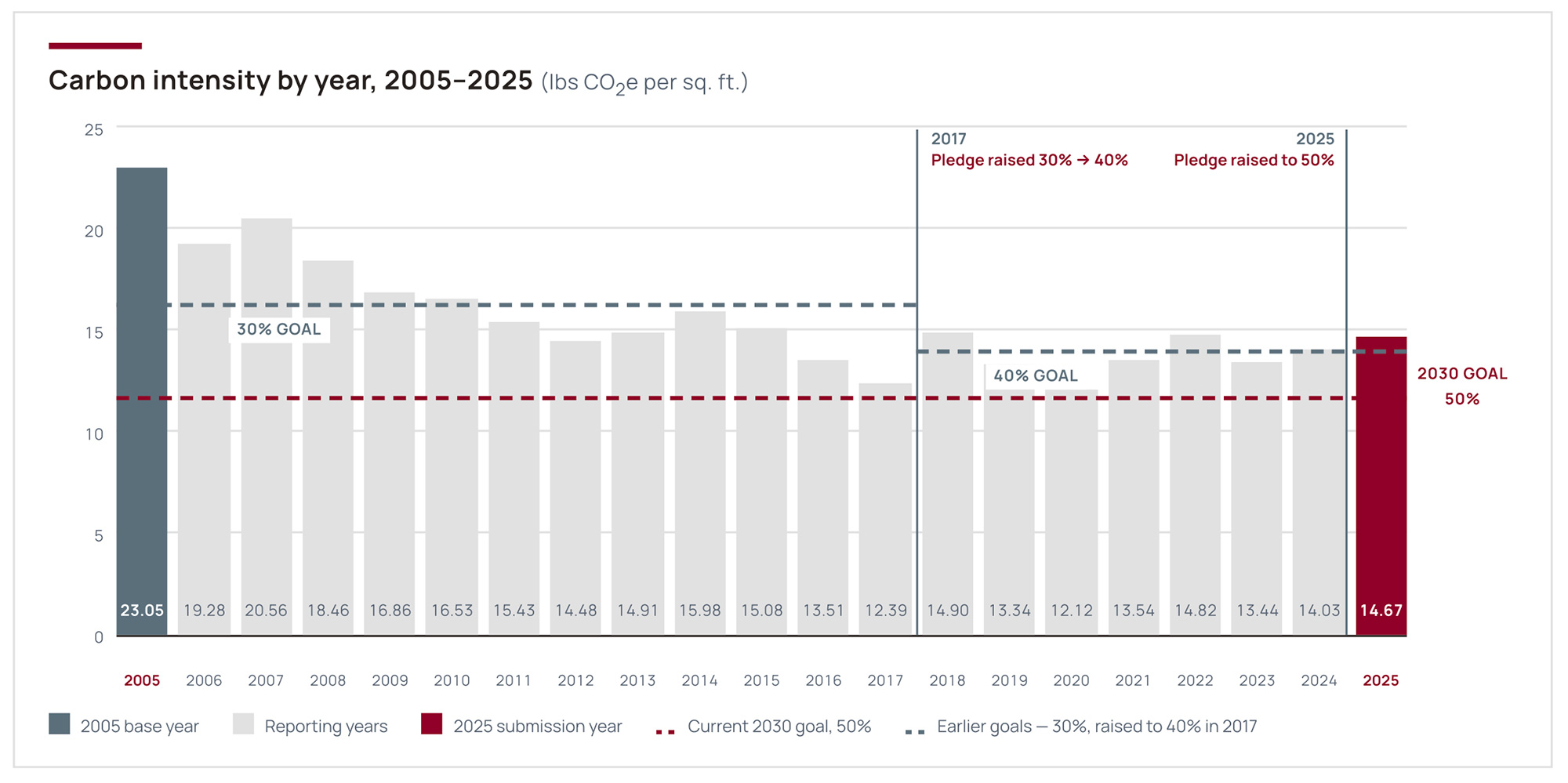
Fordham University was a founding signatory to the NYC Carbon Challenge in 2007 and extended its pledge to a 40% emissions reduction in 2017 and to a 50% reduction in 2025. This summarizes performance through the 2025 reporting year.
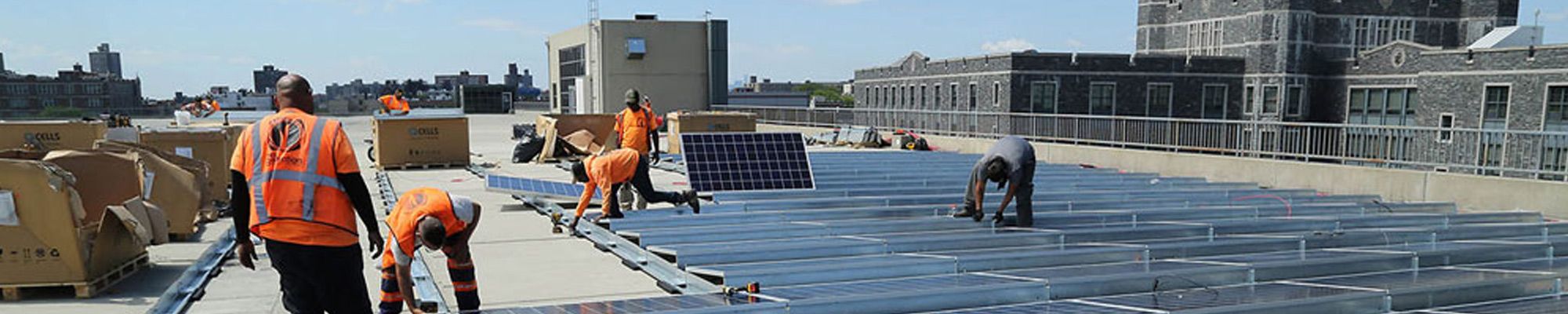
On-site and off-site solar
3.6 MW
Installed solar capacity
- 2,790 panels on the Rose Hill parking garage — roughly a megawatt, and the largest campus array in New York City.
- A 2.6 MW off-site ground-mounted array, the largest dedicated to an educational entity in the city, has generated more than 7,300 MWh to date.
- Fordham owns and retires 100% of the associated renewable energy credits, with material Local Law 97 benefit.
On-site power
2.6 MW
Installed power capacity.
- Expanded portfolio to 4 grid-connected chemical conversion to power arrays.
- Largest nonutility array in New York State, having generated 11,851 MWh to date.
- An efficient form of power with no combustion — 99% smog reduction and 30% CO2 reduction.
- Recycles its water usage, saving the equivalent of 189 Olympic swimming pools to date.
- Resilient power with cost certainty.
- Future proofing for heat capture, carb on capture and hydrogen fuel.
Equipment and building efficiency
712,000 kWh
Saved annually by LED relamping.
- Two strategic LED relamping initiatives replaced more than 100,000 lamps across Rose Hill and Lincoln Center.
- 90% of the Rose Hill Gym converted to LED in the 2021 reporting cycle, with fixture- by-fixture replacement continuing campus-wide.
- A new boiler plant was added to the Rose Hill campus in 2022 that is 15% more energy efficient.
- Campbell, Salice and Conley Halls are certified LEED Gold; the Law Building / McKeon Hall is certified LEED Silver.
- All new construction is designed to achieve a minimum of LEED Silver, so added square footage arrives more efficient than the portfolio average.
A
Local climate policy
Benchmarking
And commissioning
- Every New York City property above 25,000 sq. ft. is
benchmarked under LL84 andaudited and retro-commissioned
under LL87. - Findings feed a rolling program of controls tuning, scheduling and mechanical upgrades — the work behind the year-over-year intensity declines.
- The NYC Carbon Challenge aligns with the Climate Mobilization Act 50% carbon reduction goal— allowable building emission limits get stricter over time, with adjustments lower in 2030,
2035 and 2040. Annual reporting is required starting in 2025 based on the prior year’s
emissions data. Buildings that exceed the allowable limits are subject to penalties equivalent to $268 per ton CO2e.
Base year and submission year inventory
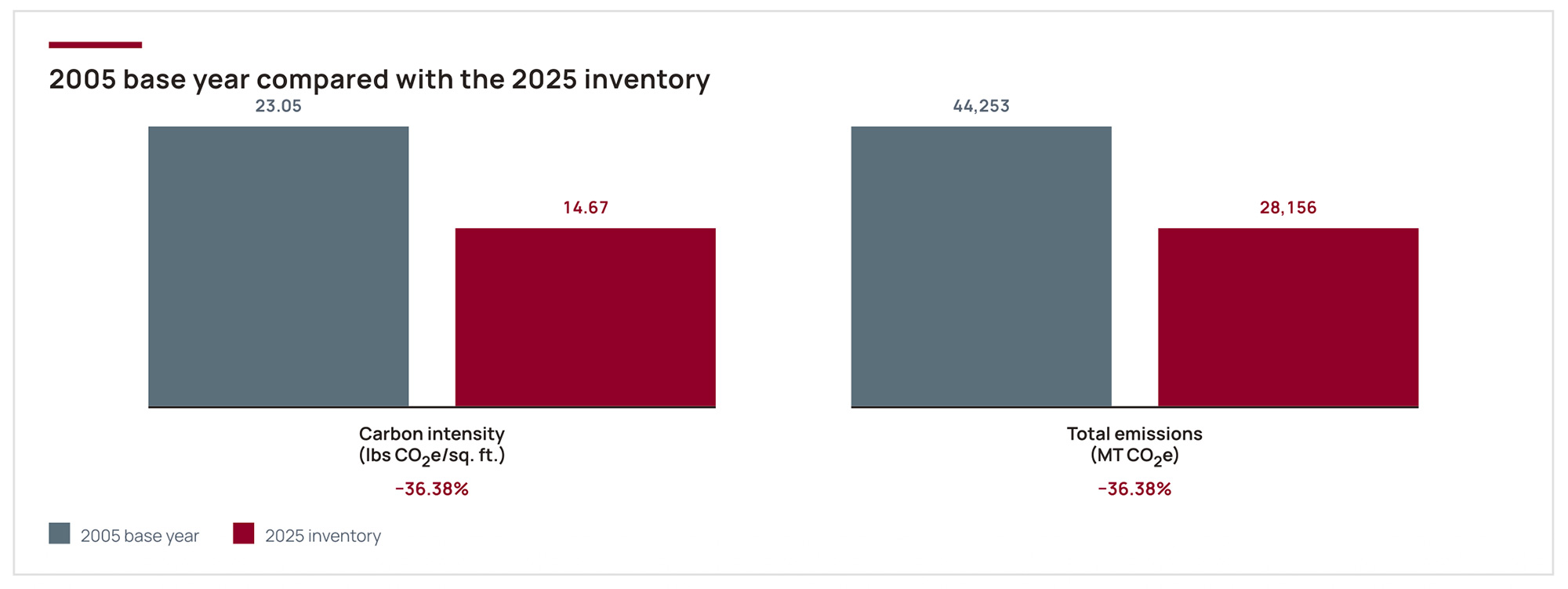
| Metric | 2005 Base | 2025 | Change | 2030 Target |
|---|---|---|---|---|
|
Gross square feet* |
4,232,699 |
4,232,699 |
- | - |
|
Total emissions (MT CO2e)† |
44,253 |
28,156 |
-36.38% | - |
|
Carbon intensity (lbs CO2e/sq. ft.)† |
23.05 | 14.67 | -36.38% | 11.53 |
* Base year emissions are stated on current gross square footage under MOCEJ baseline recalculation guidance; carbon intensity is unaffected by that adjustment. Figures use MOCEJ’s revised, yearvarying emissions coefficients and supersede those published in prior annual reports.
† 2025 figures are tentative. MOCEJ lists the 2025–2030 electricity and steam emissions factors as TBD, so the workbook carries the 2024 factors forward as placeholders; the 2025 column will move once MOCEJ publishes.
2007
Founding signatory to the NYC Carbon Challenge, at an initial 30% pledge
2017
Commitment extended to a 40% reduction by 2030
2024
Met the 40% reduction goal, six years ahead of the 2030 deadline