Research Fall 2025 Newsletter Spotlight on Fordham Researchers
Sarah Elizabeth Penry discusses her research
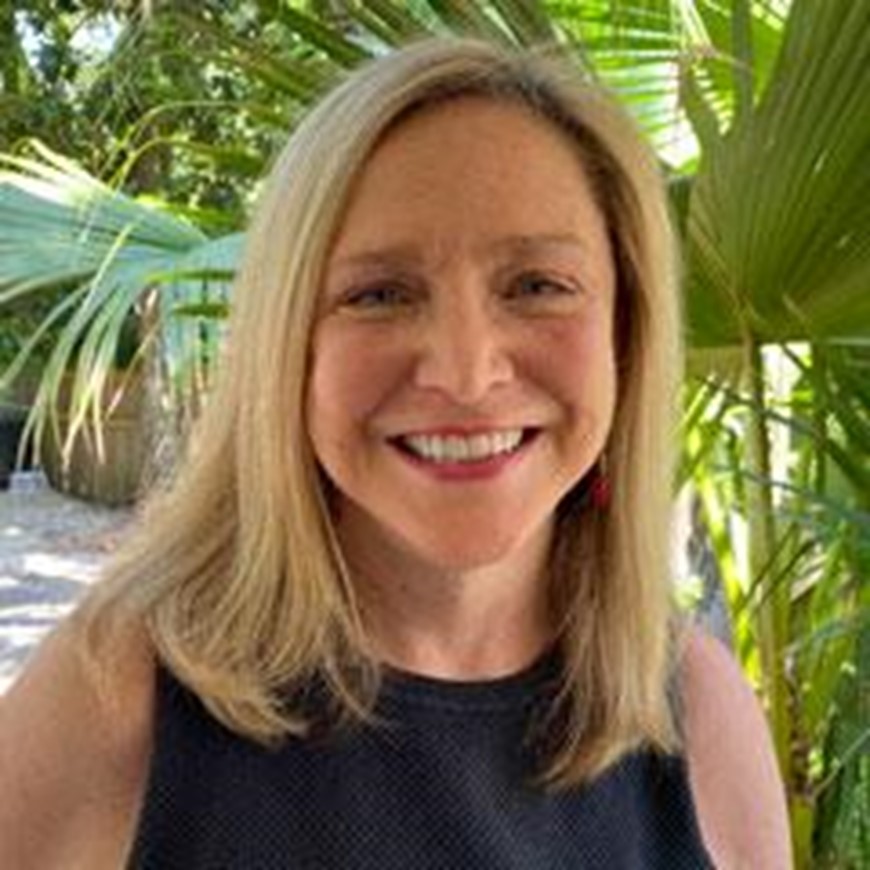
Sarah Elizabeth Penry is an Associate Professor of History and Latin American and Latinx Studies. She was named Fordham’s 2025 Distinguished Researcher in the Humanities, an honor presented at Research Day this past April. In recent years, she has received four fellowships, including two from the National Endowment for the Humanities. Her book The People are King: The Making of an Indigenous Andean Politics has earned seven awards, among them Best First Book from the Association for Spanish and Portuguese Historical Studies and the Howard Cline Memorial Prize from the Conference on Latin American History.
Here is her interview at the end of the Spring 2025 Semester:
Q. Your book The People are King: The Making of an Indigenous Andean Politics focuses on the indigenous people of the Andes and their conquerors -- the Incas and the Spanish. Can you please give a brief synopsis of your book?
A. The People Are King explores how Indigenous Andeans responded to colonialism by transforming imposed institutions. In the 16th century, Spanish authorities forcibly relocated native communities into planned, self-governing towns. Rather than simply adopting Spanish cultural and political norms, Andeans gradually reworked these structures, creating a new form of civil society rooted in participatory democracy. This hybrid model combined pre-colonial traditions of collective life with Spanish legal and civic ideals. Over time, it became the basis for indigenous rebellions against both colonial authorities and native hereditary elites in the late 18th century—and it continues to inspire Indigenous movements in Bolivia today.
Q. What were the major challenges of writing this book, and how did you address them?
A. The central challenge was to write from an Indigenous perspective using archival sources largely produced by Spaniards. This required a close examination of the actions and practices of Indigenous people—what, concretely, were they doing? To interpret the meaning of these actions, I adopted the anthropological method of 'thick description': analyzing where, when, how, and under what conditions these practices occurred; who participated; and who was excluded. In instances where Indigenous individuals produced their own records, I asked what they chose to say or write. Rather than seeking causal explanations for events, I focused on understanding what those events meant to Indigenous actors themselves.
Q. Your research project titled "The Italian Renaissance in Diaspora: Jesuit Education and Indigenous Modernities" reexamines early modern Jesuit education in Peru. What influence did the ideals of the Renaissance and Jesuit education have on indigenous Andean culture and life at that time?
A. I understand the Renaissance as a global movement of ideas in which Andeans were active participants. One example is Doña Ana Parpa, a wealthy Indigenous woman who bequeathed a small fortune to the Jesuit college in the silver-mining city of Potosí, expressing gratitude for what she called their “good works.” Like her European contemporaries who supported Jesuit institutions, Doña Ana assumed a recognizable Renaissance role—that of the patron, committed to advancing education and faith. Her actions reflect a Renaissance-style self-awareness: a conscious engagement with civic life, legacy, and the transformative potential of wealth within her community.
Ying Mao and his team won a large NSF grant
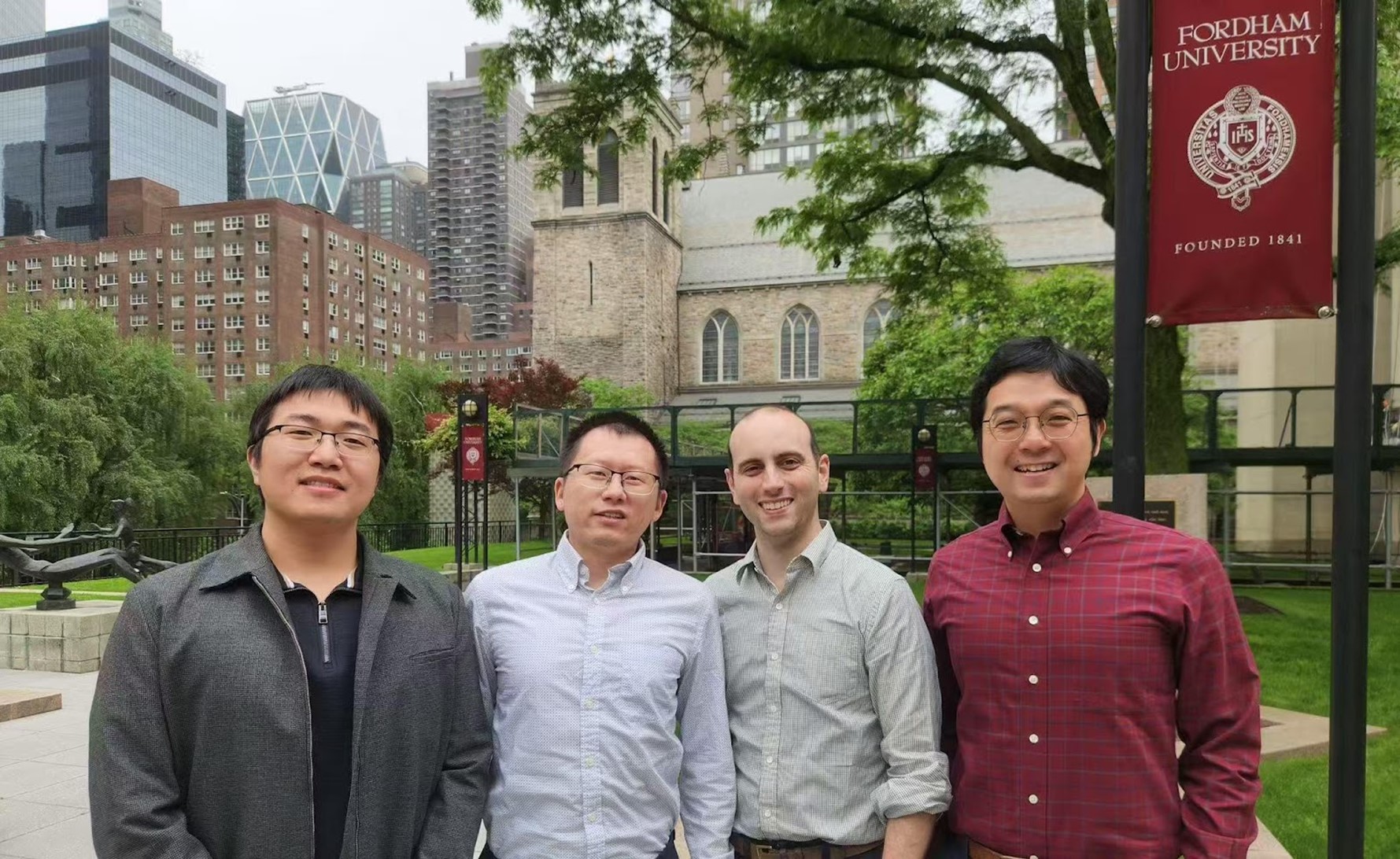 (from left to right) The NSF-grant team-- Juntao Chen (CIS), Wenqi Wei (CIS), Stephen Keeley (Biological Sciences), and Ying Mao (CIS)
Dr. Ying Mao, as PI, and his research team have won an NSF grant for a Major Research Instrumentation (MRI) project. This project began with a shared recognition among them that computational limitations were becoming a critical bottleneck for AI and data-intensive research at Fordham. The existing computing infrastructure in the CIS department could no longer meet the demands of advanced research or support emerging needs in the classroom. After interdisciplinary conversations, the team identified the NSF’s Major Research Instrumentation (MRI) program as an ideal fit. Together they developed and submitted the grant proposal, for which they were awarded almost $400,000.
We asked about the NSF grant and an inaugural CIS departmental research exhibition:
Q. Your team won a National Science Foundation grant for almost $400,000. What work does this grant support, and what are the desired outcomes?
Answered by Juntao Chen (CIS), Wenqi Wei (CIS), Stephen Keeley (Biological Sciences), and Ying Mao (CIS):
Our team’s NSF-funded project supports the establishment of a high-performance computing environment to accelerate advanced AI and data-driven research at Fordham. Beyond enabling research across disciplines, the project also strengthens STEM education by integrating modern computational tools into teaching and student training. This infrastructure empowers faculty and students to explore complex problems, collaborate across domains, and engage in high-impact scholarship. The effort aligns with Fordham’s strategic mission to promote ethical innovation, expand experiential learning, and foster inclusive academic excellence. It directly contributes to Fordham’s strategic plan to establish a university-wide AI hub that drives innovation and impact.
Q. What are the major obstacles to these outcomes you have faced so far, and how are you addressing them?
Answered by Juntao Chen (CIS), Wenqi Wei (CIS), Stephen Keeley (Biological Sciences), and Ying Mao (CIS):
The project is currently in the equipment acquisition phase, working closely with Fordham’s data center and our CIS department system administrator to ensure compatibility with existing infrastructure. A key challenge involved navigating technical details to integrate the new cluster seamlessly. The team also had to manage uncertainty in pricing caused by global tariffs, seeking competitive quotes from multiple vendors. After thorough evaluation, a vendor contract has been finalized. Hardware delivery is expected by the end of summer, followed by installation. The team is working diligently to ensure the system is ready as soon as possible to support the broader Fordham community
Q. In addition, the Fordham Computer and Information Sciences department organized its inaugural departmental research exhibition on May 9, 2025 at the Fordham School of Law. What were the highlights of this event?
Answered by Juntao Chen (CIS), Wenqi Wei (CIS), and Ying Mao (CIS):
The May 9, 2025 Fordham CIS Research Exhibition featured a keynote by IEEE Fellow Prof. Rajkumar Buyya on emerging trends in cloud and quantum computing. A cross-sector panel discussion followed, offering students valuable insights on building research-driven careers in academia, industry, and national labs. The event concluded with a student poster session showcasing 16 research projects spanning AI, cybersecurity, quantum computing, and intelligent systems. Organized by Professors Ying Mao, Juntao Chen, and Wenqi Wei, the exhibition reflected Fordham’s commitment to nurturing student research and fostering a vibrant academic community through interdisciplinary innovation and scholarly excellence.
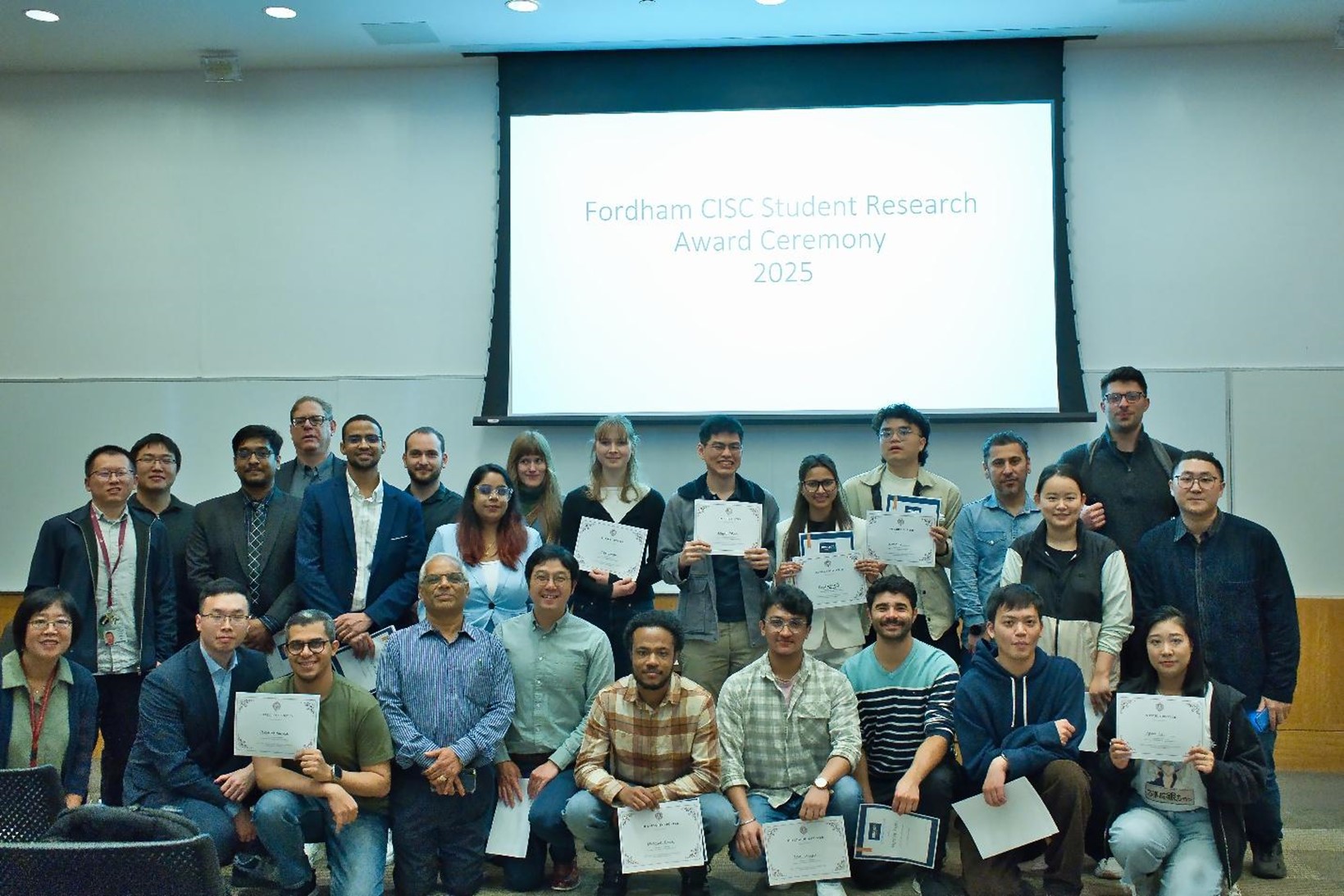 CIS faculty and students at the inaugural CIS Research Exhibition