Salary Structures
Fordham’s Salary Structure Design
The Salary Architecture Framework translates into two salary structures that provide the foundation for pay ranges across administrative roles. Both structures share the same design and methodology, providing a consistent, fair, and market-aligned approach to compensation.
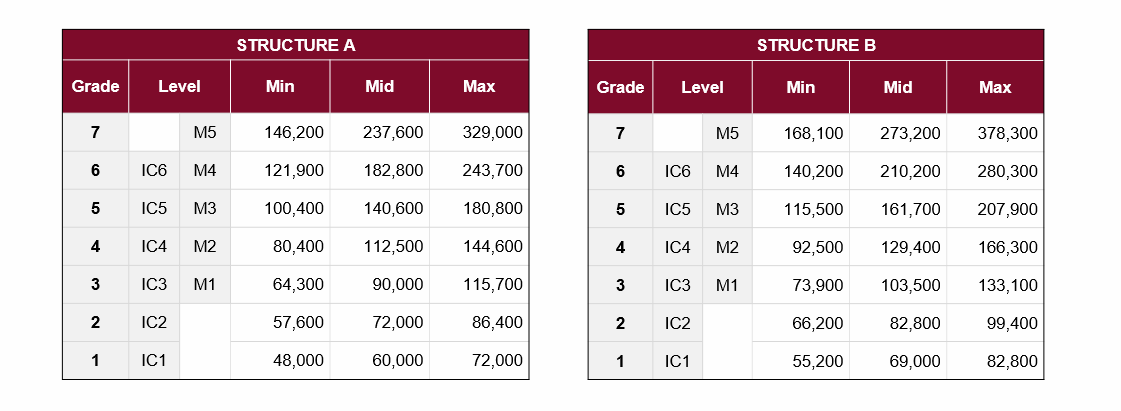
Structure A: Structure A covers the majority of administrative job families and aligns pay with typical higher education market levels. It provides a consistent framework for most roles across the University, ensuring that salaries reflect the scope, responsibilities, and internal value of each position.
Structure B: Structure B applies to select administrative job families where the external market shows higher compensation for similar roles. This often occurs in areas with specialized skills, highly competitive labor markets, or industry-specific demand. Aligning these roles with Structure B ensures Fordham remains competitive in recruiting and retaining talent. Job families included in Structure B are:
- Advancement
- Engineering
- Finance & Business
- Information Technology
- Legal and Compliance
Both salary structures contain seven salary grades and follow the same leveling approach. They also use consistent definitions for job families, career streams, career levels, and salary ranges, ensuring a unified and equitable framework for organizing roles and determining compensation across the University.
A position is assigned to Structure A or Structure B based on its job family and relevant market data, not on the individual employee’s performance, length of service, or department. This ensures the University remains competitive in specialized labor markets while maintaining fairness and consistency in compensation practices across the institution.
For this framework to work consistently and fairly, each position must be clearly defined. Job descriptions provide that foundation by documenting the purpose, responsibilities, and requirements of each position. They ensure that roles are evaluated consistently, placed in the appropriate job family and level, and aligned to the correct salary range.
Certain positions are excluded from the salary architecture and are not assigned to a structure or grade. Compensation for these roles is determined through alternative processes due to their unique nature, funding source, or regulatory requirements. The following types of positions are excluded from the salary architecture:
- Executive roles (including Vice Presidents & Academic Deans)
- Head Coaches
- Grant-funded roles
- Investment roles
- Full-Time Faculty who hold other administrative positions (i.e, Associate Deans)
- Post-Doctoral Fellows/Researchers
- Part-Time Administrative roles working under 25 hours per week