Catherine Cusick, FCLC 2026
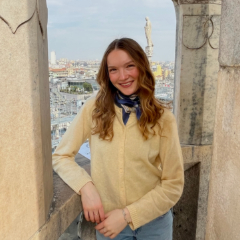
Major: Art History and French & Francophone Studies
Bio: Catherine is a senior at Fordham College at Lincoln Center majoring in Art History and French & Francophone Studies. She is completing two senior theses for her double major, entitled Another Look at Rosa Bonheur's The Horse Fair (1852-1855) and Resistance, Repetition, Reincarnation: Jacques Lipchitz and Prometheus Strangling the Vulture. Catherine is passionate about accessibility and education in Art History and museums. Outside of academics, Catherine enjoys running, a good book, and karaoke.
Title of Research: Resistance, Repetition, Reincarnation: Jacques Lipchitz and Prometheus Strangling the Vulture
Mentor: Audrey Evrard, Languages and Cultures
Abstract: In 1937, sculpturist Jacques Lipchitz (1891-1973) completed a massive plaster sculpture for the World Fair in Paris, France. The sculpture depicted the mythological Prometheus who, punished by the Greek god Zeus after sharing fire with humankind, is chained to a mountain to have his liver eaten by an eagle each day. Lipchitz’s version, however, shows Prometheus freed from his chains, strangling the bird, portrayed instead as a vulture. Celebrating the triumph of humanity over ignorance, Lipchitz’s sculpture was also an allegory for the struggle against rising fascism in Europe at the time. The sculpture was destroyed in 1938 after the closing of the World Fair, yet Lipchitz returned to the theme of Prometheus Strangling the Vulture, considering it one of his “major obsessions.” Lipchitz went on to create several more iterations of Prometheus, including a commission in 1943 for the Ministry of Health and Education in Rio de Janeiro, Brazil, a small-scale bird-headed Prometheus in 1943, and a plaster version in 1944 later cast in bronze in 1953 for the Philadelphia Museum of Art and the Walker Art Center in Minneapolis. This project will explore the recurring sculptural theme of Prometheus Strangling the Vulture, proposing that the final 1944-53 rendition of Prometheus reincarnates the prior versions, embodying the continual existence and resistance of a Jewish artist before, during, and after World War II. Analyzing these sculptural changes culminating in 1953 offers the opportunity to enhance understanding of Lipchitz’s choice to manipulate the myth of Prometheus, the sculptor's artistic process and internal motivations, and, more broadly, the intersection between art and political protest against injustice.