Iris Kobrock, FCLC 2026
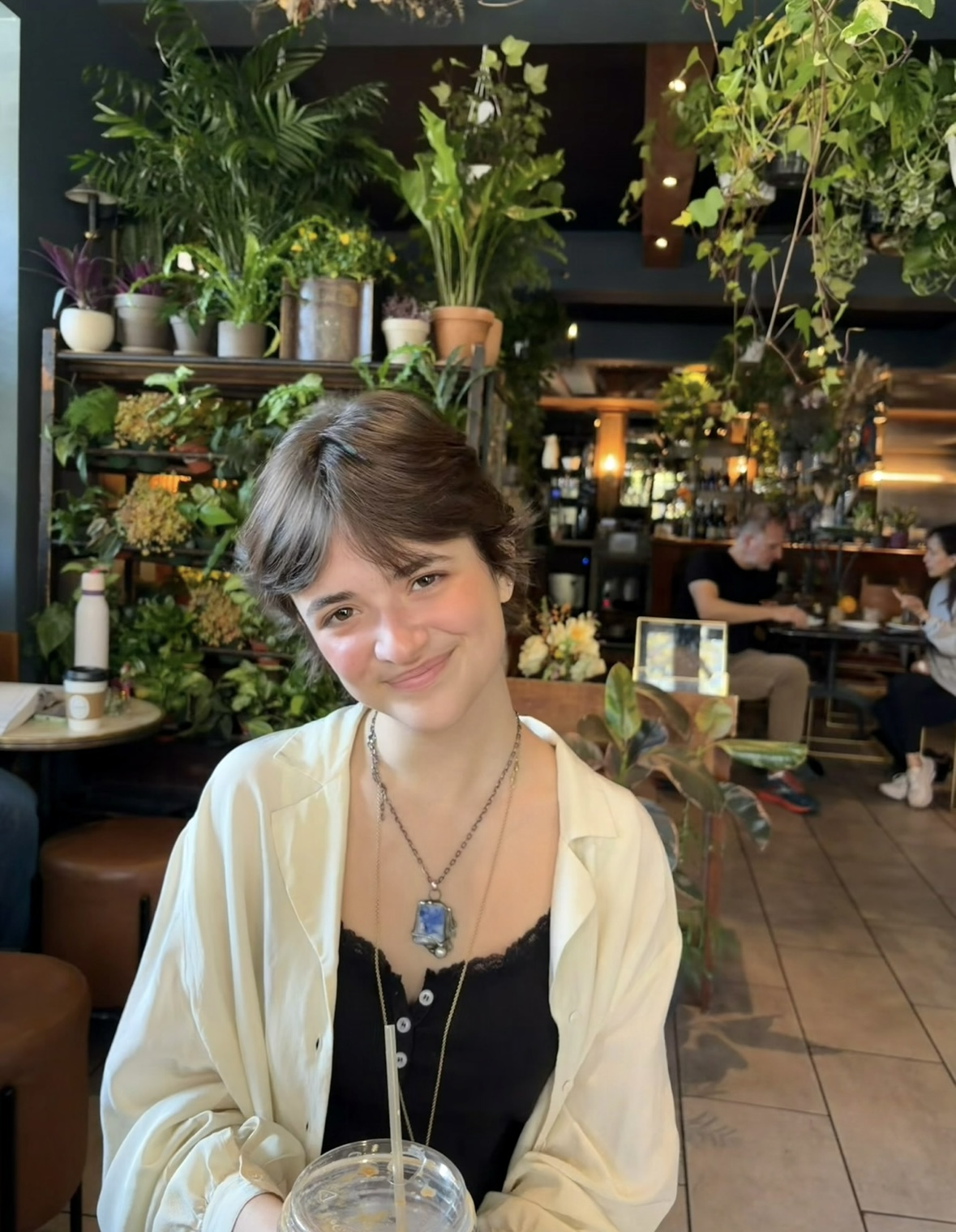 Major: English
Bio: Iris Kobrock was born and raised in New Orleans, Louisiana, in a family full of teachers. She is currently wrapping up her final semester of undergraduate study at Fordham University. After graduating with a BA in English in the spring, she’ll begin a doctoral program at Boston College, where she hopes to continue studying 19th-century prose and American film (especially horror), re-tracing renderings of race and queerness across texts.
Title of Research: The Madwoman in the Sunken Place: Desire and Disorder in Jordan Peele’s Get Out
Mentor: Anthony Michael D'Agostino, English
Abstract: The American horror film remains haunted by the racial constructions of the 19th-century novel – especially by (as literary critics Sandra Gilbert and Susan Gubar famously christen her) the "madwoman in the attic," the “darkest double” of Charlotte Bronte’s Jane Eyre. From the 1992 Candyman’s institutionalized heroine, to Barbarian’s (2018) basement-bound “Mother,” to the “sunken” psychologies of Jordan Peele’s pathbreaking Get Out (2017), American film-makers have invoked and revised the incarcerated, pathologized, and racialized “other” of 19th-century Gothic literature. In Get Out, Jordan Peele stages incisive racial allegory through a body-horror of mutilated minds, through the “Coagula” procedure: an implantation of white minds in the bodies of Black men and women, who live on only in the semi-consciousness of the "sunken place." Peele’s thriller, in its nightmarish imaginings of an embodied loss-of-mind, provokes a rereading of the maddened “double,” of the racial “transplantations” through which the white subject has long possessed racialized psyches and, further, Gothic texts themselves. Complicating readings of the madwoman’s alterity, her “otherness,” I contend that Gothic madness composes a white fantasy of interracial intersubjectivity, of absolute (and often violent) access to the “other” – that is, what Get Out might call “transplantation.” In Get Out, however, the queer and intersubjective possibilities of Gothic madness are powerfully reappropriated as a site of homosocial, intraracial intimacy and solidarity. The "crazy" psychologies of Gothic horror morph into a collective imagination. Re-encountering the "madwoman in the attic” through her cinematic after-images, we ultimately find a Black horror genre conjuring up – and radically reconfiguring – the Gothic, re-centering the "sunken" subjects of American horror.