MSAIB Success Stories
Hitansh Nagdev
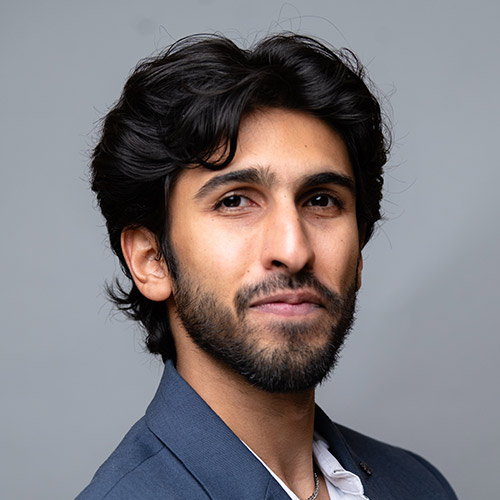
I’m currently an AI solutions architect and founder working at the intersection of compliance and construction intelligence. I graduated from UC Berkeley with a double major in economics and data science. I started my career in product management at Docyt, an accounting automation startup, prior to moving to New York City to join Datagrid as an AI Solutions Architect. There, I helped launch an AI-powered compliance agent for construction documents and built an SMS-based system, bringing AI workflows directly to field workers. Currently, I'm building a new AI startup focused on MEP and construction compliance intelligence, partnering with design teams in New York City and Miami to help reduce the rework and inefficiencies that cost the industry billions, while also growing Hexmarked, a location-based social discovery platform that's reached over 200 early users across NYC.
What drew you to the MS in Artificial Intelligence in Business program, coming from a data science background and having already worked in the startup world?
What drew me to the Gabelli School’s MSAIB program was both the timing of the degree’s introduction and its specificity. Fordham was one of the few universities offering a master's degree focused specifically on AI in business, which stood out as I watched AI move from a theoretical technology into something actively reshaping real business workflows. Coming from UC Berkeley and the fast-moving startup world, I wanted a deeper foundation—not just how to use AI tools, but how the underlying systems worked and how to think strategically about where AI actually creates value. The Gabelli School was the right fit because I wanted to stay in New York City—one of the best places to be at the intersection of AI, enterprise software, finance, construction, and startups. The MSAIB program allowed me sharpen my fundamental skills while staying plugged into the city where so much of this is actually being built.
Which specific skills or courses from the MSAIB program have been the most useful in building and running your startup?
The most useful course for me has been LLMs in Applied Finance with Professor Andy Li. Even though it's finance-focused, it taught me many of the core concepts behind modern agentic AI startups such as retrieval-augmented generation, vector databases, embeddings, document parsing, evaluation, and prompting, and how LLMs connect to structured and unstructured data. It gave me a mental model to understand, debug, and design AI systems from first principles instead of treating them as a black box. That's been directly relevant to what I'm building now. In construction, a lot of valuable information lives inside messy documents such as specifications, submittals, drawings, RFIs, and compliance reports. The course gave me a much stronger foundation for extracting, structuring, retrieving, and reasoning over that information, which matters enormously when accuracy, traceability, and business impact are everything.
Was there a moment during your studies where something clicked that directly shaped how you think about your business today?
Yes. A major turning point came during the LLMs in Applied Finance course, especially when we dug into RAG pipelines and how LLM applications can be built around real business data. I had already worked with AI products in the startup world, but the course helped me connect the dots at a deeper level. I understood not just what the technology could do, but how to architect systems that reliably solve domain-specific problems, which was especially important for construction. At Datagrid, I saw firsthand how project managers, executives, and field teams dealt with compliance issues, documentation gaps, and costly rework around submittals, drawings, and specifications. The course gave me a clearer framework for thinking about how AI could move beyond chatbots and become a system that helps teams find risks, validate documents, and make better decisions earlier in the project lifecycle. In that sense, it acted as a bridge between my on-the-ground experience in construction AI and the technical foundation needed to build something scalable.
What advice would you give to future MSAIB students?
My advice would be to ground yourself in one or two real problems and start building. There are infinite AI products, tools, and demos launching every day, and it's easy to get distracted chasing every new release. But the real value comes from staying disciplined. Pick a use case where you deeply understand the user and the business pain and build around that. The speed at which you can go from idea to working product is becoming one of the biggest moats in AI, and even if the first version doesn't work, you'll learn far more by building than by waiting for the perfect idea or tool stack. MSAIB gives students a strong opportunity to combine technical learning with business context, so use that combination seriously: don't just learn AI as a concept, apply it to a problem you care about, talk to real users, and keep shipping.
Nathanael Lara
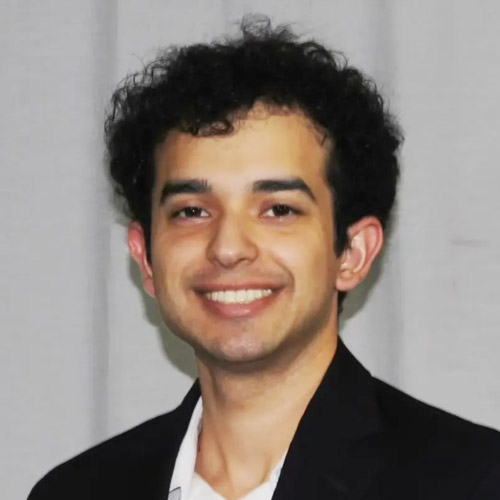
I earned a BBA in Finance from the University of Texas at San Antonio, with a concentration in corporate finance and investment banking, and a minor in economics. I am currently a
full-time student in the MSAIB program at Fordham.
What was your professional background prior to joining the MSAIB program?
Before joining the Master’s in AI in Business Program, I worked as a financial operations intern at a credit union. I also gained legal experience as an intern at the Bexar County Courthouse and at a criminal defense law firm.
What acquired skills or professional experience have you gained through the MSAIB program that have helped you most in securing your current job?
The program equipped me with strong technical skills in Python, SQL, and system architecture. I also gained experience deploying solutions in real-world environments and working with organizations like PwC and the United Nations. Building my capstone project and learning to use LLM tools were especially valuable.
What is one important habit or mindset from the MSAIB program that you leverage in your daily work?
I always verify AI outputs. Whether for personal tasks or production workflows, I consistently validate the accuracy of code and results.
What is one pivotal moment in your career that made you feel you were truly on the path to success?
Receiving offers from Deloitte, Samsung SDS America, and BCG X was a defining moment for me. My capstone and hackathon projects played a key role in opening those opportunities. I’ll be joining BCG this summer, with the potential to convert to a full-time role.
Would you recommend the MSAIB program? What has been the most valuable part of of the program for you?
I would highly recommend the MSAIB program. The hands-on experience and the strong industry connections it provides have been most valuable for me.